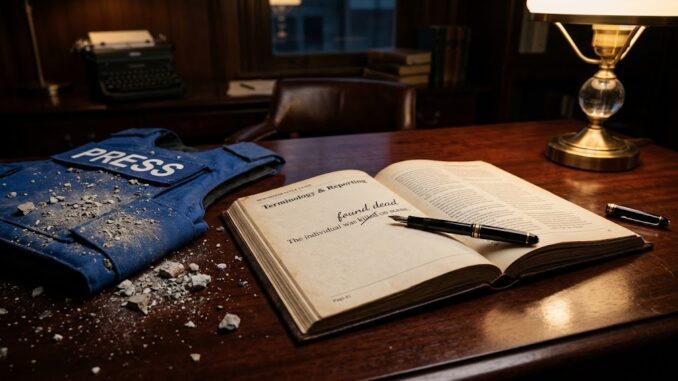
A senior keeper of the words explains why territories are disputed, why Palestine is a special-occasion word and why, in the last three years, almost 300 dead journalists were simply found.
Dawe: Thanks for coming in.
Clarke: Pleasure, Bryan. Good to be here.
Dawe: You chair the joint editorial standards committee for the BBC, the New York Times, CNN and our own ABC.
Clarke: That’s right. We look after the words.
Dawe: You act as censors?
Clarke: Heavens above, no. We see ourselves more as caretakers. Words need a lot of looking after, Bryan. They end up in the front bar and over the back fence. It’s a huge responsibility.
Dawe: All of them?
Clarke: The important ones. We keep them in a style guide. “Words of Concern”, we call them. Take “killed”. Now that’s a word you have to watch. “Killed” could hurt somebody.
Dawe: Hurt somebody?
Clarke: Hurt anyone. Everyone. We prefer something with a bit of protective gloss on it. It’s like a Rolls Royce. A Rolls Royce never breaks down. It simply fails to proceed.
Dawe: There’s a new UN report on media coverage of Gaza. It’s by Francesca Albanese, the UN Special Rapporteur on the occupied Palestinian territory.
Clarke: We’ve been in touch. Lovely woman, Francesca. Very thorough. She named us in her report. Must be a fan, Bryan. Nobody studies you that closely if they don’t love you.
Dawe: The BBC style guide describes the West Bank and Gaza as “disputed” territories.
Clarke: That’s the Israeli government’s preferred description, Bryan. We like to use the preferred description. It’s a courtesy.
Dawe: The International Court of Justice found Israel’s presence there unlawful.
Clarke: Yes, and that’s disputed.
Dawe: By whom?
Clarke: By the people whose preferred description we use. Everything is disputed by somebody, so we say so.
Dawe: CNN told its staff to remind audiences that Hamas caused the conflict.
Clarke: Context is very important, Bryan. We like to start it on the seventh of October.
Dawe: The New York Times told its journalists to use the word “Palestine” only in very rare cases.
Clarke: Correct. It’s a special occasion word.
Dawe: What’s a special occasion?
Clarke: Oh, a map of the ancient world. A pub quiz. You bring it out the way you’d bring out a bottle of Grange. Not every night of the week.
Dawe: Then there’s “human shields”.
Clarke: Beautiful phrase. Does a lot of work. A bit like “double-tap”. Or the clean-as-a-whistle word “strike”.
Dawe: Between October 2023 and August 2025 the New York Times used “human shields” 176 times. The BBC used it 81 times.
Clarke: The BBC is publicly funded, Bryan. It has to ration.
Dawe: The report found the BBC left out Israeli responsibility in 83 percent of relevant headlines.
Clarke: That’s our house style. We prefer the passive voice. It’s calmer. People are reading this over breakfast.
Dawe: What about the other 17 percent?
Clarke: We’ve set up a working group.
Dawe: The BBC headline on Hind Rajab says she was “found dead in Gaza days after phone calls for help”.
Clarke: Which is accurate.
Dawe: She was six years old. The report says she was killed by Israeli forces.
Clarke: You can’t put everything in a headline, Bryan. You’d never get it on the phone.
Dawe: The report also names the ABC, for dismissing Antoinette Lattouf after she reposted a Human Rights Watch report on starvation in Gaza.
Clarke: We didn’t dismiss her, Bryan. We relieved her of the remainder of her week.
Dawe: The Federal Court found it was unlawful.
Clarke: And that finding cost us over two and a half million dollars.
Dawe: To lose.
Clarke: You don’t get a finding like that for nothing.
Dawe: The court found senior management had acted to appease the pro-Israel lobbyists.
Clarke: That’s very unfair. We’d have appeased anybody. We’re a public broadcaster. We serve everyone. Frank and fearless, Bryan. Within reason.
Dawe: Ms Albanese wrote to twelve of the outlets for comment. Three replied.
Clarke: That’s a very strong response rate for us.
Dawe: She uses the word “mediacide”.
Clarke: That’s not in the guide.
Dawe: What would you say?
Clarke: A tightening of the local talent pool.
Dawe: Under the Geneva Conventions, journalists are civilians.
Clarke: Unless they’re terrorists.
Dawe: Who decides they’re terrorists?
Clarke: The people who killed them, Bryan. Usually afterwards.
Dawe: The Committee to Protect Journalists says Israel killed two thirds of all the journalists killed in the world in 2024. And again in 2025.
Clarke: That’s a very strong market share.
Dawe: What has the Australian government said?
Clarke: Oh, the Foreign Minister was very firm.
Dawe: She said she was “deeply concerned” about the reports.
Clarke: Deeply concerned. Straight out of the guide, Bryan. Top of the range. You can’t get more concerned than that without doing something.
Dawe: Doing something?
Clarke: Yes. You’d be on the verge of moving to “profoundly concerned” within a press cycle or two.
Dawe: When Israel ruled out charges over the killing of Australian aid worker Zomi Frankcom, she summoned the Israeli ambassador and said Australia was outraged.
Clarke: That’s different, Bryan. Zomi was one of ours.
Dawe: Israeli forces have killed nearly 300 journalists since October 2023. More than the American Civil War, both World Wars, Korea, Vietnam and Afghanistan combined.
Clarke: Found dead, Bryan.
The facts Dawe puts to Clarke are on the record:
- Francesca Albanese’s report to the UN General Assembly, A/81/249
- The BBC style guide
- The International Court of Justice advisory opinion
- CNN’s instruction to staff
- The New York Times memo
- The BBC’s Hind Rajab headline
- The ABC’s own tally of its Lattouf legal costs
- The Committee to Protect Journalists’ record of press killings
- The Costs of War comparison
- Foreign Minister, Penny Wong’s “deeply concerned”
- Foreign Minister, Penny Wong’s summoning of the Israeli ambassador over Zomi Frankcom
The rest of Clarke’s answers are satire.
A tribute to John Clarke (1948 to 2017), whose method this borrows and whose genius it cannot. With thanks to Bryan Dawe.
The Clarke and Dawe format and characters remain the work and property of John Clarke (Roderick Willows Pty Ltd) and Bryan Dawe. This sketch is an independent homage, written and published by Urban Wronski, and is not affiliated with or endorsed by them.
Keep Independent Journalism Alive – Support The AIMN
Dear Reader,
Since 2013, The Australian Independent Media Network has been a fearless independent voice – holding power to account and delivering journalism that matters.
Running this site isn’t cheap. Rising costs mean we need your support now more than ever. Every donation, big or small, keeps our servers running, our writers working, and our stories free for everyone.
Donate here:
PayPal or credit card – just click on the Donate button below
Direct bank transfer: BSB: 062500; A/c no: 10495969

We’ve also set up a GoFundMe as a dedicated reserve fund for hosting and future improvements.

Thank you for standing with us. We couldn’t do this without you.
With gratitude,
The AIMN Team

Be the first to comment