Have no fear of perfection – you will never reach it. (Salvadore Dali).
Nothing lasts, Nothing is finished, Nothing is perfect. (Richard R Powell).
What would we like our society to look like?
I’m quite confident that we all have a different answer to that sort of question, reflecting, no doubt on the values we personally hold.
We all have views on what is perfect.
Time and again, violence has been used in an effort to create a perfect world, time and again violence has failed to make a perfect world.
Failure is natural ground for creativity, striving to produce something beautiful, or perfectly expressing an emotion whether visually or in audio. Ask any artist writer, musician, or any one striving for some perfection or other. Failure in creative endeavours are motivations to improve, to continue to strive for perfection, to strive for that masterpiece, knowing that it really is unattainable, but worthy of the effort to keep striving.
Much the same for elite sports people, knowing that they they put their bodies on the line for that prize of being up there, striving for Olympic Gold, or the Grand Final Cup, the Green jacket or any other trophy which recognises the achievement, being the best on that day.
In all fields, things are constantly shifting. We are in a constant state of flux, of change, of uncertainty.
Technological change, is probably the most visible today, and with it comes a new world of communication and interaction, a new way of looking at the world which has some clamouring for the old times, the halcyon days of yore, where ‘perfection’ was some how realised… or was it, could that just be the way those days are preferred to be remembered.
I recall conversations with my mother-in-law who lived through some incredible technological changes in the Netherlands during the early 1900’s. Things we take for granted, like electricity, she saw brought into the house, no longer needing a candle to find her way up the stairs to her bedroom as a young child, a light at the top of the stairs showed the way. Or the hand pump by the back door was made redundant with the introduction of reticulated water supplied to the kitchen, and laundry. Or the early days of having a telephone, where calling anyone required a dial up to the exchange and then manually put through by the operator… And in a small community, who knows whether the operator actually listened in to the conversation.
Ah the halcyon days. The days of a depression which saw millions out of work, the halcyon days where work days were 12 hours long, or non existent when there was no work to be done.
A reminder of that with a recent visit to the port city of Fremantle, where there is a commemorative bench outside a hotel near the port. Waterside workers would gather before the start of the workday to see whether there was work for them on that day. The lucky ones had their number read out until the roster was filled. Those who remained did not work that day, but dutifully turned up day after day in the hope they would get to work a shift.
Since that time, we have had a world war which saw a striving for racial perfection in Germany, and earlier a striving for religious perfection in Turkey where the state supervised the encouragement of mass slaughter of people who did not fit the narrow definitions of either religious orthodoxy or racial purity, but in the following peace, an almost unified Western Europe which formed the foundation of today’s European Union, but that after about 80 years is under threat as the economies face tough competition and waves of immigration as a result of wars and discrimination in previously colonised regions.
And in Russia, sorry USSR, Stalin went on a murderous campaign to have a perfect communist nation, with over 20 million slaughtered in the quest for political perfection.
Everywhere we look around the world, we see that perfection is difficult to find. In France, we have seen a time of protest with police seemingly at war with protestors, the role of the police is as an arm of government, not a protector of the people. Strange though that in their 250-year-long quest for perfection, the constitution of the French Republic recognised individual rights as being an important motive for the revolution.
In Iran and Afghanistan, religious fundamentalists have formed governments which suppress freedoms, restrict learning and education to fit in with the dogmas of the faith bound leaders. In Hindu India, religious orthodoxy is striving to remove Islam and Sikh religions, marginalising those minorities, trying to purify the religious belief of over 1.3 billion people.
In Europe, the USA, Britain and here too, the fear of Islam becoming a powerful religion is one of the driving forces in the anti immigration debate.
Politics in democracy has always been a battleground, but generally the invective has not called for stoning and hangings, has not called patriots traitors, has recognised difference as being a project to work with, to achieve a semblance of acceptance. And while the temperature rises, and name calling and put downs become more and more vitriolic, almost inevitably, and yet surprisingly, something dramatic happens, a politician is targeted in what may have been an assassination attempt, and we are shocked into realising how the imperfections of our society can lead to violence, to dire consequences when one person or another senses a hopelessness, that the current system is not able to be reconciled to the way one person or group would like it to be.
Or people celebrating a religious festival get killed as at Bondi last December, vile cartoons appear on a politician’s promotional page lambasting other politicians for perceived weaknesses or even treason, people dressed in religiously defined clothing are spat at or subjected to other forms of abuse.
Can we celebrate perfect imperfection?
The end of the Great War, WWI, saw the formation of an international body dedicated to finding a way to a peaceful world. It failed, and the reasons for failure were many, not the least of which was the punitive call for reparations to be paid by the ‘losers’, and the failure to include all nations, thereby building tensions for the next major conflagration, The Second World War. The deaths of around 22 million was not enough a price to pay, the second war added between 70 and 85 million casualties.
The USA decided not to join the League of Nations, their choice. Germany and the newly formed USSR were banned from joining, but were later admitted as members. Hitler withdrew Germany in 1939. Colonised states were ‘represented’ by their colonial masters.
The formation of the United Nations saw the writing of the UN Declaration of Human Rights as a priority, as was the formation of the State io Israel. While that in retrospect appears to be a contradiction of the principles behind the declaration, it may also be seen as an expression of perfect imperfection.
The core principles of the declaration are that respect is given to the inherent dignity and equality of all people, that there may be no discrimination regardless of race, colour, sex, language, religion, political opinion, national or social origin, property, birth or status, and that those principles apply to all people, everywhere, regardless of where or under what government they live.
The key foundational rights expressed in the declaration include:
- Right to life, liberty, and security.
- Freedom from slavery
- Freedom from torture
- Recognition before the law
- Equality before the law
- Right to a fair trial
- Freedom of movement.
Trying to achieve the imperfect perfect is difficult, until we read those words and apply them to ourselves, in other words, hold the mirror up, look into our own souls to see what rights we demand for ourselves, and ask why those rights should not be given to all people.
The leaders of the day argued long and hard to write the declaration, and since that time there has been about a week that there has been no wars. Considering that there are are currently about 214 countries in the world, and 193 of those are UN members and two are non-member observer states, The Vatican and Palestine, and still there are wars despite the hopes of peace through the negotiations within the United Nations.
Each nation strives to find a balance between the perfect and imperfect, some through democracy and diplomacy, others use more brutal tactics, yet each has signed the Declaration of Human Rights. Religious discrimination is rife in many Asian countries, political discrimination is highlighted with the rancour of political debate and amplified through the press and through social media. Marginalisation runs through our communities as people who are different are ‘othered’, discriminated against.
Anger rises, political tensions rise, rhetoric seems to condone violence, targeting people who have dedicated their lives to finding that balance, to achieve an imperfect perfect.
The art of politics is inevitably the art of compromise. Campaigns are fought highlighting different view on what we as a body politic strive for, and when the counting of votes is completed, one party or the other assumes the mantle of government, and tries to bend the governance to its objectives. But no matter what the policy objectives may be, they need to fit into the disparate needs of the governed. In a democracy, there will be elections at the end of the term of government. Yet some politicians refuse to compromise.
If a government is dedicated to serving all its constituents, the core principles of the UN Declaration of Human Rights need to be considered, since the constituents cover a broad spectrum of people. Some will be wealthy, privileged, land owners, others disadvantaged, there will be men and women, LGBTQIA+ people, professionals and manual workers, believers from many faiths, unbelievers, people from different ethnicities, of different skin colour, even different hair and eye colour, people with disabilities and other health needs.
And so the question arises, who are we, and who do we want to be. And each of us will have different answers to those questions, but when addressed to who we as Australians are, what does it mean to be Australia, and what will it mean to be Australian in some tomorrow is a vexing question, because of the uncertainties we perceive.
It is interesting to take a look at where we have come from, what it meant to be Australian in a previous generation. Coming here as a seven year old boy, an immigrant, in the 1950’s, was a bit like coming to a part of England, but through my lifetime that has changed, in part as I grew up, pretty much as an Australian, but that transition was more difficult for my parents. I was reminded of that when I picked up a book by Jared Diamond, ‘UPHEAVAL; How nations cope with crisis and change’ (published 2019) from a second hand bookshop, where six nations are studied, and the changes made to adjust to various challenges of geography, getting on with neighbours, internal and geo-politics, war and peace, immigration, emigration and adjusting to the new world we inhabit, ethnically and morally.
Australia is one of the six nations studied. An important issue raised is the one of race. It has been a fundamental divisive issue pretty much since 1788.
An interesting aside here, in a recent discussion, an immigrant from England was bemoaning the apparent Islamic invasion of Britain, commenting that people driving there should agree to living according to British cultural norms, forgetting that that was not an issue as Britain built its empire from sea to shining sea. The question of living according to indigenous people’s cultural norms was never asked.
In Australia, what are those norms and how have they moved? As an immigrant from the 1950’s, the challenges my parents faced were not that different than the challenges faced by people arriving in Australia today. They were the days that “Football, meat pies, kangaroos and Holden cars” really were cultural markers. I recall a conversation with my father, I had ‘discovered’ Subiaco Oval and what the noise was about on Saturday afternoons, what it was was football, but not according to Dad, football was the game he grew up with, we used to call it soccer. As for cars, he preferred European ones.
The 1950s saw the beginnings of change, largely as a result of World War II, where the dependency on Britain for our defence proved to be a pipe dream, and the USA came to our rescue as the British were defeated in their efforts to save Singapore from the Japanese. The alliance with the US in the ANZUS agreement is a challenge for today, as we appear to be funding the mighty US military machine with billions of $A going to pay for someday, maybe, getting some nuclear powered submarines.
The ANZUS treaty has seen Australia involved in wars such as Korea, Vietnam, Iraq and Afghanistan to mention just a few. Thinking about the cost and promises of AUKUS and reflecting on the earlier dependency on Britain, one wonders how beneficial these arrangements are, and whether in a time of real crisis who could we trust to defend us.
One of the issues posed within that dependence is our trading partners. The perception of China as the current threat to our security lies at odds with our dependence on the US as our saviour should anything bad ever happen. When China was seem as a threat under the previous LNP government, trade restrictions did severe damage to our economy, when that same government signed us up to the AUKUS agreement, our reputation as reliable commercial partners was destroyed by tearing up an agreement to build French submarines.
Geography plays an important part in defining what it is to be Australia, and the trading relationships we had with Britain before their entry to the European Common Market during the 1960’s changed the way we could trade, that other markets needed to be found for our economic survival, and Japan, who only a few years previously had threatened us with invasion became a major trading partner as their economy restructured after the war. Our major trading partners today include China, Japan, Indonesia and other South East Asian nations.
The White Australia Policy, together with a sense of European, and especially British racial superiority were foundational elements in the development of post convict era Australia. Despite the use of ‘black birding’ to have slave labour in the sugar industry of Queensland, the view of other races was clearly expressed in a 1896 edition go The Melbourne Age:
“We wish to see Australia the home of a great homogenous Caucasian race, entirely free from the problems which have plunged the United States into civil war… there is no use in protecting our workers from the pauper labour of the Far East if we admit paupers ourselves.” (Upheaval, Jared Diamond, 2019, page 227).
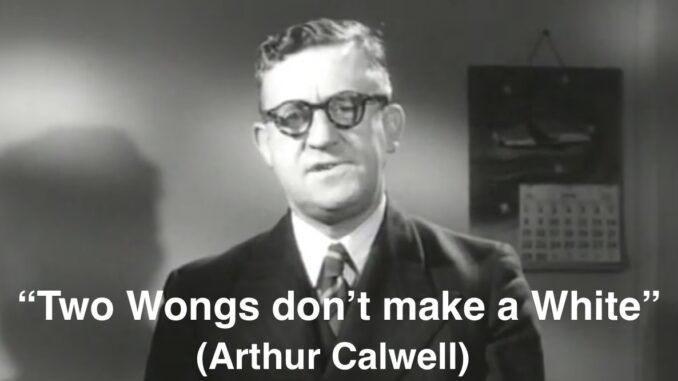
Or as Arthur “Two Wongs don’t make a White” Calwell, as Minister for Immigration from 1945 till 1949 commenting on Australian soldiers wanting to return with Japanese wives wrote:
“No Japanese women, or any half-castes either, will be admitted to Australia; they are simply not wanted and are permanently undesirable… a mongrel Australia is impossible” (Ibid, Page 278).
The White Australia policy slowly eroded, Japanese war brides and their children were admitted in 1949 and through the Colombo Plan Asian students gained University entry and potential settlement into Australia, until it was finally shut down during the Whitlam Labor government.
The most significant issues facing us as we move on from where we are now, is to really consider the humanitarian aspects of where we want to be, how we define what it means to be Australian. In the current debate, humanitarian aspects are distinctly absent, self definition is on essentially racist and religious definitions, which imply that those who are of a different race or hold different religious views are somehow unworthy of being Australian… Or British, or American, or European it would appear. Yet all were signatories to the UN Declaration of Human Rights. Or could that be so long ago, another generation back that we can say, like John Howard in refusing to acknowledge the need for an apology to Aboriginal Australians, that he had done nothing to apologise for, we have moved on, our priorities are different, or are they the priorities of racial and ethnic superiority, the same priorities which led to two world wars and countless regional conflicts.
It is a changing world we live in, and looking back through history, building societies has never been easy. We each have a view of perfection, and that perfection may well look very much the ‘me’ of who ever we are, but that ‘me’ is different than every other ‘you’ we may meet. Some a bit different, some very different, but all sharing the same humanity.
Perhaps recognising that Aussie Rules football is as much football as soccer, that cricket and baseball are essentially just team sports where one person throws a ball, another tries to hit it with a bit of wood and see which team can throw or hit the best.
Or that the argument of “my God is better than your God” is not used to deny the humanity of people who have a different faith. We need look only at the horrors of the Reformation in Europe, the transporting of religious exclusivity to settlements in the Americas or the fractious wars in the Middle East to see how deadly that can be.
Building an imperfect perfect society is hard, but history has shown that we really must accept that the perfect solution is going to be imperfect, until we see that humanity, despite the superficial differences, is almost perfect, if only we can concede that.
Keep Independent Journalism Alive – Support The AIMN
Dear Reader,
Since 2013, The Australian Independent Media Network has been a fearless independent voice – holding power to account and delivering journalism that matters.
Running this site isn’t cheap. Rising costs mean we need your support now more than ever. Every donation, big or small, keeps our servers running, our writers working, and our stories free for everyone.
Donate here:
PayPal or credit card – just click on the Donate button below
Direct bank transfer: BSB: 062500; A/c no: 10495969

We’ve also set up a GoFundMe as a dedicated reserve fund for hosting and future improvements.

Thank you for standing with us. We couldn’t do this without you.
With gratitude,
The AIMN Team

It still enrages me that John Howard refused to apologize to the Stolen Generations. Apologies don’t equate to acknowledgment. Acknowledgment does however equate with apology. The nuance in the word is knowledge. Howard was the proverbial British arse licker. I have many friends and colleagues who hail from Britain and I would never presume that they, individually, are responsible for the outrageous conduct of their forebears who colonized and purloined treasures of places where they had no right to be.
I am a white Australian who feels very lucky to be born in Western Australia. I wasn’t born into poverty or discrimination.
But it is a stain on our country that our First Nations’ people have been so marginalized and disrespected.