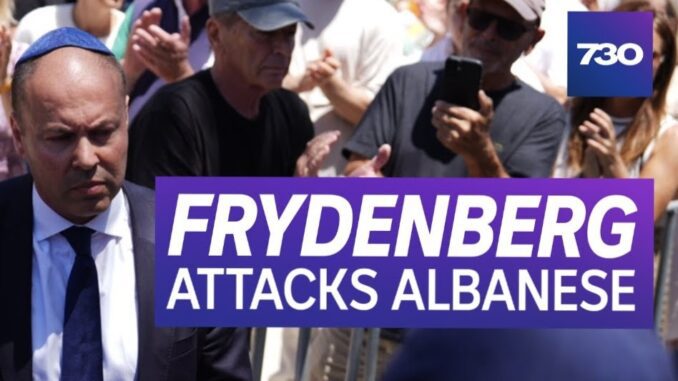
For weeks Josh Frydenberg – and senior figures in the opposition – demanded a Royal Commission into the Bondi shootings. Their criticism of Prime Minister Albanese was relentless: he was accused of dithering, of failing to act decisively, of putting politics ahead of public safety and accountability.
The message was unambiguous. A Royal Commission was urgently needed, and the Prime Minister’s failure to immediately call one was presented as a serious dereliction of duty.
Then Albanese did exactly what he was accused of refusing to do. He called a Royal Commission.
What followed was not relief, nor support, nor even cautious endorsement. Instead, Frydenberg launched into a fresh round of criticism – this time over the Prime Minister’s choice of commissioner. The demand for action had been met, yet the outrage only intensified.
At this point, it is reasonable to ask: what, precisely, was Frydenberg seeking?
Royal Commissions are among the most serious instruments available in Australia’s democratic system. They are designed to establish facts, test evidence, and make recommendations independent of political pressure. When politicians demand them, they are effectively asking the government to hand over control of an issue to an arm’s-length process that cannot be directed once established.
Or at least, that is how they are supposed to work.
In this case, Frydenberg’s behaviour suggests the Royal Commission itself was never the point. The point was the political leverage gained by accusing the government of inaction. Once that leverage evaporated – once the Prime Minister called the inquiry – the focus shifted immediately to delegitimising the process itself.
Frydenberg’s criticism of the appointed commissioner rests on the implication that the individual lacks credibility, independence, or suitability. But this raises an obvious question: if Frydenberg believes the commissioner is unfit, why was there no articulated standard beforehand? Why was the demand not for a Royal Commission led by a person meeting clearly defined, bipartisan criteria?
The answer appears uncomfortable but unavoidable. Any commissioner appointed by this government was always going to be unacceptable, regardless of credentials. The outrage is not conditional; it is structural.
This is where the episode drifts from political disagreement into something more corrosive. By first demanding a Royal Commission and then attacking its leadership the moment it is established, Frydenberg sends a contradictory message to the public: trust this process – unless the wrong people are running it.
That is not a healthy position for a major political actor to take, particularly in the aftermath of a tragedy. It risks turning an institution designed to uncover truth into a partisan battlefield before it has even begun its work.
The absurdity lies in the sequencing. The opposition, in unison with Frydenberg, argued that failing to call a Royal Commission was irresponsible. Now they imply that calling one – without their preferred appointee – is equally irresponsible. Under this logic, there is no scenario in which the government could have acted correctly.
It is worth pausing on what this means in practice. If every decision is wrong by definition, then criticism is no longer about improving outcomes or safeguarding integrity. It becomes performative – a reflex rather than a reasoned response.
This pattern is not new, but it is becoming more pronounced. Demands are made loudly and publicly, framed as matters of urgent national importance. When those demands are met, they are immediately reframed as failures, missteps, or evidence of ulterior motives. The standard is not excellence, but impossibility.
In the context of a Royal Commission into a violent public tragedy, that approach carries real risks. It encourages cynicism about the process before evidence is heard, witnesses are examined, or findings are made. It invites the public to see the inquiry not as a search for answers, but as another front in a political war.
None of this requires blind faith in the government or its appointments. Scrutiny is legitimate. Questioning decisions is part of democratic accountability. But there is a difference between scrutiny and pre-emptive sabotage.
If Frydenberg truly believes in the value of a Royal Commission, he should allow the process to function and judge it on its conduct and findings. If he does not, then he should be honest about that position rather than using the language of accountability as a political bludgeon.
Australians deserve better than a debate in which every outcome is framed as failure simply because it was delivered by the wrong side of politics. Royal Commissions are not toys to be thrown aside once they stop being useful.
If Frydenberg – and the opposition – demanded one in good faith, now is the moment to prove it.
Keep Independent Journalism Alive – Support The AIMN
Dear Reader,
Since 2013, The Australian Independent Media Network has been a fearless voice for truth, giving public interest journalists a platform to hold power to account. From expert analysis on national and global events to uncovering issues that matter to you, we’re here because of your support.
Running an independent site isn’t cheap, and rising costs mean we need you now more than ever. Your donation – big or small – keeps our servers humming, our writers digging, and our stories free for all.
Join our community of truth-seekers. Donate via PayPal or credit card via the button below, or bank transfer [BSB: 062500; A/c no: 10495969] and help us keep shining a light.
With gratitude, The AIMN Team


Politics, politics and more politics.
We need ”a Royal Commission into a violent public tragedy”, the deaths of 2,000+ Australian citizens wrongly accused of thieving from the Robodebt fiasco which occurred when first Scummo then Friedeggburgher were successive Treasurers in the last forlorn inept COALition misgovernment.
Both Treasurers were advised that the Robodebt strategy was incorrect and illegal, yet both continued knowingly to support the trashing of Australian lives and families with reckless indifference. Indeed, the matter was only resolved by the Commonwealth making an almost $1 BILLION pay-out to affected families grieving over the loss of loved family members.
Why should any politician be exempt from accountability of such a travesty of injustice? It is time for these two incompetent corporate backside lickers to be held responsible for the damage that they knowingly caused illegally.
The Fact that NSW, with the full backing of the Federal Government, was in the process of establishing a RC seems to of escaped the attention of the Liberal Party and baying Journalists. Nothing is good enough for the Liberal Party or the Jewish Lobby or the large contingent of Pro Israel Journalists. Shame that they seemed to of over looked another thing, most Australians see it as a waste of time and money. So the truth is, it has no REAL support
Leefe, some one nominated by the Zionist lobby to produce the desired outcome.Frauden burglar was jettisoned by his electorate,correctly, and he is handily demonstrating why.
Once an arsehole, always an arsehole.
the calls for a royal commission shows the power of the jewish lobby and how they are influencing our government and everyday australians! this will only produce more antisemitism!
For some time I have supported Albanese in his decision not to have an RC for the many reasons others have outlined including that most of the demand was ginned up by Zionists and their supporters. In the past I have criticised Albanese for his knee-jerk first response of ‘ruling out any action’ then capitulating and, in the process looking weak. Along the way he undermines support not only for him but for the Party. I still don’t believe a Royal Commission is an appropriate response to Bondi and nor do any of those with whom I mix. We see the pressure on Albanese and the Government as politically motivated and evidence of undue influence from Israel and its supporters (not Jewish people who condemn the country for its genocide). By capitulating rather than aggressively calling it for what it is, Albanese has demonstrated, again, his unfitness for the office he holds. Time for him to go. As for Friedanegg, he too has demonstrated his unfitness for any leadership position. I hope he stands again and is once again handed his hat.
Leefe
Silly Sussan wants three Royal Commissioners; one is never enough. I heard on one news report that Jillian Segal would be assisting the Royal Commissioner although she has not been appointed to do any such thing.
Albanese is to Australia what Mahmood Abbas is to Palestine, it doesn’t matter how much he does for Israel it won’t be enough.
Tosh Friesnburger doesn’t even amount to a horse’s doova.
Plainly and simply, Josh became a nothing and nowhere man flailing uselessly around in real life. When the attack occurred he saw a chance to be a something again and get his mug back in the public arena. It’s all about Joshie and nothing else!
Frydenberg’s probably held to account, at least to a degree, working 9 – 5 in a bank. He was never held to account for his incompetence in politics. And Suss might be a pushover, and he could attain his dream of leading the rotten LNP. Remember the coffee mugs they had made with “Back in the black” on them? When he lost $60 billion? These are never mentioned any more.
One of your best MT, exquisitely argued, thank you.