By Denis Hay
Description
What Australians want is bold public investment. So why does Labor fund private profit over public need? Here’s what your government won’t admit.
Introduction: A Speech Full of Rhetoric, Not Reform
Picture this: Jane, a single mother in Western Sydney, skips another medical appointment she can’t afford. Her daughter studies by candlelight because the energy bill swallowed their grocery money. Jane wonders: “Why does it feel like we’re doing everything right, but still losing?”
Prime Minister Albanese’s Press Club speech painted a picture of stability and progress, but it failed to address what Australians want most: bold public investment, government accountability, and real independence. Australians were left asking: Where was the vision? Where was the courage?
Despite having the tools of monetary sovereignty, Labor continues to govern with the caution of a party still bound by neoliberal dogma, relying on the private sector to resolve problems the public sector should be leading. This article reveals what Australians truly want from their government and why the current leadership is failing to address these needs.
Public Need vs Private Preference
From housing to healthcare, the government’s agenda continues to bypass what Australians want in favour of private sector solutions that benefit donors and consultants.
1. Public Housing, Not Private Profits
Australia’s housing crisis is spiralling. Yet, instead of directly funding and constructing public housing, Labor funnels billions into subsidising developers, hoping market incentives will deliver affordability. It hasn’t.
A massive build of publicly owned homes is what Australians want, not another fund that enriches developers while renters struggle.
In places like Finland, public housing accounts for a significant share of the total housing stock. Here, public builds are minimal. The government could create jobs, stimulate the economy, and house people, but chooses not to.
2. Free Education, Not Lifelong Debt
Australia once led the world in education equity. Now, it leads to student debt. Fee-Free TAFE only covers select courses in high-demand industries. Meanwhile, billions in public funding flow to elite private schools and institutions.
To Labor’s credit, the government has recently made a token gesture toward easing the burden by forgiving a small part of HECS-HELP debt, linked to indexation reforms. However, this measure falls far short of the systemic change needed to restore education as a public good.
A generation is left burdened by HECS-HELP debts, while private schools thrive on taxpayer money. Redirecting this funding to entirely free public education is both feasible and fair.
3. A Job Guarantee: Security with Dignity
Unemployment and underemployment persist, despite record job numbers. The government’s approach? Let the market decide.
Instead of forcing people into insecure gig work or punitive welfare schemes, a publicly funded Job Guarantee reflects what Australians want: stable, meaningful employment that serves the community.
4. Universal Health and Aged Care
Medicare is under strain. But instead of comprehensively strengthening it, the government continues to subsidise private health insurance, reinforcing a two-tiered system. This public money could eliminate waiting lists and fully fund dental, mental health, and aged care services.
The question isn’t whether we can afford it. With monetary sovereignty, the question is: Why aren’t we choosing to?
5. Raise Support Payments Above the Poverty Line
Many Australians on JobSeeker, Youth Allowance, the Disability Support Pension, and the Age Pension live below the poverty line.
Australians want a government that guarantees a liveable income for all, ensuring no one is forced to choose between food and rent. Raising all support payments to a dignified level would reduce poverty and stimulate local economies.
Australia has the sovereign capacity to fund these increases – what’s missing is the political will.
The Real Cost of Neoliberalism
6. Government by Contractor, Not the Constitution
Australia’s governments increasingly act as service brokers, not service providers. Private companies are tasked with running aged care homes, training systems, toll roads, and even parts of the National Disability Insurance Scheme (NDIS).
These aren’t just contracts – they’re handovers of public responsibility to private profit.
7. Privatisation’s Hidden Costs
Citizens pay twice: first through the allocation of public money to private operators, and then again at the checkout or toll booth. From the NBN rollout to power grids, privatisation has increased costs, reduced accountability, and failed to deliver better service.
Australians know this. And they want it reversed.
8. AUKUS and the Loss of Sovereignty
Australia’s growing military integration with the U.S. through AUKUS and the presence of military bases on our soil is not just a strategic alliance; it’s a matter of sovereignty. Billions are earmarked for nuclear submarines while urgent local needs go unmet.
This isn’t what Australians want from government. We want peace, diplomacy, and independence, not permanent war readiness.
A Public Vision for a Just Australia
9. Reclaim Public Services
Australians want energy, transport, water, healthcare, and education to be returned to public hands. Public ownership ensures fair pricing, transparency, and long-term planning, qualities that the market often does not deliver.
10. Use Australia’s Monetary Sovereignty
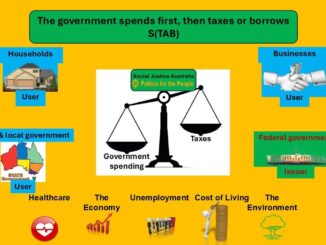
As the issuer of its own currency, the Australian government cannot run out of money. It can fund all essential services – public housing, free education, universal healthcare – without raising taxes or borrowing.
As economist Professor Bill Mitchell puts it, “We constrain ourselves by choice, not necessity.”
11. Govern for People, Not Donors
Australians are disillusioned by a political system that prioritises lobbyists, not lives. Real reform means banning corporate donations, closing lobbying loopholes, and restoring a citizen-first governance approach.
Transparency, donation caps, and an end to corporate influence are what Australians want from a democracy that puts people before profit.
The Path Forward
Australians have always valued fairness, community, and equal opportunity. But neoliberalism has eroded these values, replacing them with privatisation, austerity, and corporate influence.
What Australians want from the government isn’t radical. It’s responsible.
It’s time to:
• Reclaim public housing.
• Fund universal free education and healthcare.
• End reliance on private profiteers.
• Reject militarisation and reassert independence.
• Use our sovereign currency to uplift our people.
It’s time our leaders stopped managing perceptions and started delivering what Australians want: a strong public sector, peace-focused foreign policy, and a government that works for all.
Q&A Section
Q1: Is it financially possible to fully fund public services?
Yes. Australia’s monetary sovereignty means the federal government can always afford to buy what’s available in its own currency. The constraint is real resources, not money.
Q2: Won’t public ownership be inefficient?
Private ownership hasn’t delivered better outcomes. Services such as energy and transportation have become more expensive. Public ownership ensures transparency, equity, and reinvestment into communities.
Q3: What can I do to support change?
Share this article. Write to your MP. Support independent media. Most importantly, vote for candidates who put people over profit and understand Australia’s monetary power.
Call to Action
Curious what others think? Please read what our readers are saying on our Reader Testimonials page.
If you found this article insightful, you can explore more on political reform and Australia’s monetary sovereignty at Social Justice Australia.
Share this article with your community to help drive the conversation toward a more just and equal society.
Click on our Reader Feedback page.
Please let us know how our content has inspired you. Submit your testimonial and help shape the conversation today!
Support Social Justice Australia – Help Keep The Platform Running
Social Justice Australia is committed to delivering independent, in-depth analysis of critical issues affecting Australians. Unlike corporate-backed media, we rely on our readers to sustain this platform.
If you find value in our content, consider making a small donation.
Your support helps:
• ✅ Keep this website running without corporate influence
• ✅ Fund research and publishing of articles that challenge the status quo
• ✅ Expand awareness of policies that affect everyday Australians
Thank you for being part of this movement for truth and justice.
If you value our work, please leave a quick Google Review here and help others discover us.
This article was originally published on Social Justice Australia
Also by Denis Hay: Why Protecting Our PBS Is More Urgent Than Ever
Dear reader, we need your support
Independent sites such as The AIMN provide a platform for public interest journalists. From its humble beginning in January 2013, The AIMN has grown into one of the most trusted and popular independent media organisations.
One of the reasons we have succeeded has been due to the support we receive from our readers through their financial contributions.
With increasing costs to maintain The AIMN, we need this continued support.
Your donation – large or small – to help with the running costs of this site will be greatly appreciated.
You can donate through PayPal or credit card via the button below, or donate via bank transfer: BSB: 062500; A/c no: 10495969


I agree entirely Denis,It’s very depressing.The Labor party desperately needs a change of ownership,from the corporate crooks back to the people.
I watched that Press Club address..lots of repeated motherhood statements,but all piss and wind.Not going to happen with Albanese..they’ll need to be shaken up at the next election.One shade of neoliberalism lighter than the other halfwits.
Unfortunately, we’ve almost run out of time.
We certainly have run out of time, with politicians selling off our massive gas assets for a song (and commission?).
We seem “out cold”, while they harvest our crown jewels.
Two things, as a retired teacher,l have been banging on about for years.
1 HECS always was totally unfair. You take a cohort or young people and tell them to give up immediate work to go to uni and become a more educated and valuable member of society. Like, l don’t know, an educator, a health professional, an economist, a legal expert? Then once the graduate with their “borrowed” degree you set them off to work debt free and just when they are starting to get a decent wage and thinking about a house, marriage, kids perhaps further study and qualifications? You say nup! Stay in your share house or your parent’s spare room and pay back all that money we loaned you all those years ago. Talk about the sword of Damocles.
2 free primary, secondary and 1 free tertiary course provided they meet requirements for every Australian child.
No. 1 is how to drive most young people into less qualified work and a life of little means.
No. 2 is how you keep our country stocked with adequate numbers of qualified professionals so that we don’t have to consider stealing medical personnel from other countries the next time a pandemic arises.
Abroad, we Canadians are often envied for our supposedly universal healthcare, yet, in a significant way, it comes second to the big-profit interests of industry.
Besides ‘treating’ mental illness, pharmaceutical companies (a.k.a. a largely sedation and ‘happy’-pill industry) greatly profit from the continual and even addictive tranquilization and concealment, via antidepressants and/or tranquilizers, of symptoms of cerebral disorders like ADHD and higher-functioning autistic spectrum disorder, along with the notable anxiety and/or depression that often accompany them — especially when there’s related adverse childhood experience trauma.
Also, I wouldn’t be surprised if profit-motivated industry representatives have a say in the composition, including revisions/updates, of the Diagnostic and Statistical Manual of Mental Disorders.
In Canada at least, it’s also a case of relatively few physicians integrating adverse childhood experience or other PTSD science into their diagnoses and treatments of patients. Meantime, the only two health professions’ appointments for which Canadians are fully covered by the public plan are the two readily pharmaceutical-prescribing psychiatry and general-practitioner fields.
[Indeed, over the last 18 years or so, Health Canada has diverted a large portion of its resources from consumers’ health/wellbeing and onto the pharmaceutical industry’s business interests. Health Canada places about four times more of its resources, such as staffing and funding, toward getting new drugs onto the market than it does on consumers’ safety, the latter which includes monitoring and recording adverse effects caused by the drugs.]
Such non-Big-Pharma-profiting health specialists as counsellors, therapists and naturopaths (etcetera) are not covered at all by the public healthcare plan. Psychotherapy, for example, costs $150-$200 an hour, for who-knows-how-many sessions, which likely makes it inaccessible for most Canadians, including me.
In the U.S., relatively few Democrats are politically-practicing social and fiscal progressives, with the ‘fiscal’ ensuring that everyone has access to the basic necessities of life.
Other than perhaps Barack Obama, it’s doubtful any presidential contender or president — including and especially Donald Trump — has genuinely realized that Americans collectively want and deserve better than just either of the usual callous conservative or neo/faux liberal establishment candidate thus very corporate friendly president in the White House (something I believe they very likely will never get).
One almost gets the impression that the Republican and Democratic parties are still unaware of the non-corporately-commissioned polls showing that a majority of Americans favor the governmental implementation of some public programs, especially universal health care.
One would think the Democrats in particular would finally support thus implement a universal healthcare plan, so why is the DNC refusing to allow it — even if only by disallowing the fiscally progressive Senator Bernie Sanders to run as its presidential nominee, however many Democrat-voters want him? That is, other than the DNC being afraid of crossing the corporate lobbyists, especially those hired to represent the healthcare industry’s unlimited-profit interests, who make some of the largest donations to the party election coffers.