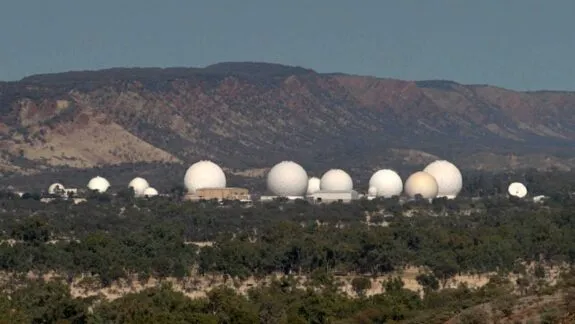
It remains a prickly reminder that Australia remains an embarrassed vassal of power, annexed to the security interests of another state basking in imperial and fast diminishing splendour. Pine Gap, known more technically as the Joint Defence Facility Pine Gap (JDFPG), is a largely US-operated effort in Alice Springs, Central Australia. As the late scholar of strategic studies Desmond Ball pithily remarked in 1988, it is “an espionage operation.
Euphemisms should not be allowed to obscure this essential point.” It grew out of a desire on the part of the US Central Intelligence Agency (CIA) in 1965 to establish a remote Australian-sited ground control station intended for signals intelligence satellites. Land belonging to the Central Arrernte people was accordingly excised the following year for the site. The decision, in typically rough fashion, was made without consultation and discussion with local residents or elders, a secret place that became what Trevor Paglen would describe as a “blank space on the map … erased from the public record.”
The facility staffs some 800 personnel from the US National Security Agency (NSA), CIA, the US National Reconnaissance Office (NRO) and such Australian agencies as the Australian Signals Directorate and Australian Federal Police. Over the years, the base has become increasingly corporatised with a heavy American accent: Raytheon, Northrop Grumman and General Dynamics, IBM and Hewlett Packard. A mere 10% of the constituted personnel are said to be Australian government employees.
The base periodically attracts its keen and principled protesters, aghast at the base’s role in furnishing targeting data for US and allied drone and missile strikes across the Middle East and Africa. This year, the Close Pine Gap-Sacred Land Back convergence featured three days (July 18-20) of activities, with hundreds of participants gathered in Alice Springs to demand the closure of the facility through a series of workshops, panels and woven “threads of anti-militarism and decolonial movements.”
On July 20, a rally of 300 individuals gathered close to the front of the spy base, the largest since 1987, sporting signs and flags and chanting the stock phrases: “shut it down”, “close Pine Gap”, and “always was, always will be Aboriginal land.” New South Wales Greens Senator David Shoebridge was present, expressing his concern about a “foreign military base set up for the interests of a foreign military” in the service of “right wing politics” and disrespectful of international law. The base was also a potential target for any adversaries the US might be willing to antagonise, thereby bringing “danger into the heart of our country.”
Arrernte Apmereke-artweye traditional custodians Felicity, Wyonna and Jacquita Hayes offer sound if disturbing logic, as reported by the Australian Associated Press: Pine Gap sits on a sacred site that not only profanes tradition but acts as vehicle for the waging of foreign wars and the conduct of genocide. “We don’t want to be feeling guilty all the time when bad things are happening overseas to little ones. We’re not the ones controlling that facility, but we feel guilty that it’s coming to our land.”
The custodians wished for the facility to be closed “so the generation coming can be safe. We want to be compensated so we can get houses at Whitegate community.” It is also with some astonishment that the residents of Whitegate, to this day, are deprived of rudimentary services, including decent housing and running water. The water has to be brought in by truck. There is no sewerage.
Richard Tanter of the Nautilus Institute, one of Pine Gap’s most astute and flawlessly detailed critics, proved ever reliable in remarking that, “Unless the Australian direct and indirect military relationship to Israeli activities in the Gaza Strip are closely reviewed … it is not possible for the Australian government to assure parliament and the Australian public that Australia is no complicit in acts of genocide.” The good professor has been able to shed much light on the facility’s broader purposes and is dismissive of critics who fault claims that the site is being used to feed such military efforts as those of Israel. (He can point to at least three satellites having the Gaza Strip within their reach.) In October 1973, for instance, satellite intelligence from Pine Gap was passed on to Israel during the Yom Kippur War, a contribution that aided Israel’s breakthrough of the Egyptian lines.
This is of little concern to the clubland militarists in Canberra and such think tanks as the Australian Strategic Policy Institute. Former intelligence officer Patrick White, writing for ASPI’s The Strategist, laments the diminished secrecy and security of the site, worrying that trends in signals technology have no longer made the base “irreplaceable”. The advent of extensive encryption means that satellite download feeds can be protected “almost anywhere. The remoteness that once hid the site from view no longer hides much at all.” He is sentimental about the ties with Washington. “We have shared in intelligence and expertise far beyond anything our own resources could produce. We have no satellites of this kind.” Precisely why Canberra is blood-crusted in its complicity, less an authoritative host than a butler eager to please.
Pine Gap acts, then, as a symbol of highly distilled, triple strength colonisation: a garrison outpost dominated by the US imperium and its personnel (a poke in the eye of Australian sovereignty), located on native land it defiles (a poke in the eye of the First Nations peoples), and also responsible for aiding the predations of Washington’s allies – more recently the Israeli Defense Forces in its cleansing conflict against the Palestinians. “I understand the genocide in Gaza against my people is made possible by intelligence flowing from the heart of this colony in Alice Springs directly to the Israeli occupation forces,” stated Palestinian activist Remah Naji of Justice for Palestine Magan-djin with potency. Shoebridge agreed: “We’re letting them use our land, this key real estate, I think [to] commit some of the worst atrocities we’ve seen.”
As the AUKUS Public Inquiry continues its various hearings on that ghastly, doomed security pact between Australia, the United Kingdom and the United States, the Close Pine Gap campaign should be commended as a linked, worthy extension. The former’s proceedings have been mostly savaging the wisdom of a pact that has shown Australia to be embarrassingly disadvantaged, its politicians largely deluded, and its strategic establishment impressionable and bankrupt. (That establishment seeks to bankrupt the Australian treasury to the princely sum of AU$368 billion over promised nuclear-powered submarines that may never arrive.) The Close Pine Gap protests, while receiving less in the way of coverage, is no less pertinent and urgent in its aims.
Also by Dr Binoy
Manuring the Ground: Trump, China and Stolen Elections
Ironic Fates: Bolton, Trump and Mishandling Classified Documents
The Hand-Me-Down Alliance: Australia, AUKUS and Op-Shop Submarines
Dangers to the Fourth Estate: The 2026 World Press Freedom Index
Keep Independent Journalism Alive – Support The AIMN
Dear Reader,
Since 2013, The Australian Independent Media Network has been a fearless independent voice – holding power to account and delivering journalism that matters.
Running this site isn’t cheap. Rising costs mean we need your support now more than ever. Every donation, big or small, keeps our servers running, our writers working, and our stories free for everyone.
Donate here:
PayPal or credit card – just click on the Donate button below
Direct bank transfer: BSB: 062500; A/c no: 10495969

We’ve also set up a GoFundMe as a dedicated reserve fund for hosting and future improvements.

Thank you for standing with us. We couldn’t do this without you.
With gratitude,
The AIMN Team

Pine Gap is a perfect example of the ineptitude that prevails amongst Australian politicians when considering the responsibility of protecting and maintaining our sovereign territory and our future security within the South Asian region.
Pine Gap has no modern air defence system and is vulnerable to nuclear capable ICBM attack from several potential sites in the Norther Hemisphere. Many Australian citizens are not aware of the implications of agreements and treaties made between USA and Australia that enable the presence of active US military assets on Australian territories.
Such agreements include:
Force Posture Agreement (2014) – rotational US military presence and access to facilities. Thus, several thousand fully equiped and active US Martines are lodged in Darwin NT each year.
Acquisition and Cross-Servicing Agreement – mutual logistics support. This includes Australia providing housing and services for hundreds of US Navy personnel and their families located at HMAS Stirling W.A.,the future home base for the AUKUS submarines.
The use of Tyndall airfield NT by US nuclear weapons capable B-52 bombers is another unsatisfactory arrangement vis-a-vis Australia’s reputation with our near north neighbours.
Status of Forces arrangements – legal status of US personnel. US service personnel are not subject to the full extent of law in Australia.
Numerous intelligence, communications and technology agreements that enable the two militaries to function together with a high degree of interoperability. Note the interoperability means Australia acquiring US manufactured military equipment rather than use of Australian technologies.
USA will never allow a foreign intelligence facility or military forces to be permanently located within US territory. It is unsatisfactory that Australian politicians allow this to happen because USA secretly operates Pine Gap as a weapons targeting asset for wars against foreign nations with whom Australia has no disagreement.
The UAE is a significant provocateur and arms supplier to the renegade Rapid Support Forces and their killing spree across Sudan (which the USA/UK/EU seems to ignore). Oz has its only (external) military base in UAE. During USA’s operation Epic Fury (unilateral attack on Iran), Oz sent troops, missiles and a highly sophisticated E7-A Wedgetail surveillance and battle management plane to the UAE for deployment in the Persian Gulf.
There is no question that Oz participated in the US’s illegal war, and also no question that that Wedgetail used and relied on the US (Five-Eyes) satellite network, systems and data flowing for Pine Gap and other US base stations.
Further, there would be no question that the AUKUS pillar I subs would rely on the Wedgetails (and/or their descendents) and the US (Five-Eyes) satellite network, systems and data flowing for Pine Gap and other US base stations.
Maintaining Oz sovereignty my fat foot.
There is no question that we remain a mere butler to the increasingly egregious US military machine and exceptionalist hegemonic politics. If Oz was urged (similarly to the Persian Gulf Wedgetail deployment) to send ‘Wedgetails’ and AUKUS subs into a ‘US-China contest’ in the South China sea, those ‘assets’ would almost certainly be blown to smithereens.
Oz is so deep into its arrangements with the USA, there is also little question it would be excruciatingly difficult to extricate ourselves from them without substantial blow-back from the US. But to deepen those arrangements via the febrile and high risk toxic (HEU) AUKUS pillar I subs pact is lunacy.
Especially when Oz could revert to France’s smaller but adequate Suffren class (LEU) subs without turning SA’s Osborne naval shipyards into a highly dangerous fortress with mind-blowingly expensive infrastructure for extracting weapons-grade highly enriched uranium (HEU) in massive hull sections to be transported, stored for 1000 years+ somewhere on Oz soil, with IAEA scrutiny, and jeopardizing our NPT and Treaty of Rarotonga obligations.
US/UK/EU/Russia/Ukraine/Israel, particularly in the last decade or so, with chest-beating and olde worlde geostrategic madness and lack of ballistic restraint has made everyone extremely tetchy.
From when the USA persistently at close quarters ring-fenced China, from about 20 years ago China (Oz’s biggest trading partner) commenced a rapid build-up and modernization of its military machine, and it could now significantly outflank the US at close quarters, and unambiguously has an ability to strike with missiles at least over 10,000 kilometres. Yet unlike the US, it has not in 40 years ever threatened (except minor skirmishes with India on their borders) or fired a shot into others’ territory.
So, where does Oz think its going now?
@ Mediocrates, Clakka: Excellent articles!! History shows that the Australian politicians in power when these various treaties were arranged suffered badly form the ”cultural cringe” that has been encouraged in Australia for over a century.
We should reme3nber that the US has “assets; ”Not allies”, and as seen in other countries for almost 150 years, absolutely no concern over intervening in the domestic politics of another country when the US State Department thinks it will benefit US owned multinational corporations achieving their corporate goals, especially access to natural mineral resources.
Remember the 1972 Whitlam Dismissal ….. or suffer the same fate again.
Indeed NEC.
And it is notable that the USA has usurped or precipitously and divisively withdrawn from all (or nearly all) the treaties it has ever entered into.
For three-quarters of a century, Australian foreign policy has been anchored in a singular, unshakeable dogma: that a small, distant nation of Western heritage requires the military umbrella of a global superpower to survive in an inherently hostile Asian hemisphere. This foundational narrative has dictated everything from intelligence sharing via the Joint Defence Facility at Pine Gap to the multi-billion-dollar procurement of nuclear-powered attack submarines under the AUKUS framework.However, as the global order undergoes a profound structural realignment, this long-held premise has been revealed as fundamentally back-to-front.The Western security umbrella is no longer a shield; it has become a lightning rod for strategic instability.
By acting as a forward offensive node for an unpredictable, heavily indebted, and domestic-crisis-ridden hegemon, Australia does not secure its existence—it actively imperils it.