When the Trump administration abducted the Venezuelan President Nicolás Maduro and his wife on January 3, an open incitement to international lawbreaking was asserted. Here was thuggish impunity, crude acquisition and harsh plunder in operation: the seizure of a sovereign leader in office on fanciful narco-terrorist charges, a violation of the territorial sanctity of a state guaranteed by Article 2 of the United Nations Charter, and the demand that Venezuela be compliant with Washington’s objectives in its vulgar reiteration of the Monroe Doctrine. The prize was clearly oil.
Towards the end of August, President Donald Trump was in a sprightly mood on his favourite platform of choice, Truth Social. In a post, the President announced that he had reached, with Venezuela, “THE BIGGEST OIL DEAL IN WORLD HISTORY!” Under his direction, the US Secretary of State Marco Rubio, the Secretary of War Pete Hegseth, working with interim President Delcy Rodriguez of Venezuela in “partnership with private business, have secured majority US control of more than 65 BILLION BARRELS of proven Oil Reserves in Venezuela, at no cost to the American taxpayer.”
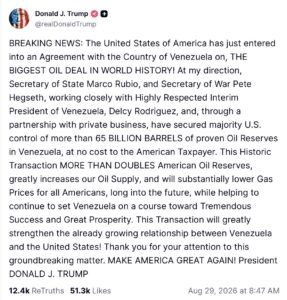
This brazen assertion of control would more than double oil reserves in the US (currently at 46 million barrels), increase oil supply and, most importantly regarding the election prospects for the Republicans, “substantially lower Gas Prices for all Americans, long into the future, while helping to continue to set Venezuela on a course to Tremendous Success and Great Prosperity.”
President Rodriguez tried to polish what could only be regarded as a particularly unpleasant turd. Lasting 25 years, the agreement was in line with the country’s Hydrocarbons Law and would secure US$100 billion in investment, with US$209.3 billion in royalties and taxes. She was less than forthcoming about the level of tax revenue that will flow in from these transactions.
This cocksure initiative is, as with much issuing from the mind and easy mouth of Trump, one part hope and several parts fiction. The initial question to ask is when the benefits of this plunderous exercise will flow back to the American economy in any timely way. “Ultimately, prices are going to come down,” Trump remarked in the Oval Office. “Now, will it happen before the election? I can’t tell you that.”
The cognoscenti in the field of commodities are sceptical and excited. Patrick De Haan, head of petroleum analysis at GasBuddy, offered his doubts to The Hill. Well it might be that prices would come down “several years from now” but that was hardly likely in the short term. There were, for instance, troubling legal risks to the agreement, and various other contingencies, but were it to have legs, “with huge investments, with a big increase in oil production, it could be big. But, again, the gas price impacts are years down the road, not days, weeks or months.”
These comments easily inspire reference to those damning words of the economist John Maynard Keynes, penned in A Tract of Monetary Reform (1923): “The long run is a misleading guide to current affairs. In the long run we are all dead.” Gas prices might fall, but in the short term, we have Trump’s airy, often buffoonish assessments.
There are a multitude of considerations as to why the long run matters. From Lipow Oil Associates, Andy Lipow reminds us about the necessary infrastructure for the venture to work. “It’s going to take a decade to upgrade the infrastructure system to have a material impact on the oil market” though he did not wish to ignore the possibility of “some incremental improvements in the next year or two.” To push Venezuelan oil to levels of high production could cost somewhere in the order of US$180 billion; “an extraordinary amount of money [is needed] to be spent just to get oil out of the ground and delivered to the market before it’s even refined.”
The agreement has all the crude tailoring of gangster capitalism. The Trump administration is not exactly forthcoming on the list of enlisted business partners, but one reliably soiled candidate is North American Blue Energy partners (NABEP), led by the Venezuelan investor Alejandro Betancourt. The company is planning to move six drilling rigs into its Venezuelan oil fields by the end of the year, with the intention of deploying a further 12 rigs in 2027. The anticipated total is 52. In keeping with Trump’s taste for squalid, thieving characters, Betancourt is under investigation for overseeing the embezzling of US$2 billion from state oil company Petróleos de Venezuela (PDVSA), having also caught the eye of authorities in Spain and Switzerland for alleged money laundering and tax fraud. Despite this seemingly choking cloud of suspicion and query, Betancourt has been given near complete freedom to use private planes, accompanied by his troupe of family, partners, investors and business associates from the banking and mining industries.
As for the aforementioned legal risks, these are hard to shake off. Does the transaction pass muster under the Venezuelan constitution, given that Washington, not Caracas, is the one deciding the model at stake and companies that will participate in the venture? Trump has no care in the world for such statutory niceties, but prospective business partners and investors do. Luisa Palacios, an adjunct researcher at Columbia University’s Center on Global Energy Policy, is blunt on this point: “If the goal was to try to reduce the risk of investing in Venezuela, the United States might be doing the exact opposite with this transaction: further weakening the country’s already fragile institutional framework.”
Ed Chow, former Chevron executive and non-resident senior fellow at the Center for Strategic and International Studies, has this to add: “For a capital intensive, long-term industry, uncertainty slows you down. Sometimes it freezes you.” If there is a freeze in all of this, it certainly will not be due to any moral scruples on the part of the parties. However rich the returns, Venezuelan clientelism and kleptocratic initiative has been assured.
Keep Independent Journalism Alive – Support The AIMN
Dear Reader,
Since 2013, The Australian Independent Media Network has been a fearless independent voice – holding power to account and delivering journalism that matters.
Running this site isn’t cheap. Rising costs mean we need your support now more than ever. Every donation, big or small, keeps our servers running, our writers working, and our stories free for everyone.
Donate here:
PayPal or credit card – just click on the Donate button below
Direct bank transfer: BSB: 062500; A/c no: 10495969

We’ve also set up a GoFundMe as a dedicated reserve fund for hosting and future improvements.

Thank you for standing with us. We couldn’t do this without you.
With gratitude,
The AIMN Team

Consider this comment about the Venezuela Oil Deal from
Ron Filipkowski in Meidas+ (310826) This Weekend in Politics, Bulletin 451.
”… NYT: “The Trump admin’s highly unusual deal to develop Venezuela’s vast oil resources would have the US govt collaborate with an influential and polarizing Venezuelan businessman. Under the deal, the US would work with Alejandro Betancourt López, whose family controls Venezuela’s second largest private oil producer, North American Blue Energy Partners.”
… “The federal govt is expected to back the development of a significant portion of Venezuela’s proven oil reserves through the Pentagon’s Office of Strategic Capital, while Betancourt’s company would lead operations. Trump described the deal as giving the US ‘majority control’ over a large portion of the country’s reserves, though many of the details of the highly unorthodox arrangement remain unclear and were expected to change as the project gets going.”
… “Any meaningful new production from Venezuela will take years to materialize. As a result, the effort will have little immediate impact on global commodity prices, which in turn determine what US consumers pay at the pump.”
… It’s not “an oil deal with Venezuela.” It’s Trump kidnapping an autocrat, refusing to hold elections, then leaving the remainder of the regime in place but only if they allow him to pillage their natural resources, which they are doing to remain in power oppressing the people.
… This is what Trump said during the 2024 campaign: “We’re buying tar from Venezuela and we’re refining it in Houston. It’s the dirtiest, worst oil anywhere in the world. And we’re refining it – so you can imagine what’s going up in the air.”
… Ronald Reagan’s former budget director David Stockman posted: “Trumpy scores another own goal. The all-in economic cost of Venezuelan heavy crude is $70 per barrel compared to the 56 year constant dollar average price of global crude at $71/barrel, less 15% discount for low quality Venezuelan crude or $60 per barrel. That is to say, a $10/barrel loss on 65 billion barrels of crude under the Donald’s latest deal. The Art of the Deal strikes again!!!”
… Republican commentator and consultant Emmanuel Rincon, who is based in Miami and specializes in Latin American issues:
“Trump could have called for elections, negotiated with legitimate leadership in Venezuela, and secured the country’s oil concessions with the legitimacy and backing of 90% of the Venezuelan population. Instead, he chose to negotiate a deal with Delcy Rodríguez behind the backs of the Venezuelan people—one that I believe will have an enormous negative impact on the US for decades to come.
In doing so, he has handed the anti-imperialist Latin American left a powerful weapon that they will use to win elections for decades, turn populations against the US, and, in turn, once again push the majority of Venezuelans against the US.
For decades, many people, myself included, argued that the US was a better strategic and economic partner for our countries than China, Russia, or Iran because it respected the rule of law, institutions, and democracy. Today, given what has just happened, it will be extremely difficult to make that case.
After January 3, Trump was seen as a hero by the vast majority of Venezuelans and by a large portion of Latin Americans. That image has changed dramatically over the past few months, and the way this deal has been handled will only make the situation worse.
It is deeply unfortunate, because Trump could have achieved an equally favorable outcome for the US while also having the backing of the Venezuelan people. He only needed to change the interlocutor. Now, I don’t see how this can be fixed, and I believe that, politically, this will greatly benefit communists and socialists—the true enemies of the US—across the region.”
… Trump posted this claim today: “One of the things I am going to do with the Venezuelan Oil is fill up the Strategic National Reserves which, because of Sleepy Joe Biden, has been virtually emptied. The ‘topping out’ process will begin very shortly, and is a Gift from Venezuela to the People of the US.”
… This will never happen. Trump will leave the SPR far lower than he found it. When Joe Biden left office there were 394 million barrels of oil in the SPR. Right now there are 289 million barrels of oil in the SPR.
We can also think on his cruelty to Cuba.
And was this not why the Gaza mess was dreamed up, as a diversion from a diversion?
Dr Kampmark is right to question the basis of the oil “deal” with Venezuela.
At the G20 meeting just concluded, according to sovereignista.com, China has refused to endorse a U.S.-led G20 statement calling for “free, safe, and predictable navigation through the Strait of Hormuz,” leaving Beijing as the only G20 member that did not support the statement in full.
China also rejected portions of the statement dealing with trade imbalances, “non-market policies,” critical minerals and sovereign debt.
Beijing is unwilling to give Washington multilateral political cover for its position on Hormuz.
China is also pushing back on the Venezuela deal.
Also from sovereignista.com, China has called for its “legitimate rights and interests” in Venezuela to be protected following reports that oil projects involving Chinese and Russian companies will be transferred to US-backed North American Blue Energy Partners (NABEP).
The corporation is set to receive long-term concessions for 17 oilfields holding 65 billion barrels of proven crude reserves. Five of the projects reportedly involve Chinese firms including CNPC and China Concord Petroleum, while another is believed to be operated by a PDVSA-Russian joint venture.
This has only just started. China and Russia will not allow any working on their concessions that are done for the benefit of the dollar.
It could be that news of the deal emanating from the US is just more hot air from Trump.
If it’s not hot air, if the US begins to work these fields, the days of US proxy wars might be over.
The world is pushing back, not just China and Russia.
Things might be about to get hot.
Will Trump care?
He knows Australia will have his back.
As usual Trump increasingly vain, desperate and running amok. His regime’s unilateral illegality proves to be no obstruction in the USA’s quest for oil, and control of global oil supplies. His attacks on Venezuela & Iran and manoeuvres in the Persian Gulf are creating global havoc, and rapidly isolating the USA, particularly in the Middle East and Latin America.
As for filling the American strategic Strategic Petroleum Reserve (SPR), which is in underground salt domes (already unstable & vulnerable to collapse) due to being almost drained. This is what CNN had to say:
“The Venezuelan oil that the new public-private joint venture produces will be used to fill up the SPR, Trump claimed, after the United States released 130 million of the 172 million authorized barrels to shore up supply during the Iran war.
The plan faces several problems:
Heavy, sludgy Venezuelan oil fails to meet the SPR’s quality standards and could damage the storage facility.
Venezuelan oil infrastructure needs significant investment and repairs to produce oil on a scale that would facilitate the refilling of the SPR.
Congress needs to approve the SPR’s oil purchases.
A plan to begin replenishing the SPR is already in the works.
The Trump administration could conceivably work around those issues. But using Venezuelan oil to fill the SPR to the top is probably not a near-term solution to the problem.”
Al Jazeera has noted that there’s no transparency re what’s happening to the money surrounding the current or future exports of oil from Venezuela to the USA, there’s also gold & other mineral resources, and it seems the Trump regime is entrenching an un-elected corrupt regime in Venezuela, where’s the accounting, accountability, the contracts & the money.
It certainly seems this is likely to blow up in the Trump regime’s face, and we can guess what that means.
Isn’t this what happened in Cuba when American crooks took over the economy and Fidel Castro had the people rise up against that US Mafia ?