By James Moore
“I was born in the autumn of things.” (Richard Flanagan, Australian author).
Our carburetors had to be opened up for the engines to get us up the Front Range. We had just entered Rocky Mountain National Park and were already angling upward toward the Great Divide and there was not enough air mixing with the gas we were burning. The motorcycles sputtered approaching the highest elevated paved road in America. There was concrete beneath our wheels that was taking us to a height of more than 12,000 feet above sea level, up where the air was so thin trees were unable to grow. Butch was out front on his shining new Triumph Bonneville 650, blue on white, and I was struggling to stay apace on my used and battered 450 Honda. We had come across Iowa and Nebraska from Michigan and at every gas pump we lost ourselves in talk of mountains and roads winding to the top of the world.
I wanted to see if the country was as big and open and free as it appeared on the old black and white westerns my father watched to escape the agonies of the assembly line, and Butch, I was certain, hoped to not think about the war that had killed all his Army buddies but not him. Not even a leech had landed on his skin, and the why of it was mystifying. I stared at his long hair, pulled upward into the slipstream, curling out of the back of his helmet, and wondered if anything important inside of him had broken or become dislodged. There was nothing delicate about my friend; he came from a strong Italian family of five boys who were slinging hammers and wielding shovels in construction before they were even teens. Whatever war might have done to him was not visible to me, but I probably was not the best observer of subtleties while intoxicated by the open road.
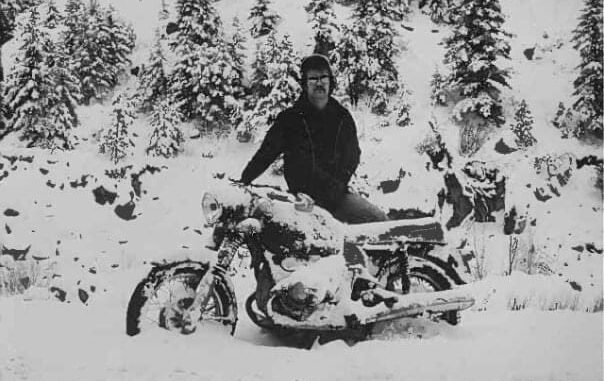
Up we rode, into the face of a July snowstorm coming across the Never Summer Mountains to our west. Our gear was inadequate to protect from such cold and we were lucky to arrive at the Alpine Visitors Center without having slipped and fallen. The snow was not wet and heavy and quick to melt, which might have been expected of a summer flurry, and we were forced to wait out the white wind blowing across the peaks. I had wanted to find the back roads on the other side of the Divide and run up to the headwaters of the Colorado River. My imagination had us following the river course all the way to Mexico and camping on a beach at the Gulf of California but the weather at altitude was too much of a challenge. On the steep switchbacks, we came across evidence there were smarter motorcyclists and took a picture of a beautiful bike that had been abandoned to the unseasonable squall.
In a decade, I was living in those mountains and also giving up a motorcycle to the snow. Heading eastward on the interstate, I sat a Harley Sportster, riding foolishly on a Thanksgiving weekend errand. Blowing snow began to make drifts and I knew I was doomed to leave the bike by the roadside or give up my trip to Omaha, but I needed to say things to my love, and they had to be in person, not over the phone. I put the kickstand down on a flat rock, and stuck my thumb out into the wind, hoping to get a ride to the bus station in Denver. When I finally came down from the mountains, the storm had caught up to the Continental Trailways bus I had boarded and we shuddered and crawled through the dark to a closed I-80 in Big Springs, Nebraska. Thanksgiving dinner in a truck stop cafe booth was meatloaf, mashed potatoes, a side salad, and coffee, $4.99. I ate sullenly among strangers, spending the holiday wondering what kind of man I was becoming.
My job that fall was to wander the Intermountain West with one of the best cameramen in the TV news business and write stories about issues and history and characters who defined what it meant to be Western in a modern world. The Hotel Colorado, which became the Western White House during the administration of Teddy Roosevelt, was my home. I saw the president’s picture on the hallway wall each morning when I left for work, a paradox of a man who loved the natural world as much as the risks and glories he perceived in war. Outside the window to my room were the Glenwood Hot Springs where Doc Holliday had come seeking the curative waters to end his consumption, and just beyond the clouds of steam, the frothing rapids of the Colorado glowed in starlight. An open window let me fall asleep to the subtle rumble of the mighty flow running down to the Grand Canyon. Every snowflake, melting and trickling down rock, rushing to a creek, fed the eternal river.
Even then, though, there was reason to worry that there might be forces that outstripped the power of the Colorado. A short drive downstream, the Exxon oil corporation was investing a billion 1980 dollars to build a town on Battlement Mesa for workers it planned to hire for oil shale recovery. Before a drop had ever been captured, there were rows of homes on paved streets, a grocery and drug store, a hospital, community center, golf course, and gas stations. Because this was oil shale, and not shale oil, the science behind refining from the rock involved strip mining and digging deep shafts into the ground. The rock is a marlstone, which contains kerogen, a precursor to oil. The ore must be heated to 750 degrees Fahrenheit to extract the petroleum liquid, and the energy consumed in that process is close to being greater than what is generated.
I rode an elevator platform 2000 feet into the dark earth with Interior Secretary James Watt, who spoke hopefully of a refinement of natural resources that seemed illogical and ruinous. Exxon was getting permits to begin strip mining, too, and Watt said it was possible 400,000 barrels a day might be delivered along the river’s bank. The town across the river was being developed to house 25,000 workers who would confront and create the problems of high water usage, significant power consumption, and carbon emissions. The cost was too high, however, and the project was abandoned. When the technology improves, though, the corporate interests will be back, and they will gash the hillsides with giant machines, pollute the air and water, and turn a profit. The Piceance Basin in Western Colorado will not be permanently ignored because it contains an estimated 1.525 trillion barrels of oil, a staggering figure, according to the Colorado Geological Survey.
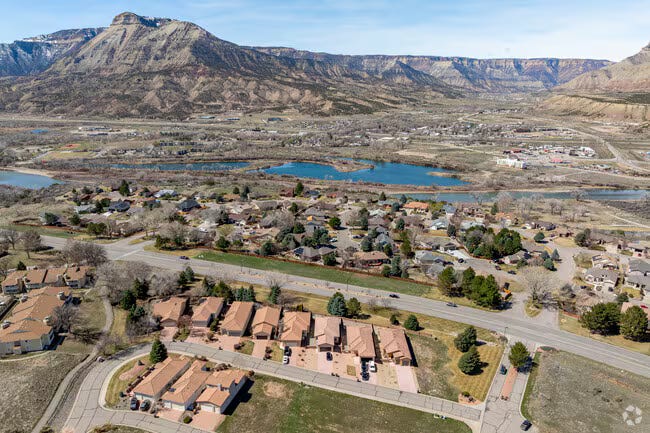
I spoke often with the people who lived downstream from the Colony Shale Oil Project and none had confidence their water and forests and hills would survive the vast extraction. Most of them had moved to the geographically isolated town of Grand Junction, and the idyllic communities up on the mesas like Fruita and Palisade, to evade the grinding machines of cities. The Gunnison and the Colorado Rivers came together in their valley and the mesas were green and flowering with peach and apple orchards. They were 400 miles from Denver and just under 300 from Salt Lake City and did not expect to be overrun by the driving wheel of progress. An escape from shale oil was just a temporary reprieve, too, since the Piceance Basin is also a prolific natural gas preserve and includes more than 3000 functioning wells. Exploration is slowly slipping westward from Glenwood Springs and Garfield County down the river valley toward Utah.
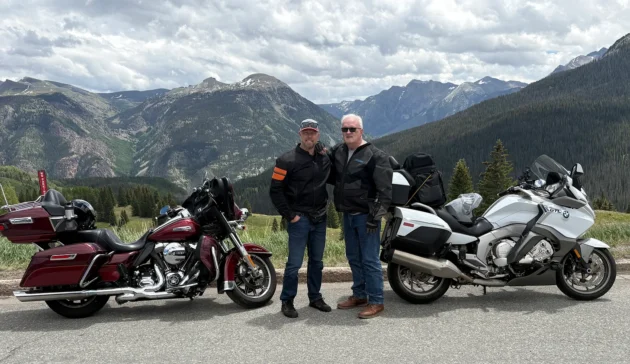
I was thinking of the West’s greater problem as my friend Shaw and I rode our motorcycles south of Grand Junction and up into the Colorado National Monument, maybe the most stunning of America’s parks. The Colorado River system has been under stress for years and in the first quarter of 2026 has dropped to only 36% of capacity. The snowpack has reached the lowest level on record, and two of the most important reservoirs in this country are alarmingly low. Lake Powell in Arizona has a quarter of its storage capacity with projected inflow for the critical April-July window to be at 27% of normal. By late summer, it’s high water mark is expected at 3900 feet above sea level, which means Glen Canyon Dam’s hydro generators might not be able to make electricity. Lake Mead, below Powell on the Colorado, has one third of its storage capacity and is expected to reduce hydro power later this summer by 40 percent. Some of the 40 million people in Los Angeles, Phoenix, Las Vegas, San Diego and beyond, who rely on the river, may face blackouts this summer, and not a drop to drink.
Water is the new oil.
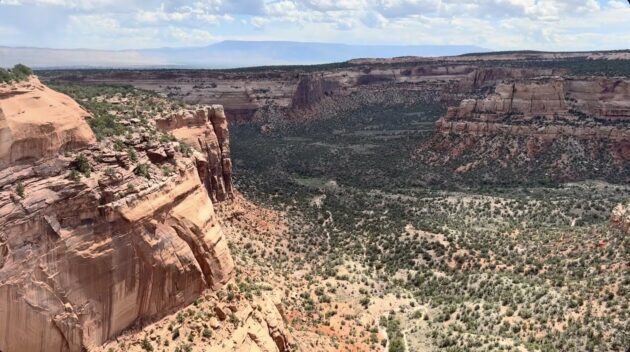
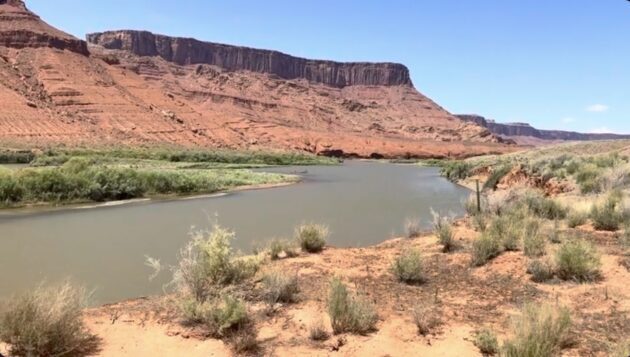
We continued pressing westward and picked up Utah’s Route 128, which traced the river’s course through red rock canyons and beneath ancient epic mesas. The Colorado still spoke there of its endless epochs of power that had been carving the Grand Canyon further downstream, before cities with millions of inhabitants began diverting the water for lawns and car washes and golf courses and irrigation to grow food crops to feed the overpopulated masses. This looked like a spot sufficiently remote that the builders of vacation homes might never pour concrete in sight of the river, but development and growth are our chosen curse in America, and little is safe from scheming profiteers. I have ridden in all the lower 48 states and have constantly confronted the puzzlement of how a land so geographically blessed can be supremely cavalier regarding its grandest gifts.
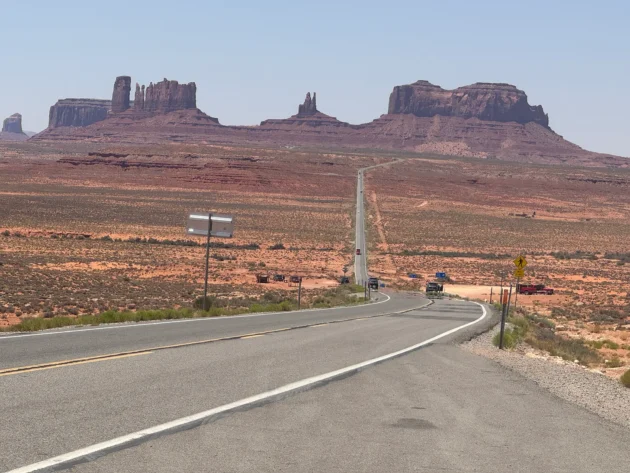
We went south out of Moab toward Monument Valley because Shaw had never seen the Grand Canyon and my two dozen visits with rim-to-rim hikes and runs made me a convincing claimant of expertise. I was not certain how to feel when I discovered that one of the country’s most iconic roadways had been renamed after a movie character who loved shrimp, but the view was unchanged, and, as always, emotionally charged with almost incomprehensible feelings prompted by the grandeur. The heat across the high desert was nearly debilitating in our run to the North Rim and we sat for lunch in the lodge at the same table I had occupied after concluding my initial 1970 crossing from the South Rim. A dry wind was blowing from the west, exacerbating the drought, and a few days after we left a fire raced across and burned to the ground the 100-year-old lodge, which had been built by the Union Pacific Railroad to get more tourists to the canyon’s north side.
Friends have insisted I am being unreasonable to fret about the canyon’s future but there are monied forces with political power that consistently talk about a new dam where the Colorado exits its palisades. Everything we thought eternal is becoming uncertain. Our culture is transitioning from custodial to unabashed opportunism and unconstrained greed. National parks are at risk of becoming strip mines and oil fields. We have chosen leaders, too, who make decisions based on the denial of climate changes caused by the works of man even as legendary forests burn through the West and wheat and corn crops wither across the Great Plains in recurrent, rainless springs. What politician is aware that it takes a century for vegetation to grow back in the desert? What country, what people, would stand back and let this all happen?
This article was originally published on Texas to the world.

James Moore is the New York Times bestselling author of “Bush’s Brain: How Karl Rove Made George W. Bush Presidential,” three other books on Bush and former Texas Governor Rick Perry, as well as two novels, and a biography entitled, “Give Back the Light,” on a famed eye surgeon and inventor. His newest book will be released mid- 2023. Mr. Moore has been honored with an Emmy from the National Academy of Television Arts and Sciences for his documentary work and is a former TV news correspondent who has traveled extensively on every presidential campaign since 1976.
He has been a retained on-air political analyst for MSNBC and has appeared on Morning Edition on National Public Radio, NBC Nightly News, Last Word with Lawrence O’Donnell, CBS Evening News, CNN, Real Time with Bill Maher, and Hardball with Chris Matthews, among numerous other programs. Mr. Moore’s written political and media analyses have been published at CNN, Boston Globe, L.A. Times, Guardian of London, Sunday Independent of London, Salon, Financial Times of London, Huffington Post, and numerous other outlets. He also appeared as an expert on presidential politics in the highest-grossing documentary film of all time, Fahrenheit 911, (not related to the film’s producer Michael Moore).
His other honors include the Dartmouth College National Media Award for Economic Understanding, the Edward R. Murrow Award from the Radio Television News Directors’ Association, the Individual Broadcast Achievement Award from the Texas Headliners Foundation, and a Gold Medal for Script Writing from the Houston International Film Festival. He was frequently named best reporter in Texas by the AP, UPI, and the Houston Press Club. The film produced from his book “Bush’s Brain” premiered at The Cannes Film Festival prior to a successful 30-city theater run in the U.S.
Mr. Moore has reported on the major stories and historical events of our time, which have ranged from Iran-Contra to the Waco standoff, the Oklahoma City bombing, the border immigration crisis, and other headlining events. His journalism has put him in Cuba, Central America, Mexico, Australia, Canada, the UK, and most of Europe, interviewing figures as diverse as Fidel Castro and Willie Nelson. He has been writing about Texas politics, culture, and history since 1975, and continues with political opinion pieces for CNN and regularly at his Substack newsletter: “Texas to the World.”
Keep Independent Journalism Alive – Support The AIMN
Dear Reader,
Since 2013, The Australian Independent Media Network has been a fearless voice for truth, giving public interest journalists a platform to hold power to account. From expert analysis on national and global events to uncovering issues that matter to you, we’re here because of your support.
Running an independent site isn’t cheap, and rising costs mean we need you now more than ever. Your donation – big or small – keeps our servers humming, our writers digging, and our stories free for all.
Join our community of truth-seekers. Please consider donating now via:
PayPal or credit card – just click on the Donate button below
Direct bank transfer: BSB: 062500; A/c no: 10495969

We’ve also set up a GoFundMe as a dedicated reserve fund to help secure the future of our site.
Your support will go directly toward covering essential costs like web hosting renewals and helping us bring new features to life. Every contribution, no matter the size, helps us keep improving and growing.

Thank you for standing with us – we truly couldn’t do this without you.
With gratitude, The AIMN Team
I used to teach high school geography. I can’t remember what the unit was but it involved a study of the Colorado River and it’s many dams and water uses. We had a video to show the kids about the Colorado and the conclusion at the end still stuns me.
Let me paraphrase.
The mighty Colorado river managed to erode the Grand Canyon at the same rate as natural uplift elevated the north and south side to create the canyon that exists today. And yet today, the Colorado does not reach the sea. The many uses and dams deplete the natural flow to the point of complete exsanguination of this once mighty river.
Years later l flew over the Canyon in a light aircraft and beheld the wonders of the canyon proper. My mind went back to another point made in the school video. It took several years for the dams on the river to fill because they were built in porous rock. Rock that, like a sponge, absorbed close to half of the water that flowed into the dam proper.
What sensible politicians should be REALLY concenrened with, the environment.
Good writing from James Moore and Kerrity
James Moore along with the southern Californian writer Mike Davis, both, are articulate exponents of the dangers of the creeping apocalypticism that characterises that nation, blighted as it is by the dominance of the industrial quest for profit at all levels at whatever the cost.
In the lyrics of the British artist Benjamin Clementine’s song, Winston Churchill’s Boy, is the line that says “‘they say no man can be a prophet in his own country,” and it would appear to be the case not only with Moore and Davis but many who have spoken out about the environmental decline of that once majestic land. Rachel Carson, Denis Hayes, Barry Commoner, Judi Bari, Bill McKibben, to name just a few of the many who’ve articulated the costs of environmental destruction; voices in the wilderness, all.
Agreed all of the above.
Indeed, a sceptical observer could reasonably conclude that American citizens as a class of persons have an apocalyptic death wish based on distorted biblical reasoning added to a grim determination to insure that the apocalypse occurs, sooner rather than later.