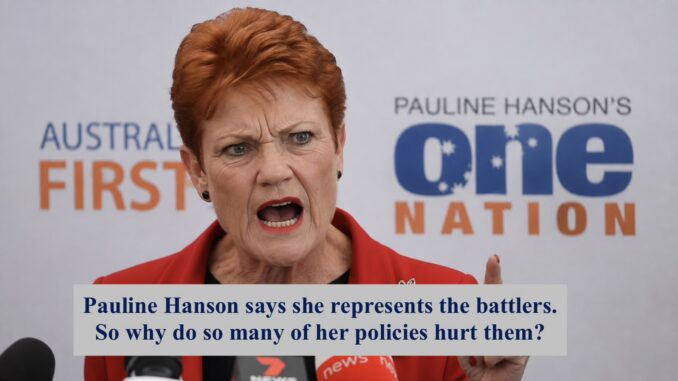
Pauline Hanson has built a remarkably successful political career out of telling Australians that she speaks for ordinary people.
The battlers.
The forgotten.
The Australians who work hard, pay their taxes and supposedly get nothing in return.
It is an extraordinarily effective political message because there really are millions of Australians who feel that the political system has forgotten them.
They are struggling with mortgages and rents. They are watching grocery bills rise. They are worried about electricity prices. They are trying to get their children into a home. They are working two jobs. They are wondering whether their wages will ever catch up with the cost of living.
And they are angry.
Pauline Hanson understands that anger.
But there is an important question that deserves rather more attention than it receives:
What if the policies being offered to the battlers don’t actually make their lives better?
Because once we move beyond the slogans about immigration, multiculturalism and “putting Australians first”, One Nation’s economic and social policies start to look rather different.
And, rather awkwardly for a party that claims to represent working Australians, some of those policies appear to favour the interests of employers, higher-income households and the fossil-fuel industry rather more than they favour the people at the bottom and middle of the income ladder.
Let’s take a look.
The workers who apparently need protecting – from their own wages
Perhaps the clearest example is industrial relations.
One Nation has been increasingly vocal about the need to overhaul Australia’s workplace laws.
At her National Press Club address in June, Hanson complained that businesses were unable to sack workers and described some employees as “lazy”. She has also questioned workplace entitlements and suggested that some protections could be wound back. One Nation has opposed recent improvements to workplace rights, including wage-theft legislation and same-job-same-pay laws.
That is an interesting position for a party supposedly devoted to the battler.
Because the battler is rather more likely to be the person receiving the wage than the person signing the pay cheque.
If you are a nurse, cleaner, truck driver, teacher, factory worker, childcare worker, retail assistant, builder, hospitality worker or aged-care employee, workplace protections are not an abstract ideological issue.
They are the difference between having bargaining power and having very little.
And when the Fair Work Commission awarded a 4.75 per cent increase to modern award wages and a 6 per cent increase in the national minimum wage from July 2026, One Nation was on the wrong side of that argument. The increase affects millions of Australian workers.
That matters.
A politician doesn’t become a champion of working people simply by calling them “battlers”.
At some point, you have to ask whose side they are actually on when the pay packet is being negotiated.
What about the family on $80,000?
One Nation’s proposed tax system provides another fascinating example.
The party wants couples with at least one dependent child to be able to combine their incomes and split them equally for tax purposes.
On the surface, that sounds wonderful.
More money in the family budget!
But there is a catch.
Income splitting disproportionately benefits households where one person earns substantially more than the other.
Imagine a household in which one parent earns $200,000 and the other earns nothing. Splitting that income between the two parents before tax is calculated can produce a substantial tax saving.
Now compare that with two parents each earning $50,000.
There is little or no equivalent windfall.
In other words, the larger the disparity in household incomes, the greater the potential benefit.
One Nation itself gives an example of a single-earner household on $120,000 saving $9,533 a year under its proposal. That sounds impressive until you remember that many Australian battlers do not have a $120,000 single income to begin with.
The policy has also been estimated to cost around $32 billion over four years.
So we have a rather peculiar definition of helping battlers:
Give the biggest tax benefits to households with the greatest taxable incomes, while the government forgoes tens of billions of dollars in revenue.
That money has to come from somewhere.
Which brings us to the next problem.
The great $90 billion spending cut
One Nation says it can find enormous savings in government spending.
The party has talked about cutting Commonwealth expenditure by around $90 billion a year.
That sounds fantastic if you imagine government spending as nothing more than politicians throwing money into a furnace.
But governments spend money on things:
- Hospitals.
- Medicare.
- Schools.
- Aged care.
- Disability services.
- Defence.
- Roads.
- Public servants.
- Social security.
- Health research.
- Childcare.
- The NDIS.
And a thousand less visible things that people only notice when they disappear.
If you promise to remove $90 billion from the budget, the obvious question isn’t:
“Wouldn’t it be nice to save $90 billion?”
It is:
“Which $90 billion?”
One Nation has not provided anything remotely resembling the level of detailed costing required to demonstrate that such cuts could be made without affecting services ordinary Australians depend upon.
And that becomes even more difficult when we consider another of its proposals.
One Nation wants to spend more on defence
One Nation wants defence spending increased to 3.5 per cent of GDP.
That is an enormous commitment.
It is also rather difficult to reconcile with the promise to slash government spending.
The economic analysis reported by the ABC notes that One Nation’s major commitments – including increased defence spending, income splitting, indexing tax brackets to inflation and pursuing zero net migration – could create enormous budgetary pressures.
There is nothing inherently wrong with wanting a stronger defence force.
But if you’re going to tell a pensioner that government spending needs to be slashed, a young family that it needs to tighten its belt and a worker that wage increases are too expensive, you probably need to explain why defence suddenly gets a very large exception.
Housing: the problem isn’t solved by shouting “immigrants”
One Nation has made immigration central to its housing argument.
The party proposes an annual migration cap of around 130,000 and argues that lower migration will reduce pressure on housing and infrastructure. It also wants to prevent foreign ownership of residential property and has proposed measures including changes to GST on building materials.
There is a legitimate discussion to be had about the relationship between population growth, housing supply and infrastructure.
But immigration is not the entire housing crisis.
And telling Australians that the housing shortage can essentially be solved by stopping foreigners from buying houses is politically convenient but economically incomplete.
The more interesting One Nation proposal is its plan for 30-year fixed mortgages at 5 per cent through Australia Post, funded by abolishing the government’s $11.5 billion Housing Australia Future Fund.
Economists have questioned the risks of putting those mortgage risks onto the government’s balance sheet, particularly during a housing downturn.
Again, the battler deserves more than a slogan.
If the government takes on enormous financial risk to make mortgages cheaper, taxpayers ultimately carry that risk.
And taxpayers include the battler.
Cheaper petrol sounds wonderful. Until you ask what happens next.
One Nation wants to halve the fuel excise.
That is easy to understand.
Petrol is expensive.
Cutting the tax should make petrol cheaper.
Excellent.
Except that fuel excise is also government revenue.
And if you simultaneously promise enormous tax cuts, huge spending cuts, increased defence expenditure, cheaper mortgages and cheaper energy, somebody eventually has to produce the calculator.
One Nation also wants to scrap net zero, abolish the Department of Climate Change, withdraw from the Paris Agreement and dramatically expand Australia’s use of coal and gas.
The party says this will reduce energy prices.
But the important question is not whether coal and gas are cheaper to produce.
It is whether that automatically translates into permanently cheaper electricity for Australian households.
One Nation has promised a 20 per cent reduction in energy prices but, according to the ABC, has not provided a detailed timetable or mechanism capable of demonstrating how that target would be achieved.
And there is another issue.
The people most vulnerable to rising energy costs are generally not the wealthy.
They are the people living in older houses, renting, struggling to pay their bills and least able to absorb another price increase.
Climate policy isn’t just about polar bears and carbon dioxide.
It is also about the future cost of electricity, insurance, food, water, infrastructure and housing.
The gas industry gets a very different kind of battler treatment
One Nation’s latest gas policy is particularly revealing.
It proposes giving oil and gas exploration a 30 per cent rebate while allowing the Commonwealth to take an equity stake in projects. It also wants to abolish the Petroleum Resource Rent Tax for new projects and replace it with a royalty.
There is an argument for Australians receiving a greater share of the wealth generated by Australia’s natural resources.
In fact, that is an argument I suspect many Australians would support.
But there is a difference between ensuring Australians receive a fair return from their resources and providing substantial incentives to the companies extracting those resources.
One Nation’s proposal would see taxpayers sharing both the profits and the risks of investment.
And if the Commonwealth is going to become an equity partner in gas projects, Australians aren’t merely collecting a cheque when things go well.
They are also exposed when things don’t.
It is worth asking why the party that worries so much about government spending is so enthusiastic about government becoming a business partner in the fossil-fuel industry.
And then there is health
One Nation’s health policies should concern anyone who believes government has a responsibility to protect Australians from unsafe medicines and medical products.
The party wants to abolish the Therapeutic Goods Administration, the national regulator responsible for approving medicines and therapeutic goods.
It also wants to review around $3 billion worth of medicines approved for the Pharmaceutical Benefits Scheme during the pandemic.
There is certainly nothing wrong with scrutinising government agencies.
But abolishing the country’s principal medicines regulator is a rather more radical proposition.
For the battler, the question is simple:
Who do you want standing between you and a pharmaceutical company selling you a medicine?
A regulator accountable to the Australian public?
Or the market?
The same question applies to One Nation’s position on abortion.
The party describes itself as pro-life, wants to reduce gestational limits and has supported attempts to restrict access to abortion.
People can have legitimate moral disagreements about abortion.
But the point is that these policies affect ordinary women, particularly those who cannot afford to travel interstate or overseas to obtain healthcare.
Again, the battler is not necessarily the person making the policy.
They are the person living with it.
Immigration: the policy that hides everything else
This brings us to the issue that has propelled One Nation to its current level of support.
Immigration.
One Nation proposes a dramatic reduction in migration, an eight-year citizenship waiting period, changes to student visas, temporary protection visas and withdrawal from the UN Refugee Convention.
More recently, the party has promoted a 130,000 annual migration cap.
But even here there is an extraordinary degree of uncertainty about exactly what the number means.
Recent reporting has highlighted contradictory statements from One Nation figures about whether the 130,000 figure refers to net overseas migration, permanent visas or something else – and whether some categories of workers would sit outside the cap.
There is a broader economic problem too.
Australia has an ageing population and persistent shortages in particular industries.
A blanket reduction in migration may reduce some pressure on housing demand.
But it can also reduce the supply of workers.
And if you reduce the number of people available to work in industries that already have shortages, wages and prices don’t necessarily behave the way politicians promise.
Sometimes the result is simply fewer workers, higher costs and slower economic growth.
That is why immigration policy needs to be considerably more sophisticated than:
“There are too many immigrants.”
So who exactly is the One Nation battler?
This is the question I keep coming back to because there is a curious contradiction at the heart of One Nation.
The party talks constantly about ordinary Australians.
Yet when it comes to wages, it has opposed measures designed to strengthen workers.
When it comes to taxation, its income-splitting policy offers particularly large benefits to some higher-income households.
When it comes to government spending, it promises enormous cuts while simultaneously proposing enormous new commitments.
When it comes to housing, it offers solutions whose financial risks could ultimately fall on taxpayers.
When it comes to energy, it promises cheaper power without providing a convincing mechanism for achieving it.
When it comes to natural resources, it wants government to become a financial partner to the gas industry.
When it comes to health, it proposes dismantling a national medicines regulator.
And when it comes to migration, it offers a remarkably simple answer to a remarkably complicated problem.
None of this means that every One Nation policy is necessarily wrong: some are perfectly reasonable subjects for debate.
Australians should receive a fair return from their natural resources.
Government waste should be eliminated.
Housing affordability needs urgent attention.
Energy needs to be reliable and affordable.
Immigration needs to be sustainable.
Small businesses do need to be able to employ people and operate profitably.
These are not radical propositions, but politics isn’t about whether the problem exists – it is about who pays for the solution.
And that is where the One Nation brand becomes much more interesting.
The politics of making people angry
Perhaps Pauline Hanson’s greatest political achievement is that she has become extraordinarily good at identifying what makes people angry:
- Immigrants.
- Politicians.
- “Elites.”
- Climate policies.
- Government bureaucracy.
- Political correctness.
- The ABC.
- Multiculturalism.
- The United Nations.
The list is long.
And some of those grievances are shared by millions of Australians, but anger is not an economic policy. Nor is identifying someone to blame.
A battler who is paying $700 a week in rent doesn’t necessarily become better off because a politician tells them an immigrant is responsible.
A worker struggling to pay the mortgage doesn’t necessarily get a pay rise because a politician promises to make it easier for an employer to sack people.
A pensioner doesn’t necessarily become wealthier because the government cuts a department.
And a family struggling with electricity bills doesn’t necessarily become better off because politicians announce that net zero has been abolished.
The battler needs something much less exciting:
- A decent wage.
- A secure job.
- Affordable housing.
- Reliable healthcare.
- Good schools.
- Affordable energy.
- A social safety net when things go wrong.
And a government capable of paying for all of it.
That is much harder than identifying an enemy.
The inconvenient truth
Pauline Hanson may genuinely believe she is standing up for ordinary Australians.
Her supporters certainly do.
But political sincerity isn’t enough.
The policies need to be judged by their consequences.
And when we do that, an uncomfortable possibility emerges.
Perhaps One Nation doesn’t represent the Australian battler nearly as much as it represents the Australian battler’s anger.
Those are two very different things.
One asks:
“Who can I blame?”
The other asks:
“What will actually make my life better?”
The first is enormously powerful politics.
The second is enormously difficult politics.
And if Australians are going to decide whether Pauline Hanson really represents them, perhaps they should do something politicians of every persuasion would rather they didn’t.
- Ignore the slogans.
- Ignore the outrage.
- Ignore the flags.
- Ignore the enemies.
- Ignore the memes.
- Read the policies.
Then ask one very simple question:
“How much better off will I, personally, be if Pauline Hanson gets what she wants?”
For many of the Australians she calls “battlers”, the answer may be considerably less comforting than the slogan.
Keep Independent Journalism Alive – Support The AIMN
Dear Reader,
Since 2013, The Australian Independent Media Network has been a fearless independent voice – holding power to account and delivering journalism that matters.
Running this site isn’t cheap. Rising costs mean we need your support now more than ever. Every donation, big or small, keeps our servers running, our writers working, and our stories free for everyone.
Donate here:
PayPal or credit card – just click on the Donate button below
Direct bank transfer: BSB: 062500; A/c no: 10495969

We’ve also set up a GoFundMe as a dedicated reserve fund for hosting and future improvements.

Thank you for standing with us. We couldn’t do this without you.
With gratitude,
The AIMN Team

Naughty Michael, asking voters to read the PHONeys policies …..there are none!!
It is easy to be a ”One Nation Battler” (better described as a ”PHONey battler”) when you have become a millionaire on the public purse by grifting for decades, while doing nothing substantial for any electorate except WHINGE, WHINGE WHINGE.
How many millions has Pawlein received as salary during her time in Parliament, including access to the Parliamentary Allowances Scheme while not forgetting her sole access to the PHONey party funds extracted from aspiring candidates paying huge ”joining fees” and purchasing from exclusive suppliers of polling materials in which Handjob is reported to have an interest??
Methinks the whingeing is for media effect because there are only unthinking jibes mimicking the bleats from the bosses with whom this Ipswich former fishmonger now identifies.
Well, let them have their Pauline!
They haven’t noticed where this sort of politics leads a community, watching in the USA over the last decade or two.
Most of it follows imported think tank formulas and Trump ought to be the exemplar, not the silly sort of Ned Kelly stuff Rinehart and Hanson play at.
If many Australians are as stupid as MAGAS, let them have their Pauline.
But they are only here because of the loss of respect for Labor.
Hanson, plain and simple, bent and shitty, stands, sits, takes for self, for injured image, for money beyond her former reach or imagination, all by simpleton sulking, then the grabbing, conniving, scheming. She once earned a plain living, so good for that, But, one does not do well dreaming of a cutprice butcher for your heart surgery. Hanson avoids work in the senate, her duty, because she cannot read or comprehend well. No law, economics, social science, just simplicity under- education. She could not draft a bill nor add required inputs of law, finance, nothing relevant. Effectively she is a fraud in public life, barely a symbol of universal anti-establishment diarrhoeic discharge, ughh. And, she has inferior bludging, parasitic colleagues…a humanish skipful of site rubbish, useless.
Poolean has never released an actual policy in the entire time she has been in parliament. Rather she tells policy stories, just a bunch of made-up stuff with zero research, zero details, zero fact checking and very little thought. You could also call them thought bubbles. Just like the Lieberals anytime a journo would ask her for any actual details on her thought bubbles she will give the standard answer of “we will release the details just before or after the election”.
When one looks closely at these thought bubbles it is quite clear to see there is no real support for battlers, in fact it is all about taking everything away from the battlers.
The fact that she is so overt in her support of Trump……………do her supporters not read any news at all, have they not seen what he has done to America in less than 2 years???? Cutting virtually all aid programs, disemboweling the majority of government departments, so much corruption and cronyism, literally crapping on the entire rest of the world, wars, gigantic tax cuts for super rich people, the list just goes on and on and on. This is what Poolean wants for us, none of which even remotely resembles support for battlers.
Oh PP, you’ve done it again!! Encapsulating the very shifty former Ipswich fishmonger in beautiful language that accurately describes her as a self-serving financial parasite.
Might be an idea for all the Hanson supporters put a few minutes together to do some reading
Oh and well done getting rid of that horrid banner add.
Thanks, David.
I haven’t rid the site of it fully as yet, but with every tuft of hair I pull out I am overcome with a warm, fuzzy feeling that I can’t be too far away from success. Our tech advisor predicts it’ll be fully gone within 48-72 excruciating hours.
Because The AIMN is broke we will be adding a short promo video to some articles. These will start playing when you open an article and once you scroll past it the video will shrink and put itself in the bottom corner of the screen. They have pleasant music, btw.
You can preview it here:
https://theaimn.net/autonomous-weapons-and-killer-robots-new-warnings-old-habits/
If you don’t like the music just click on the mute button in the top right-hand corner.
… 30-year fixed mortgages at 5 per cent through Australia Post, funded by abolishing the government’s $11.5 billion Housing Australia Future Fund
I’m trying to work out why the banks and other obscenely profitable financial institutions shouldn’t be made to offer loans on those terms. Also, that policy does nothing to increase housing stock, it just pushes demand.
People can have legitimate moral disagreements about abortion
Until you are experiencing an unwanted, non-viable, and/or life-threatening pregnancy, your moral disagreement means the square root of SFA. Not your body, nothing to do with you.
How much better off will I, personally, be if Pauline Hanson gets what she wants?
Better still, ask how much better off will the country be. Ask who really benefits. And, most of all, ask who pays the price.
Michael: Is there a simple way for me to make the occasional irregular donation? Won’t be much or often, but every little bit helps, right? I’ve tried a couple of times previously, but WordPress just wouldn’t let it happen.
Hello, leefe. I can answer that for you:
At the bottom of each article there are links to payment options (PayPal, credit card or GoFundMe), or if you don’t use any of them you can transfer funds directly into The AIMN’s bank account. The BSB and account number are just above the donate button.
Some people have experienced difficulty with the bank transfers thanks to the CBA being pedantic, while others have no trouble at all. If you do choose that way – and get the bank when it’s in a funny mood – let us know. Our email is admin@theaimn.com
I appreciate your gesture. That is very kind of you.
I think Leefe is right.
I have bad problems with codes and payins…must be getting old and dotty..
The UN, through the IPCC, have made it clear, there should be no new gas and coal fields period, if climate change is to be addressed seriously.
There is an argument that the sites that might contain new gas, oil and coal fields are the sites that have a high risk attached, that’s why they haven’t been explored and developed already. As Michael pointed out One Nation’s policy would amount to that risk being shared with the government.
Congratulations Michael, this is a masterpiece in discussing One Nation.
It doesn’t denigrate anyone, it doesn’t dismiss anyone, it addresses the beliefs rationally and with respect. Well done.
Throughout my life, there have been two things that you’re not supposed to bring up in conversation – politics and religion.
Australians don’t seem good at discussing politics (guilty as charged).
Those who should know seem to be saying, that with the amount of misinformation and disinformation about, that people are forming their views by talking to friends and family.
This piece raises questions about One Nation’s philosophies/policies that could be raised in such conversations. I say questions, as I believe telling someone ‘you’re wrong, this is how it is’ wouldn’t be useful in such situations.
Ieefe, they are two great points that you make – one on the mortgage policy and one on the abortion policy. The third point I agree with personally, but I don’t think many others feel that way.
These right-wing people want to spend more on defence because that will suck funds away from social programs.
She’s a symptom of our RW MSM & Inc ABC, she uses, like many of the far right, Orwellian doublespeak to confuse and mislead many older &/or low info regional voters…..and never called out.
Ian Joyner,
is Labor’s reason for spending more on defence because it will suck funds away from social programs too?
Thommo, so glad to meet and hope you and Ian do well..
Cheers Paul.
Plainly and simply, The only battler the Red Witch represents (the rest are to be, à la her orange hero, bled dry of cash) is that obscene true ‘strayan hero Gina. Gina gives lots and lots of money and free holidays, amongst other things, to Poorween and the lamprey attached to her bank accounts. So she’ll keep dropping to her knees and prostrating herself before the throne whenever the nasty ogre snaps her fingers. The money is just too good to pass up.
Anything that Hanson talks about is all noise and cherry picking sore spots.
The truth of the matter is that Governments, regulators, legislators, lawyers, courts and magistrates decide ‘pre income distribution’ of who gets what, and who’s not entitled.
The whole upper regulatory system has been entrenched and needs dismantling and that also includes the taxation system which is broken, its all top heavy and broken.
Well, I can’t agree that One Nation don’t have any policies. After researching Pauline’s inarticulate and incoherent utterances I find that her most pressing policy is that she wants to reduce Excise tax on smokes by 75% (quickly followed by the coalition who have gone for 80%). They want smokers to have a more level playing field so that they can choose between legitimate outlets and those run by organised crime.
Now that’s democracy in action and the good thing is, whichever way it goes, big tobacco are the winners !
Terry,
And they would so thrilled that they would shower cash galore all over the Red Witch and Angus, if he’s still around that is.
Carol and/or Michael, I’ll be sending a double donation this month to make up for the one I missed last month.
@ Terry Mills: Well, that is logical in a PHONeys sort of way. It has been long known that smoking causes more health problems that cost more to rectify than the value of the tobacco excise gathered each year by the feral government.
So by decreasing tobacco price you increase government spending on medical care in our over-flowing hospital system that receives no donations from the PHONeys funds.
Much more important for Australian voters to be medically incapacitated so that the NDIS fraudsters can exploit the government coffers to their heart’s delight.
@ heather: What?? Fix the tax system?? And expect the self-entitled big salary earners to willingly pay their fair share of running the country?? This is NOT Norway!! We follow the US model of ”rip-off the workers” to keep wealth in the hands of those who know how to spend it upon themselves.
@ NEC, quite the point don’t you think?
It can be done, all it needs is political will or they will be dragged along kicking and screaming, as is the current case.
One Nation’s rhetoric/policies on the environment are not likely to endear them to an organization like Environment Victoria, so it would be nice to have confirmation from another source, but for what it is worth:
“When Pauline Hanson turned up at Loy Yang this week, Adrian Cosgriff was there.
Adrian has lived in Gippsland his whole life, and spent years working in the power industry. He knows the Latrobe Valley, and its communities.
And he was insulted.
“She was there for half an hour. I found it super disrespectful to the people of the Latrobe Valley. This was just another interstate politician dropping in for a photo op, making promises she’ll never keep and then she was gone.”
For Adrian, it wasn’t just a political announcement. It was another example of politicians playing political football with the lives of people in the Latrobe Valley, while ignoring the voices of those who actually live there.”