Part 7 – The Business of Enough
The Most Dangerous Word in the Economy
Dad’s Test
Did I have this problem five minutes ago?
Who benefits if I believe I do?
What happens if I simply say… “No thanks.”
Well…
This was supposed to be a four-part series.
Like every respectable modern project, it exceeded both its original scope and, had anyone been paying me, its original budget.
Apparently feature creep isn’t confined to software.
We’ve spent six articles talking about dissatisfaction.
Consumption.
Outrage.
Productivity.
Replacement.
Philanthropy.
Each article kept arriving at exactly the same destination.
Incentives.
People respond to incentives.
Markets respond to incentives.
Governments respond to incentives.
Algorithms respond to incentives.
Politicians respond to incentives.
Media organisations respond to incentives.
Apparently even my toothbrush is responding to incentives.
It keeps asking for firmware updates.
But there’s one word modern economies don’t seem entirely comfortable with.
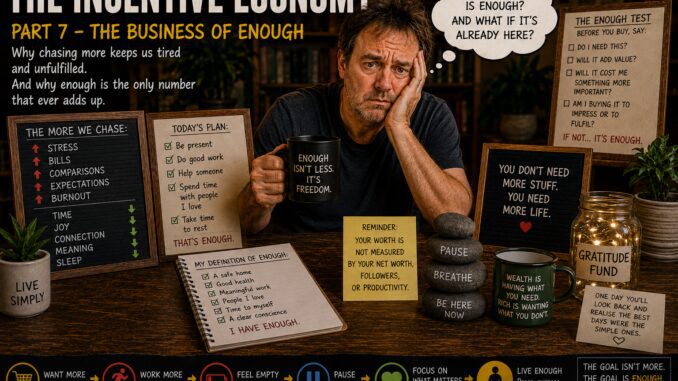
Enough.
Enough is a dangerous word.
Imagine the quarterly earnings call.
CEO:
“We’re delighted to announce our customers now own everything they genuinely need.”
Silence.
A nervous cough.
Someone from Marketing quietly faints.
Growth is wonderful.
Until growth becomes compulsory.
Consumption is wonderful.
Until consumption becomes identity.
Productivity is wonderful.
Until people become consumables.
Innovation is wonderful.
Until replacement becomes the business model.
Outrage is useful.
Until outrage becomes entertainment.
Philanthropy is admirable.
Until philanthropy quietly substitutes for justice.
Somewhere along the way we became extraordinarily good at asking,
“What else can we sell?”
Perhaps we forgot to ask,
“What would actually make life better?”
They’re different questions.
I’ve often wondered what would happen if governments measured success differently.
Not simply GDP.
Not simply productivity.
Not simply shareholder returns.
Imagine if every policy had to answer one question.
Will this leave people with more time?
More security?
Better health?
Stronger communities?
A cleaner environment?
Children who expect a better future?
Now there’s a KPI.
I don’t have many answers.
In fact, this series has mostly been questions disguised as humour.
Because questions are strangely underrated.
Good questions make us think.
Bad answers merely end conversations.
I still buy things I don’t need.
Sometimes because they’re useful.
Sometimes because they’re shiny.
Sometimes because Amazon quietly suggested that people who bought a screwdriver apparently required an inflatable kayak.
Reader…
…they were very persuasive.
I still cut open toothpaste tubes.
Not because my Scottish ancestors demand it.
Although I’m fairly sure one of them occasionally whispers,
“Lachlan… there’s another two brushings in there…”
No.
I do it because it’s my tiny, ridiculous protest against a culture that quietly teaches us to throw things away before they’re actually finished.
Will it save the world?
Almost certainly not.
Will it make me smile?
Usually.
Sometimes that’s enough.
Douglas Adams understood something most economists occasionally forget.
Humans are gloriously irrational.
We laugh.
We love.
We invent tea.
We write poetry.
We waste entire afternoons talking to friends.
None of those activities maximise quarterly earnings.
Thank goodness.
Jacques Peretti’s documentaries taught me something else.
Don’t begin with,
“Who’s the villain?”
Begin with,
“What are the incentives?”
Because once you understand incentives…
…a surprising amount of the modern world starts making sense.
So perhaps Dad’s theory needs one final update.
Businesses once made things people needed and advertised them.
Then they made things people didn’t need and advertised them until people thought they did.
Today we sometimes create problems…
… sell the cure…
… measure the cure…
… replace the cure…
… argue about the cure online…
… and then buy a subscription to help us cope with the stress caused by discussing the cure.
Honestly…
… it’s almost impressive.
This series has never been an argument against business.
Business has achieved extraordinary things.
Nor has it been an argument against wealth.
Or technology.
Or advertising.
Or innovation.
It has simply been an argument for remembering something we already know.
Systems produce what they reward.
If we reward outrage…
we’ll manufacture outrage.
If we reward endless consumption…
we’ll manufacture endless consumption.
If we reward impossible workloads…
we’ll manufacture burnout.
If we reward replacing rather than repairing…
we’ll manufacture waste.
If we reward generosity while ignoring injustice…
we’ll manufacture more need for generosity.
Perhaps that’s why Dad’s Test has stayed with me.
It’s wonderfully simple.
Before buying.
Before sharing.
Before panicking.
Before clicking.
Before becoming outraged.
Pause.
Ask.
Did I have this problem five minutes ago?
Who benefits if I believe I do?
What happens if I simply say…
“No thanks.”
Sometimes you’ll still say yes.
I certainly do.
But every now and then you’ll discover something quietly liberating.
You already had enough.
Epilogue
There’s one final incentive worth mentioning.
Curiosity.
Curiosity doesn’t trend very well.
It rarely goes viral.
It doesn’t shout.
It doesn’t panic.
It doesn’t demand your immediate attention.
It simply asks another question.
Perhaps that’s why it’s so valuable.
Homework (Entirely Optional… But Highly Recommended)
If you’ve made it this far, you’ve earned your homework.
Jacques Peretti
- The Men Who Made Us Fat
- The Men Who Made Us Thin
- The Men Who Made Us Spend
- The Super-Rich and Us
- Britain’s Trillion Pound Island
Adam Curtis
Other documentaries
Watch them.
Disagree with them.
Argue with them.
Question them.
Just don’t consume them passively.
Because that would rather undermine the point.
Dad’s Test
Did I have this problem five minutes ago?
Who benefits if I believe I do?
What happens if I simply say…
“No thanks.”
And perhaps one final question.
What if the most revolutionary thing any of us could occasionally say…
… is simply,
“I have enough.”
See also:
The Incentive Economy: Part 1 – The Business of Dissatisfaction
The Incentive Economy: Part 2 – The Business of Consumption
The Incentive Economy: Part 3 – The Business of Outrage
The Incentive Economy: Part 4 – The Business of Productivity
The Incentive Economy: Part 5 – The Business of Replacement
The Incentive Economy: Part 6 – The Business of Philanthropy
Keep Independent Journalism Alive – Support The AIMN
Dear Reader,
Since 2013, The Australian Independent Media Network has been a fearless voice for truth, giving public interest journalists a platform to hold power to account. From expert analysis on national and global events to uncovering issues that matter to you, we’re here because of your support.
Running an independent site isn’t cheap, and rising costs mean we need you now more than ever. Your donation – big or small – keeps our servers humming, our writers digging, and our stories free for all.
Join our community of truth-seekers. Please consider donating now via:
PayPal or credit card – just click on the Donate button below
Direct bank transfer: BSB: 062500; A/c no: 10495969

We’ve also set up a GoFundMe as a dedicated reserve fund to help secure the future of our site.
Your support will go directly toward covering essential costs like web hosting renewals and helping us bring new features to life. Every contribution, no matter the size, helps us keep improving and growing.
Thank you for standing with us – we truly couldn’t do this without you.
With gratitude, The AIMN Team

I am sorry to say that I have not read the previous 6 articles. I was drawn to this one because of that radical word ENOUGH. Does Mr McKenzie not understand that this is the most outrageous, dangerous, revolutionary, word in our language?. Materialism is utterly embedded in our culture. So much so, that we feel impelled to give material gifts to show our affection. So much so, that right now, in school holidays, kids see SHOPPING as a fun activity, better that sport, games, other activities. Although I am not religious, I can see that, long ago, St Francis of Assissi made the choice to give away everything, and the result was that he developed a power and influence that lasts to this day. McKenzie should be locked up, for that nefarious idea – it it were implemented, it would overturn our entire culture and civilisation – we might even start being really good to all the other creatures on this planet, as well as to each other,and become as weird as St Francis.
Noel, I fear you may be the first to expose my revolutionary tendencies. I suspect I’m already on several watchlists. Many years ago, before I stopped going to McDonald’s, I was asked, “Do you want fries with that?” I replied, “No thanks… but thanks for asking.” I thought nothing of it until I heard laughter from inside. Apparently, politely declining an upsell is rarer than one might expect. If saying “No thanks” is the first step towards “I have enough,” then perhaps I really am first up against the wall. Fortunately, as Douglas Adams taught us, I’ll bring a towel… and, just in case, my improbability drive. 😉