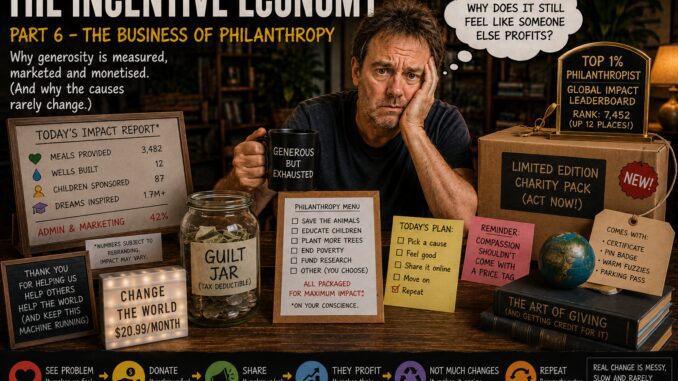
The Incentive Economy
Part 6 – The Business of Philanthropy
Saints, Sinners and Tax Deductions
Dad’s Test
Did I have this problem five minutes ago?
Who benefits if I believe I do?
What happens if I simply say… “No thanks.”
There seems to be an unwritten rule.
Once your bank balance reaches several billion dollars…
… people stop calling you wealthy.
They start calling you a visionary.
Or a genius.
Or a philanthropist.
Sometimes all three before lunch.
Here’s a strange question.
If someone becomes extraordinarily rich…
… does that automatically make them extraordinarily wise?
Apparently so.
One minute you’re selling software.
The next you’re redesigning education.
Healthcare.
Agriculture.
Democracy.
Space.
Human civilisation.
It’s quite the promotion.
Let’s begin with something important.
Philanthropy has genuinely changed lives.
Hospitals.
Medical research.
Scholarships.
Libraries.
Museums.
Disaster relief.
Food banks.
Universities.
Millions of people are alive today because someone wealthy donated money.
That deserves recognition.
Full stop.
But recognition isn’t the same thing as sainthood.
Some philanthropists are wonderful people.
Some are complicated people.
Some are deeply unpleasant people.
Some built fortunes through genuine innovation.
Some inherited them.
Some benefited from monopoly power.
Some crushed competitors.
Some fought unions.
Some lobbied against regulations.
Some externalised environmental costs.
Some aggressively avoided tax while later funding charities to tackle problems governments struggled to afford.
The word “philanthropist” tells us remarkably little.
We’ve somehow reached the point where donating one percent of a fortune often receives more publicity than the methods used to accumulate the other ninety-nine percent receive scrutiny.
That’s… interesting.
Imagine this headline:
LOCAL BILLIONAIRE DONATES $500 MILLION
Wonderful.
It should be reported.
Now imagine another headline:
How was the other $49.5 billion accumulated?
Oddly enough…
That headline seems rather less fashionable.
One billionaire interviewed in The Super-Rich and Us said something refreshingly honest.
He openly discussed continually pushing more work onto people lower down the economic ladder.
Then he wondered aloud how long people would continue accepting it.
That struck me as unusually candid.
Not because he was proud of it.
Because he acknowledged the incentive.
Most discussions stop at,
“Look how generous he is.”
Far fewer continue with,
“Let’s examine the system that produced both the fortune and the need for the generosity.”
This is where philanthropy becomes fascinating.
Imagine someone underpaying workers for decades.
Lobbying against workplace protections.
Minimising tax.
Accumulating extraordinary wealth.
Then funding a magnificent children’s hospital.
Here’s the uncomfortable truth.
The hospital is still magnificent.
Children still benefit.
Doctors still save lives.
Those things remain true.
But none of them automatically erase the earlier chapters.
Good deeds deserve applause.
They shouldn’t become historical white-out.
Then there’s influence.
Money buys many things.
One of them is choice.
A billionaire can decide whether hundreds of millions go towards:
Malaria research.
Opera.
Private schools.
Public libraries.
Climate research.
Space exploration.
Political think tanks.
Artificial intelligence.
Medical science.
That’s remarkable.
It’s also power.
Unelected.
Unaccountable.
Sometimes used magnificently.
Sometimes disastrously.
Always worth examining.
Here’s something else I’ve noticed.
When ordinary people pay tax…
… they rarely receive statues.
When wealthy people fund a building…
… their name often appears in letters large enough to be seen from space.
Perhaps there’s a lesson in branding.
Some people argue,
“If they’re giving money away, stop complaining.”
Fair enough.
Here’s my response.
I’m not complaining about generosity.
I’m asking questions about incentives.
They’re different conversations.
A society can be genuinely grateful for philanthropy…
… while also asking whether the underlying system is producing outcomes we’d actually choose if we were designing it from scratch.
This isn’t really an article about billionaires.
It’s about hero worship.
History is littered with wealthy people who were romanticised in their own time…
… and reassessed rather differently later.
Money doesn’t disinfect character.
Neither does generosity.
If anything, wealth should invite more questions.
Not fewer.
Because concentrated wealth often brings concentrated influence.
Influence over politics.
Media.
Research.
Universities.
Public debate.
Sometimes quietly.
Sometimes openly.
Sometimes with wonderful outcomes.
Sometimes not.
This reminds me of Jacques Peretti’s documentaries.
He rarely says,
“Here’s the villain.”
Instead he quietly asks,
“Who benefits?”
It’s such an irritatingly good question.
Because it doesn’t care whether someone wears a business suit…
… a charity gala tuxedo…
… or a halo.
Douglas Adams would probably have loved billionaire philanthropy.
I can almost imagine him writing:
”The richest man in the galaxy generously donated a thousand hospitals after discovering that universal healthcare was becoming surprisingly expensive for everyone else.”
He’d probably have added a footnote.
The footnote would somehow be funnier than the joke.
Here’s the irony that keeps bothering me.
We celebrate the ambulance at the bottom of the cliff.
We applaud the generosity.
We admire the dedication.
Quite right too.
But every so often…
Perhaps someone should quietly ask,
“Who keeps removing the fence?”
The greatest gift philanthropy can provide isn’t a building.
Or a scholarship.
Or a research grant.
It’s buying society time.
Time to solve problems properly.
The danger is when we mistake the ambulance for the road design.
So here’s Dad’s Test.
Before celebrating the generosity…
Ask three questions.
How was the fortune made?
What incentives produced it?
Would we rather solve this problem through democratic institutions…
… or by hoping another billionaire feels generous next year?
Because generosity is wonderful.
Justice is better.
And a society that depends upon extraordinary generosity might also be a society worth asking extraordinary questions about.
Homework (Entirely Optional… But Highly Recommended)
The Super-Rich and Us – Jacques Peretti
Britain’s Trillion Pound Island – Jacques Peretti
The Century of the Self – Adam Curtis
Watch them with one question in mind.
Not…
“Are billionaires good?”
Nor…
“Are billionaires bad?”
Instead ask the only question that has quietly threaded its way through this entire series.
What behaviour are we rewarding?
Because people respond to incentives.
Systems amplify them.
And perhaps the biggest mistake we make isn’t believing that wealthy people are all heroes…
… or all villains.
It’s believing that either question is more important than understanding the system that keeps producing them.
Continued tomorrow
See also:
The Incentive Economy: Part 1 – The Business of Dissatisfaction
The Incentive Economy: Part 2 – The Business of Consumption
The Incentive Economy: Part 3 – The Business of Outrage
The Incentive Economy: Part 4 – The Business of Productivity
Keep Independent Journalism Alive – Support The AIMN
Dear Reader,
Since 2013, The Australian Independent Media Network has been a fearless voice for truth, giving public interest journalists a platform to hold power to account. From expert analysis on national and global events to uncovering issues that matter to you, we’re here because of your support.
Running an independent site isn’t cheap, and rising costs mean we need you now more than ever. Your donation – big or small – keeps our servers humming, our writers digging, and our stories free for all.
Join our community of truth-seekers. Please consider donating now via:
PayPal or credit card – just click on the Donate button below
Direct bank transfer: BSB: 062500; A/c no: 10495969

We’ve also set up a GoFundMe as a dedicated reserve fund to help secure the future of our site.
Your support will go directly toward covering essential costs like web hosting renewals and helping us bring new features to life. Every contribution, no matter the size, helps us keep improving and growing.

Thank you for standing with us – we truly couldn’t do this without you.
With gratitude, The AIMN Team

Very good.
Philanthropy…often predicated on guilt..something akin to buying your way into heaven through a plenary indulgence, to make up for a litany of sins.The Church of Rome didn’t wax rich through philanthropy,just smart business decisions.
Then there are other filthy rich bastards who wouldn’t give you the steam off their shit, and we all know who they are.
I’m sure we’d all be better off if a managerial, parental, overseeing, patronlike, sharing and caring role was the normal outlook, and NOT the outlook of the Trumpshits, the Musk, Bezos, Suckerberg types, being ruthless owners, drivers, oppressors, conquerors. Domineering, sneering ultracapitalist bullying, disgraceful in its recently revived upsurge, is foul, immoral, evil, antisocial, incompatible with social harmony. To have and hold democracy, we must ignore USA Trumpery dogshit attitude and seek sufficient wisdom, harmony, decency and diplomatic outlook to overcome the rottenness of superstition, prejudice, Hansonite ignorance.
In a better society, nobody’s wellbeing would depend upon the generosity of strangers. Justice would ensure people had what they needed as a matter of right. Generosity would still exist—but it would be the icing on the cake, not the cake itself.
A society that relies on philanthropy to provide essential services may simply be outsourcing justice to goodwill. Goodwill is admirable. But it is voluntary, uneven, and impossible to guarantee.
Depending on generosity isn’t necessarily compassionate. Sometimes it becomes an excuse for avoiding the harder work of building institutions that don’t require extraordinary acts of kindness simply to function.
The goal of a healthy society should never be to produce more—or fewer—philanthropists. It should be to reduce the number of people whose wellbeing depends upon philanthropy in the first place.
Generosity will always have a place. But justice should come first. A society where people flourish because their rights are protected is stronger than one where they flourish only because someone wealthy happened to feel generous.
I loved reading the comments. Thank you so much! 😊🙏