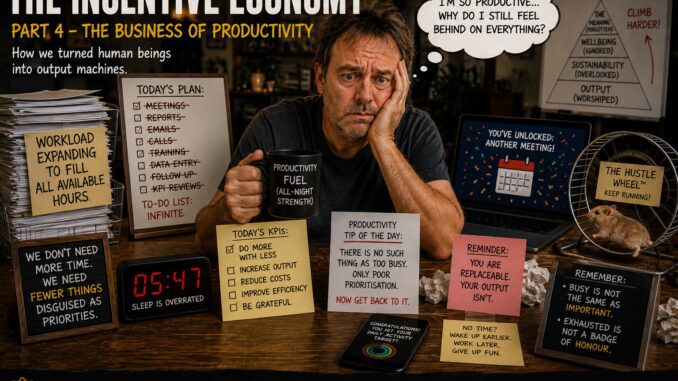
The Incentive Economy
Part 4 – The Business of Productivity
Working Harder So the Spreadsheet Feels Better
Dad’s Test
Did I have this problem five minutes ago?
Who benefits if I believe I do?
What happens if I simply say… “No thanks.”
Congratulations.
You’ve made it to Part 4.
Please complete this mandatory learning module before continuing.
Estimated completion time:
3 minutes.
Actual completion time:
47 minutes.
There will also be a short quiz.
Nobody knows why.
Productivity has become one of those wonderful words that everyone supports…
…until you ask what it actually means.
Apparently productivity means doing more.
With less.
In less time.
For less money.
While smiling.
Somewhere along the line we quietly stopped asking,
“How do we help people do great work?”
and started asking,
“How much more work can we fit into the same eight hours?”
They’re not remotely the same question.
Imagine buying a ute.
It comfortably carries one tonne.
Excellent.
Then management notices.
“If it carries one tonne…”
“…surely it can carry one point two.”
It struggles.
“But look!”
“It survived.”
Soon it’s carrying one point four.
Then one point six.
Eventually someone proudly announces,
“Our productivity has increased by sixty percent.”
No.
Your risk has increased by sixty percent.
The spreadsheet simply hasn’t caught up yet.
Healthcare knows this story rather well.
Teachers know it.
Public servants know it.
Police know it.
Construction workers know it.
Aged care workers definitely know it.
The workload expands.
The staffing doesn’t.
Somehow the work still gets done.
Management concludes the system is coping.
Staff conclude they’ll skip lunch again.
Those are very different conclusions.
One of my favourite management phrases is,
“We’ve streamlined the process.”
Translation:
“We’ve given Sharon two extra jobs.”
Poor Sharon.
Every organisation has a Sharon.
Then comes technology.
Every new software package arrives with exactly the same promise.
“This will save everyone time.”
Has anyone ever measured where all this saved time actually went?
Because I’d quite like some back.
We now have:
Software to manage meetings.
Meetings to discuss the software.
Emails summarising the meeting.
Teams messages reminding us to read the email.
Calendar invitations to discuss the Teams messages.
AI to summarise the meeting nobody had time to attend.
Another meeting to verify the AI summary.
Progress.
Apparently.
Don’t misunderstand me.
Technology is extraordinary.
Electronic medical records are vastly better than illegible handwriting.
GPS beats unfolding paper maps in the rain.
Video calls save enormous amounts of travel.
AI will undoubtedly improve many jobs.
But…
Technology often makes one mistake.
It assumes that because something can be measured…
… it therefore should be measured.
Peter Drucker famously said,
“What gets measured gets managed.”
True enough.
But something else also happens.
What gets measured gets optimised.
Even if it isn’t actually important.
Imagine a hospital.
One nurse spends twenty minutes comforting a frightened patient.
Another nurse clicks fifteen mandatory boxes confirming the patient has been comforted.
Guess which activity appears in the dashboard.
KPIs are wonderful servants.
They’re terrible masters.
They tell us whether we’re achieving what we decided to measure.
They say nothing about whether we chose the right thing to measure.
I’ve become increasingly convinced that organisations often confuse productivity with throughput.
They aren’t the same thing.
A sausage factory values throughput.
Healthcare values judgement.
Education values understanding.
Emergency services value outcomes.
None improve simply because the spreadsheet has become greener.
This is where incentives quietly sneak back into the story.
If managers are rewarded for activity…
they’ll optimise activity.
If executives are rewarded for reducing labour costs…
they’ll reduce labour costs.
If politicians are rewarded for announcing savings…
they’ll announce savings.
Whether the work still fits inside the working day somehow becomes…
someone else’s problem.
Usually Sharon’s.
I remember talking to colleagues who somehow managed to meet every target.
Management pointed at them.
“See?”
“It can be done.”
Then you actually speak to those colleagues.
They quietly admit they skip breaks.
Finish documentation at home.
Start early.
Leave late.
Do unpaid overtime.
The KPI wasn’t achieved by the system.
It was achieved by the goodwill of exhausted professionals.
That’s not productivity.
That’s borrowing against tomorrow.
Eventually the bill arrives.
Burnout.
Resignations.
Vacancies.
Agency staff.
Recruitment campaigns.
Wellbeing seminars.
Resilience workshops.
Curiously…
very few organisations hold seminars on reducing unnecessary work.
I sometimes wonder whether we’re measuring entirely the wrong thing.
Instead of asking,
“How much work did we complete?”
Perhaps we should ask,
“Could competent people complete this work safely, well, within paid hours, without sacrificing their own wellbeing?”
Now there’s a KPI I’d like to see.
Douglas Adams would probably have designed the perfect productivity app.
Its only function would be displaying one message.
STOP CREATING MORE WORK.
The update would introduce a dashboard.
This series keeps circling back to the same idea.
People respond to incentives.
Systems amplify them.
Reward managers for reducing headcount.
Headcount falls.
Reward organisations for impossible efficiency gains.
Work intensifies.
Reward unpaid goodwill.
Eventually goodwill runs out.
None of this requires bad people.
Just ordinary people responding to the incentives in front of them.
Perhaps the most dangerous sentence in modern management is:
“Everyone else is managing.”
Maybe they are.
Maybe they’re quietly paying the difference themselves.
Skipping breaks.
Missing family dinners.
Taking work home.
Absorbing stress.
Keeping the whole machine running through professionalism rather than sustainability.
If that’s the case…
the spreadsheet isn’t measuring productivity.
It’s measuring sacrifice.
So here’s Dad’s Test for this month.
Before announcing another productivity initiative…
ask three questions.
Did the work actually disappear?
Or did it simply move?
Who is carrying the hidden cost?
And…
what happens if we stop relying on goodwill to balance the books?
Because goodwill is like credit.
It works wonderfully.
Right up until the day it doesn’t.
Homework (Entirely Optional… But Highly Recommended)
- The Men Who Made Us Spend – Jacques Peretti
- The Century of the Self – Adam Curtis
If you’re a manager, here’s a challenge:
Walk around your workplace tomorrow.
Find the person everyone says is “coping brilliantly.”
Don’t ask them how productive they are.
Ask them one question.
“What are you no longer telling us?”
You might discover your most productive employee has actually been subsidising your organisation all along.
See also:
The Incentive Economy: Part 1 – The Business of Dissatisfaction
Keep Independent Journalism Alive – Support The AIMN
Dear Reader,
Since 2013, The Australian Independent Media Network has been a fearless voice for truth, giving public interest journalists a platform to hold power to account. From expert analysis on national and global events to uncovering issues that matter to you, we’re here because of your support.
Running an independent site isn’t cheap, and rising costs mean we need you now more than ever. Your donation – big or small – keeps our servers humming, our writers digging, and our stories free for all.
Join our community of truth-seekers. Please consider donating now via:
PayPal or credit card – just click on the Donate button below
Direct bank transfer: BSB: 062500; A/c no: 10495969

We’ve also set up a GoFundMe as a dedicated reserve fund to help secure the future of our site.
Your support will go directly toward covering essential costs like web hosting renewals and helping us bring new features to life. Every contribution, no matter the size, helps us keep improving and growing.

Thank you for standing with us – we truly couldn’t do this without you.
With gratitude, The AIMN Team

Oh dear …..Management Speak exposed for the propaganda that it is really.
Back in the mid 60s management authors were postulating the arrival of the 15 hour standard working week where ”technology” handled the missing 25 hours of the human working week.
It did not happen in Australia. Rather, bosses demanded (and received) unpaid overtime, reduction in work breaks, fought pay & OHS improvements and creamed off the additional profits ….. for their next European ”work related study trip” (that qualified for tax deductions).
I was shocked to discover that NSW teachers were once again fighting for the same working conditions that we fought for 30 years prior, while the NSW DoE Senior Executive Service (SES) creamed off the cushy desk jobs away from the chalk board and classroom stress with increased pay for less arduous work. Well, it does remove unwilling or unhappy or over-stressed teachers from the classroom where ”discipline incidents” can cause parent dramas for the boss.
A research report from the mid 60s showed that the time taken for housework using all the post WWII advances in housework technology like vacuum cleaners, washing machines and dishwashers actually INCREASED the time required to complete the same list of tasks by 30 minutes a day. Well, that is ”progress”.
It seems to me that ”KPIs” are the new bull whip used by ”administrators” to justify their exalted position within the organisation. What ever happened to ”profit sharing with the workers”? Yep!! Only administrators are considered for this largesse from the bosses.