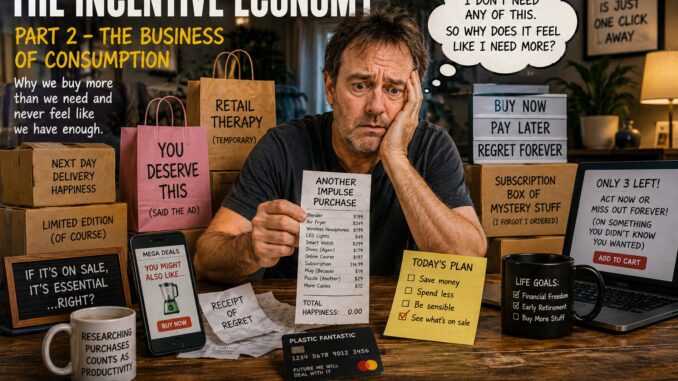
The Incentive Economy
Part 2 – The Business of Consumption
Buy Now. Think Later.
Dad’s Test
Did I have this problem five minutes ago?
Who benefits if I believe I do?
What happens if I simply say… “No thanks.”
Dad’s Test worked rather well after Part 1.
So naturally I decided to ignore it.
I opened Amazon.
Five minutes later I owned a gadget I’d never previously imagined existed.
Apparently my life had been missing a rechargeable magnetic silicone cable organiser.
It arrived the next morning.
My life remains largely unchanged.
There was a time when shopping required effort.
You drove somewhere.
Found a parking space.
Walked around.
Picked something up.
Looked at the price.
Asked yourself,
“Do I actually need this?”
Sometimes the answer was no.
You went home.
Modern shopping has very thoughtfully removed every one of those inconvenient obstacles.
Now…
One click.
Tomorrow’s delivery.
Buy now.
Think later.
In fact, don’t think at all.
We’ll do the thinking for you.
People who bought socks also bought a drone.
People who bought toothpaste also bought an ultrasonic plaque remover, bamboo toothbrushes, activated charcoal powder, probiotic chewing gum and a self-cleaning water flosser.
People who bought absolutely nothing yesterday somehow still receive seventeen emails reminding them they’re missing out.
The brilliance isn’t the technology.
It’s the psychology.
Every tiny barrier between desire and purchase has been sanded away.
Remember when you had to get your wallet?
Primitive times.
Now your watch can buy things.
Soon your refrigerator will order milk before you’ve realised you’re running out.
Eventually the toaster will subscribe you to artisan sourdough.
Don’t laugh.
Give it five years.
The documentary Buy Now! The Shopping Conspiracy explores this beautifully.
Not because shopping is evil.
Shopping isn’t evil.
I rather enjoy shopping.
Especially for things I actually need.
The documentary asks a more interesting question.
What happens when an economy becomes dependent upon us never feeling that we’ve bought enough?
Because “enough” is a terrible business model.
Imagine the quarterly board meeting.
“Excellent news everyone.
Customers have everything they need.
Sales have stopped.”
Somehow I don’t think the shareholders would applaud.
Then the documentary wanders into territory that’s genuinely uncomfortable.
Returns.
Unsold stock.
Warehouses.
Perfectly usable products.
Some investigations found that destroying certain goods could be cheaper than storing them, returning them or redistributing them.
Pause there for a moment.
Think about that.
Not because somebody is cartoonishly evil.
Because the economics can make destruction the rational decision.
That’s the point.
When incentives point one way, good people can end up making decisions that feel deeply wrong.
It’s not always malice.
Sometimes it’s mathematics.
This reminded me of my toothpaste.
Yes.
We’re back to the toothpaste.
I warned you.
I still cut open toothpaste tubes.
Not because my Scottish ancestors appear in ghostly form each evening whispering,
“Lachlan… there’s another three brushes in there…”
Although I refuse to rule that out entirely.
No.
It’s because throwing away useful product attached to perfectly usable packaging annoys me.
It feels… unfinished.
Like reading 95% of a novel and tossing it in the recycling.
The tiny amount of toothpaste isn’t going to save the planet.
Neither is my heroic tube surgery.
But perhaps habits matter.
Perhaps stopping to think matters.
Perhaps recognising “good enough” matters.
Then I remembered making my own toothpaste.
It actually worked surprisingly well.
It was vastly cheaper.
It produced almost no packaging.
Unfortunately it also required me to make my own toothpaste.
Reader, I am many things.
Consistently industrious before breakfast is not one of them.
Then my dental hygienist explained why certain ingredients in commercially available toothpaste are genuinely beneficial.
I listened.
Mostly because dental hygienists wield sharp instruments.
Back I went to supermarket toothpaste.
Progress isn’t always a straight line.
Perhaps that’s an important point.
This series isn’t arguing we should all become monks living in caves while fashioning toothbrushes from ethically sourced twigs.
Markets have given us extraordinary things.
Cheap electronics.
Reliable medicines.
Safer cars.
Food from around the world.
Instant communication.
The internet.
My criticism isn’t consumption.
It’s consumption becoming the objective rather than the consequence.
There is a difference.
Once upon a time businesses succeeded because they solved problems.
Now some succeed because they solve the problems created by yesterday’s solutions.
That’s an extraordinary business model.
Sell food.
Sell diet books.
Sell gym memberships.
Sell recovery supplements.
Sell wearable fitness trackers.
Sell sleep monitors because everyone is now too stressed to sleep.
One successful industry quietly creates opportunities for another.
No conspiracy required.
The incentives do the coordinating.
And then there’s packaging.
Somewhere along the way we appear to have decided that buying a USB cable requires:
A plastic pouch.
Inside a cardboard sleeve.
Inside another cardboard box.
Wrapped in protective plastic.
Delivered inside another cardboard box.
Containing enough brown paper to insulate a small cottage.
All to transport something roughly the size of a shoelace.
The recycling bin now has its own recycling bin.
Perhaps Douglas Adams would have appreciated the absurdity.
He understood something important.
Absurdity often isn’t invented.
Sometimes it’s simply reality described accurately.
So here’s Dad’s Test for this month.
Before clicking “Buy Now”…
…pause.
Ask yourself three questions.
Did I have this problem five minutes ago?
Who benefits if I believe I do?
And…
What happens if I simply say…
“No thanks.”
Sometimes you’ll still buy the thing.
So do I.
Sometimes you’ll decide you genuinely need it.
Wonderful.
But every now and then you’ll discover something remarkable.
You already had enough.
Homework (Entirely Optional… But Highly Recommended)
Buy Now! The Shopping Conspiracy (Netflix)
The Men Who Made Us Spend – Jacques Peretti
Watch them in that order.
Then try walking through a shopping centre without mentally asking:
“Who benefits?”
I apologise in advance.
You’ll never quite look at a “SALE ENDS TODAY!” sign the same way again.
To be continued… The Incentive Economy: Part 3 – The Business of Outrage
Keep Independent Journalism Alive – Support The AIMN
Dear Reader,
Since 2013, The Australian Independent Media Network has been a fearless voice for truth, giving public interest journalists a platform to hold power to account. From expert analysis on national and global events to uncovering issues that matter to you, we’re here because of your support.
Running an independent site isn’t cheap, and rising costs mean we need you now more than ever. Your donation – big or small – keeps our servers humming, our writers digging, and our stories free for all.
Join our community of truth-seekers. Please consider donating now via:
PayPal or credit card – just click on the Donate button below
Direct bank transfer: BSB: 062500; A/c no: 10495969

We’ve also set up a GoFundMe as a dedicated reserve fund to help secure the future of our site.
Your support will go directly toward covering essential costs like web hosting renewals and helping us bring new features to life. Every contribution, no matter the size, helps us keep improving and growing.

Thank you for standing with us – we truly couldn’t do this without you.
With gratitude, The AIMN Team

Be the first to comment