Chapter 6: Chains, Prisons, and Frontier Brutality
Shackles as Symbols of Control
When we picture colonisation, we often imagine flags, farms, and townships. Less often do we picture the chains. Yet iron shackles – on ankles, wrists, and even necks – became a common tool of colonial control.
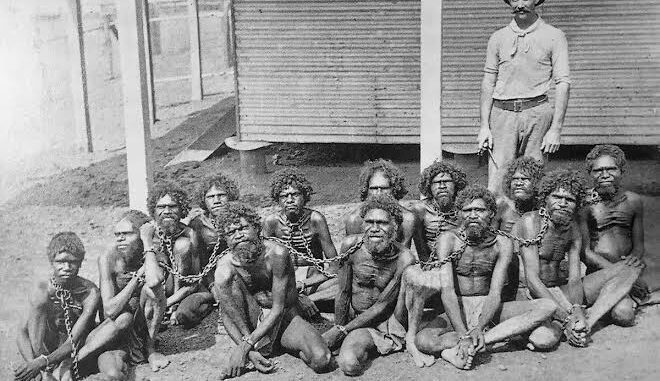
Photographs from the late 19th and early 20th centuries show Aboriginal men, women, and even children in neck chains, guarded by police. These images are stark evidence that dispossession was enforced not only through guns and massacres, but through incarceration and humiliation.
The chains symbolised more than restraint. They symbolised the colonial message: you are no longer free on your own Country. You are subject to our law, our punishments, and our control.
The Criminalisation of Resistance
Aboriginal people who defended their land, or even who simply lived according to their law, were criminalised under British authority.
Warriors who fought to protect Country were tried as criminals for “murder” or “theft.” Even taking back stock or food was labelled “cattle duffing” or “depredation,” punishable by imprisonment or death.
Leaving missions or reserves without permission could lead to arrest.
The act of surviving outside colonial control became a crime.
The Prison System as a Colonial Tool
Across Australia, Aboriginal people were swept into prisons in disproportionate numbers from the earliest years. Penal colonies used Aboriginal prisoners for labour.
Local lock-ups filled with Aboriginal people arrested under “vagrancy” or “protection” laws.
Remote police stations became centres for holding chained groups, sometimes marched for days without food or water.
Far from neutral institutions, prisons were part of the frontier project: a way to remove, punish, and exploit First Peoples.
Neck Chains in the North
The use of iron neck chains became particularly notorious in northern Australia.
In Queensland, Western Australia, and the Northern Territory, police regularly chained Aboriginal prisoners together by the neck.
People were marched in columns, sometimes hundreds of kilometres, under armed guard, and chains were justified as “practical” in remote areas, but in reality they were degrading instruments of terror.
Even well into the 20th century, Aboriginal men were photographed in neck chains in places like Broome, Wyndham, and Darwin. For many, this practice is the clearest visual evidence that slavery-like brutality was not confined to the 1800s – it persisted within living memory.
The Legal Cover
How could such treatment be justified? Colonial governments passed laws that made Aboriginal lives subject to almost total state control.
“Protection Acts” gave officials guardianship over every aspect of life: work, marriage, residence.
Police were granted sweeping powers to arrest and relocate Aboriginal people.
Courts rarely questioned the use of force; testimonies by Aboriginal people were often not admissible in law until the mid-20th century.
In this legal vacuum, brutality flourished.
Forced Labour Through Punishment
Chains and prisons were not just about punishment – they were also about labour, with Aboriginal prisoners were used on road gangs, in agriculture, and in station work.
Payment was often in rations – flour, sugar, tea, tobacco – or not at all.
Incarceration blurred into enslavement: people were forced to work under duress, with no legal recourse.
This system foreshadowed the widespread “stolen wages” era of the late 19th and 20th centuries.
Humiliation and Psychological Violence
The physical brutality of chains and prisons was matched by psychological violence: Being marched naked or half-dressed in irons was a deliberate humiliation.
Communities were traumatised by the spectacle of elders and leaders restrained like animals. Children grew up seeing their parents and relatives chained, teaching them from an early age that colonial law was an instrument of degradation.
This humiliation was not incidental – it was designed to break resistance and reinforce the message of white supremacy.
Continuity Into the Present
The over-incarceration of Aboriginal and Torres Strait Islander people today is not a new phenomenon – it is the direct descendant of this history.
From the earliest years, Aboriginal people were imprisoned at vastly higher rates than settlers.
That pattern persists: today, ATSI people make up about 3% of the population but nearly 30% of the prison population.
The chains may be gone, but the structural imprisonment remains.
Why This Matters Today
The images of Aboriginal people in neck chains are among the most confronting in Australia’s history. They destroy the myth of benign settlement. They force us to see that colonisation was enforced not just by abstract laws but by the daily, visible degradation of human beings.
To acknowledge this is to understand that the prison system, the police, and the law were never neutral in Australia. They were colonial tools, used to control and exploit Aboriginal and Torres Strait Islander peoples.
Where This Leads
Chains and prisons reveal how colonisation didn’t end with massacres. Once land was taken, the machinery of control adapted to exploit Aboriginal labour and regulate Aboriginal lives. This leads us to the next chapter: the system of slavery without the name – forced labour, ration wages, and stolen income that underpinned much of Australia’s economic growth.
Continued tomorrow…
Link to Part 5:
From Ignorance to Understanding: Facing the Truth of Colonisation (Part 5)
Link to Part 7:
From Ignorance to Understanding: Facing the Truth of Colonisation (Part 7)
Dear reader, we need your support
Independent sites such as The AIMN provide a platform for public interest journalists. From its humble beginning in January 2013, The AIMN has grown into one of the most trusted and popular independent media organisations.
One of the reasons we have succeeded has been due to the support we receive from our readers through their financial contributions.
With increasing costs to maintain The AIMN, we need this continued support.
Your donation – large or small – to help with the running costs of this site will be greatly appreciated.
You can donate through PayPal or credit card via the button below, or donate via bank transfer: BSB: 062500; A/c no: 10495969


Be the first to comment