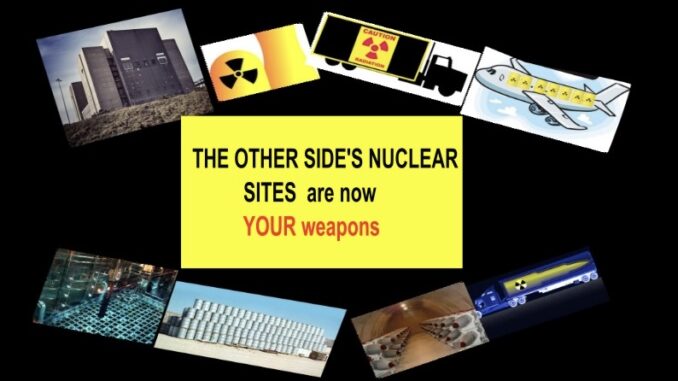
Yes, ain’t it grand! We, the God-fearing, God-loving, West and Israel don’t really need any longer to put our $billions of tax-payer money into those horribly expensive nuclear missiles, bombs, submarines. Good old new technology is providing us with much cheaper little drones.
The beauty of it all is that our enemies, those bad people in Iran, Russia, China, have got ready-made nuclear sites just sitting there, waiting to be gloriously exploded by our drones. If some sites, like nuclear reactors with strong containment covers are a bit too tough for drones, well non-nuclear missiles should do the job – still a lot cheaper than nuclear weapons.
And of course, there’s an awful lot of other nuclear stuff that is just as vulnerable, even more vulnerable, than the actual nuclear reactor. Nuclear spent fuel pools are a beaut target, with their extremely high radiation levels, risk of cooling system failure, with ensuing massive fire. Nuclear canisters, even ones clad with concrete, are quite a good target, too. And so are the various forms of transport of nuclear materials. And that’s before we’ve even considered the nuclear submarines, (some in operation, many dead and awaiting burial), nuclear weapons sites, and the transport of nuclear weapons.
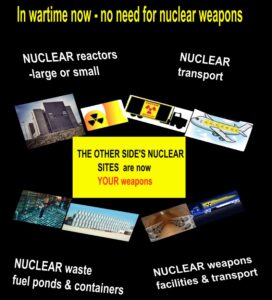
Nuclear facilities have strong safety protections, the experts tell us.. But the trouble is, that was then, and this is now: in addition to material tools like drones and missiles, we have cyber digital tools – malaware and malicious computer code can be used to seriously disrupt, even destroy the other side’s nuclear systems – whether they be military, energy, or just research, nuclear facilities.
So, it’s an exciting time for the war-makers.
Perhaps too exciting? The Bulletin of the Atomic Scientists discussed the Epic Fury threat by Donald Trump and Pete Hegseth, to obliterate Iran and its nuclear sites:
… “signaling” near a live reactor is a high-stakes gamble with an unclear ultimate purpose. While the plant continues to feed the grid, a direct hit on its containment dome would trigger a radiological catastrophe far exceeding that of Chernobyl or Fukushima. With 70-80 tons of uranium dioxide in its core and a massive inventory of spent fuel lying in nearby cooling ponds, a breach would shroud the Persian Gulf with a lethal miasma of radioiodine and cesium-137. This wouldn’t just be a strike against a regime; it would be a death sentence for the region’s environment and its people.
And wait! What if the other side has the same idea? And they do.
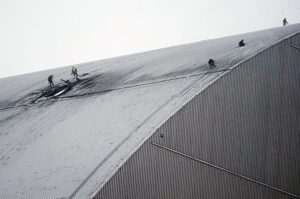
In 2021, Hamas deliberately targeted Israel’s secretive Dimona nuclear reactor site. Iran has recently attacked Israeli areas close to that site. Russian drones have struck the Zaporizhzhia Nuclear Power Plant, and the defunct Chernobyl nuclear power plant in Ukraine, though these strikes could have been unintentional.
I don’t want to bore you with the gloomy details – but these are some countries that have already developed sophisticated drones and missiles capable of devastating “our side’s” nuclear facilities – Iran, Russia, China, North Korea.
And the other subject of gloom is the diminished safety policies of the United States. Karl Grossman and Harvey Wasserman report:
“Trump’s “flood of executive orders on nuclear power have weakened or eliminated nuclear safety regulations – making nuclear power plants more dangerous than ever – and has expedited their being built.”
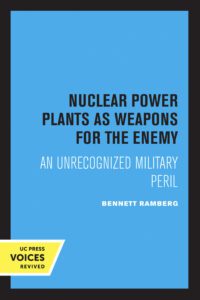
Bennet Ramberg in his 2024 book Nuclear Power Plants as Weapons for the Enemy, outlined the dangers posed by nuclear sites.
Nuclear experts are well aware of these new dangers. On April 13th on a Bulletin of the Atomic Scientists panel, eminent experts discussed them. Rachel Bronson, Lars van Dassen, Laura S. H. Holgate, all closely tied to the International Atomic Energy Agency, (IAEA), went into the subject in some detail. They looked to the IAEA as the one body that might lead the world out of this perilous nuclear vulnerability mire. But they expressed anxiety, in view of the fact that that the IAEA is underfunded and under-resourced.
I am sorry – experts. But I can’t get out of my mind the fact that the IAEA has a dual mission. Its job is to ensure the safety of nuclear facilities, and to promote the peaceful nuclear industry.
Even these three very earnest experts acknowledge that the “peaceful” and the “military” nuclear industries are now irrevocably entwined. So, apart from the weakness and lack of funding for the IAEA, it is hopelessly caught up in its own conflict of interest.
Keep Independent Journalism Alive – Support The AIMN
Dear Reader,
Since 2013, The Australian Independent Media Network has been a fearless voice for truth, giving public interest journalists a platform to hold power to account. From expert analysis on national and global events to uncovering issues that matter to you, we’re here because of your support.
Running an independent site isn’t cheap, and rising costs mean we need you now more than ever. Your donation – big or small – keeps our servers humming, our writers digging, and our stories free for all.
Join our community of truth-seekers. Please consider donating now via:
PayPal or credit card – just click on the Donate button below
Direct bank transfer: BSB: 062500; A/c no: 10495969

We’ve also set up a GoFundMe as a dedicated reserve fund to help secure the future of our site.
Your support will go directly toward covering essential costs like web hosting renewals and helping us bring new features to life. Every contribution, no matter the size, helps us keep improving and growing.

Thank you for standing with us – we truly couldn’t do this without you.
With gratitude, The AIMN Team

Geez Noel, your article reminds me of a SMH 1955 front page showing the radiation effect of dropping a Hiroshima sized atomic bomb on the Sydney Harbour Bridge.
Certainly the after-bombing effect of atomic contamination causing ”radiation sickness” and ultimate slow painful death is rarely discussed in military circles; out of sight. out of mind, out of reality??
Perhaps this is another good reason for Australia to withdraw from Scummo’s USUKA sub debacle and concentrate on becoming a non-aligned middle power staying away from the imperialistic ”adventures” of the USA (Undemocratic Sewer of Apartheid).
OOps!! Whitlam talked about that and his democratically elected Australian government was overthrown by the royally appointed gg john curr, with encouragement from Buck Palace staff and supported by High Court judge Anthony Mason with the assistance of the CIA.
Naughty Gough, being a political vassal of America does not give Australia the right to control all military resources in our own country.
AND I forgot to mention that the Trump administration has not merely weakened nuclear safety regulation, but virtually abdicated from it. Even the nuclear lobby itself has recognised this, and encouraged private industry to address safety questions.
BUT – Futurism points out -( https://futurism.com/science-energy/nuclear-startups-safety ) “new reporting by Politico‘s energy publication E&E News found that several baby nuclear companies are avoiding requests to join one of the industry’s main safety organizations. The regulatory body, called the Institute of Nuclear Power Operations (INPO), was formed in the fallout of the partial meltdown at Three Mile Island in 1979. While not a government body, the INPO is a nonprofit nuclear watchdog, responsible for conducting plant inspections, sharing operational guidance between nuclear companies, and helping companies train nuclear personnel.
For a nuclear energy company, joining the INPO is completely voluntary, though every operator has — until now”
Noel, under the current criminal mafia administration of the lunatic president, if there isn’t instant profit and personal gratification…FORGEDABOUDIT.
SAFETY?Yeah, nah.
Interesting concept: you can create nuclear-strike consequences without ever owning a nuclear missile.
Build enough reactors, spent-fuel storage, or nuclear infrastructure and an enemy only needs conventional weapons, drones, sabotage, or cyberattacks to create radiological catastrophe.
Don’t tell Australia’s nuclear-power enthusiasts — they’ll go ballistic.
Congratulations. You’ve achieved nuclear strike consequences without the inconvenience of owning nuclear weapons.