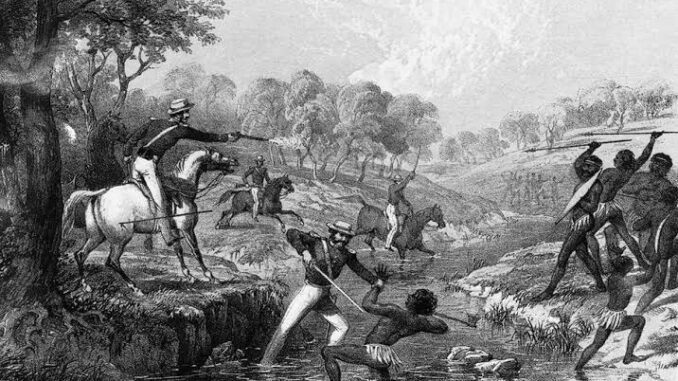
Chapter 5: Massacres, Punitive Expeditions, and Policies of Extermination
The Myth of Peaceful Settlement
For much of Australia’s history, schoolbooks and monuments promoted the idea of “peaceful settlement.” In reality, settlement was enforced through systematic violence. From the early years at Sydney Cove to the outer reaches of the frontier in the late 1800s, Aboriginal people resisted dispossession – and were met with brutal force.
Historians now refer to this period as the Frontier Wars: a century-long conflict involving massacres, guerrilla resistance, reprisals, and military-style expeditions. It is one of the most significant yet least acknowledged wars in Australian history.
The Logic of Elimination
The violence was not random. It followed a logic:
- Colonists wanted land for farming, grazing, and mining.
- Aboriginal custodians defended their Country, food, and families.
- Settlers and authorities responded with overwhelming force, aiming to remove or destroy resistance.
The underlying policy was clear: Aboriginal people were expected to either be “absorbed” through assimilation, or eliminated if they resisted. This is why many scholars describe colonisation as containing elements of genocide.
Punitive Expeditions
When Aboriginal resistance threatened settlers, colonial authorities often sanctioned punitive expeditions – military-style raids designed to terrorise and kill. Soldiers or mounted police would sweep through camps, shooting indiscriminately.
Survivors were often pursued for days, with orders to “make an example.”
Official reports usually downplayed the numbers killed, using phrases like “dispersed” or “cleared.”
These expeditions were state-backed violence, designed to enforce the fiction of terra nullius with gunpowder.
Massacres Across the Continent
Massacres were not isolated tragedies. They were widespread, repeated, and part of the fabric of frontier expansion.
Some of the best-documented include:
- Myall Creek (1838, NSW): At least 28 Wirrayaraay people – mainly women, children, and elderly — were tied up and slaughtered by stockmen. Remarkably, several perpetrators were later tried and executed, a rare instance of colonial law punishing such crimes.
Coniston (1928, NT): Often described as the last officially sanctioned massacre, police and settlers killed dozens of Warlpiri, Anmatyerre, and Kaytetye people in reprisal for a white dingo trapper’s death.
Pinjarra (1834, WA): Governor Stirling led a raid that killed at least 15 Binjareb Noongar people, though oral histories suggest the toll was far higher.
Waterloo Creek (1838, NSW): Hundreds of Gamilaraay people are believed to have been killed by Major James Nunn’s mounted police.
Beyond these, historians and truth-telling projects have documented hundreds of massacre sites across Australia. The University of Newcastle’s Colonial Frontier Massacres Map lists over 400 incidents between 1788 and 1930.
Language of Concealment
Colonial records rarely used the word “massacre.” Instead, officials wrote of “dispersals,” “punishments,” or “collisions.” This bureaucratic language concealed the reality: the killing of men, women, and children.
Newspapers often framed Aboriginal resistance as “outrages” or “depredations,” while portraying settler reprisals as unfortunate necessities. This language of concealment allowed colonists to see themselves as victims, even while carrying out large-scale killings.
Policies of Extermination
While not always formalised in law, extermination was openly discussed and, in some places, encouraged:
- Some colonial leaders argued Aboriginal people would “die out” naturally – a belief that justified neglect and violence.
- Others, particularly in Queensland and Tasmania, saw elimination as a practical step for securing land.
- In Tasmania, the Black War of the 1820s–30s led to near-total devastation of the Palawa population.
Even where outright extermination was not the stated goal, policies of protection, segregation, and assimilation were rooted in the belief that Aboriginal people would not survive as distinct nations.
The Scale of Death
It is impossible to know exactly how many Aboriginal people were killed during the Frontier Wars. Estimates vary, but historians suggest:
- Tens of thousands died in massacres and expeditions.
- Many more died from introduced disease, starvation, and displacement.
- For every settler killed in frontier conflict, as many as ten to twenty Aboriginal people were killed in reprisal.
This scale of violence places the Frontier Wars among the major conflicts in Australian history – yet they remain largely unacknowledged in public memory.
Resistance and Survival
It is important to emphasise: Aboriginal peoples did not vanish quietly. Resistance was fierce and enduring:
- Leaders such as Pemulwuy, Yagan, Windradyne, and many others led campaigns against settlers.
- Raids on stock, ambushes of patrols, and sabotage of farms demonstrated tactical adaptation.
- Oral histories preserve stories of warriors and communities who fought back despite overwhelming odds.
Survival itself became resistance. Despite massacres and policies of extermination, Aboriginal nations endured, holding onto culture, language, and law through extraordinary resilience.
Why This Matters Today
Massacres are not simply tragic episodes of the past. They are foundational to the creation of modern Australia. The wealth of pastoral industries, the expansion of farms, and the growth of towns were built on land cleared through bloodshed.
To ignore this is to continue the violence in another form: the violence of denial. Truth-telling about massacres is not about dredging up guilt; it is about acknowledging the cost paid by First Peoples, and the reality that the benefits of that violence are still enjoyed today.
Where This Leads
The Frontier Wars were only one layer of colonisation. Violence cleared the land, but exploitation secured it. Once Aboriginal people were driven off or reduced in number, colonists found ways to harness their labour. Many were forced to work in conditions that amounted to slavery, under systems of control and stolen wages.
That is where we turn next.
Continued tomorrow…
Link to Part 4:
From Ignorance to Understanding: Facing the Truth of Colonisation (Part 4)
Link to Part 6:
From Ignorance to Understanding: Facing the Truth of Colonisation (Part 6)
Dear reader, we need your support
Independent sites such as The AIMN provide a platform for public interest journalists. From its humble beginning in January 2013, The AIMN has grown into one of the most trusted and popular independent media organisations.
One of the reasons we have succeeded has been due to the support we receive from our readers through their financial contributions.
With increasing costs to maintain The AIMN, we need this continued support.
Your donation – large or small – to help with the running costs of this site will be greatly appreciated.
You can donate through PayPal or credit card via the button below, or donate via bank transfer: BSB: 062500; A/c no: 10495969


I’m astonished this piece of writing hasn’t garnered more attention.
It explains to an extent the failure of the Voice referendum and also gets close to offering an understanding of what Palestine is actually about. Yes.
It might be one of the best pieces of work I’ve read here.