
By Denis Hay
Australian political reform could give citizens more influence between elections. Is our democracy really delivering for the people?
Introduction: What Does Democracy Actually Deliver?
Australia proudly describes itself as a democracy. Every few years we vote for our representatives and decide which major party will form government.
But there is a question we rarely ask:
How much influence do ordinary Australians actually have once the election is over?
We are told that citizens can influence government through elections, petitions, protests, submissions, lobbying and contacting MPs. Yet having the right to influence government is not the same as actually changing government policy.
This raises an uncomfortable question: Is democracy simply about choosing who governs, or should it also mean that government listens to citizens and delivers for them?
China provides a fascinating comparison because it operates under an entirely different political model.
Australia: The Power to Vote
Australia’s House of Representatives is elected for a maximum three-year term, using preferential voting. The party or coalition commanding a majority forms government.
This gives Australians an important democratic right: we can remove a government at an election.
But what happens between elections?
This raises a fundamental question: does Australia’s democratic system really serve the people?
Citizens can protest, sign petitions, make submissions and contact politicians. Yet governments are not required to accept those demands.
Political influence is also unequal. Australia’s parliamentary research has recognised concerns that political donations can create opportunities for undue influence, while research into federal lobbying has identified weaknesses in transparency and accountability.
So we have political participation – but does that participation translate into political power?
Labor or LNP: Does Changing Governments Change the System?
This is perhaps the most important question.
Australians can vote Labor out and elect the LNP, or vote the LNP out and elect Labor. The policies of the two parties are certainly not identical, and governments make genuine differences in areas such as industrial relations, welfare, climate policy and public spending.
But do these differences fundamentally change Australia’s economic and political direction?
There is substantial academic literature examining Labor’s relationship with neoliberalism. Research has argued that Labor governments have operated within, and sometimes helped develop, the neoliberal economic framework.
More recent research suggests that today’s Labor government has made tangible policy changes while still accommodating significant elements of the existing market-based framework.
This leads to a provocative possibility:
Perhaps Australians can change the government without being able to substantially change the system.
The parties may argue fiercely about individual policies while accepting many of the same underlying economic assumptions.
If that is true, elections can become a choice about who manages the system, rather than allowing citizens to choose fundamentally what kind of system they want.
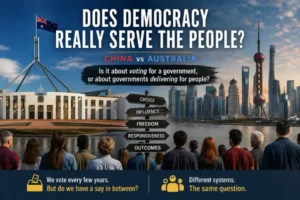
China: A Completely Different Model
China cannot be described as a multiparty electoral democracy like Australia.
The Chinese Communist Party (CCP) leads the political system, and opposition parties do not compete for national government in the Australian sense. China’s Constitution explicitly establishes CCP leadership while also providing for people’s congresses and political consultation.
However, it would also be misleading to claim that Chinese citizens simply have no elections or political participation.
China has elections for people’s congresses at different levels. County and township-level deputies are directly elected, while higher-level congresses are elected indirectly. The Chinese system also incorporates political consultation through bodies such as the Chinese People’s Political Consultative Conference.
It is a different conception of political participation – not Australia’s competitive party model.
Does China Deliver for Its Citizens?
This is where the comparison becomes particularly interesting.
Whatever criticisms we make of China’s political system, it is difficult to deny the scale of its economic and social transformation.
The World Bank reports that China eliminated extreme poverty by 2020 and that access to health, education and other services improved significantly over the preceding decades.
China has also invested enormously in infrastructure, housing, transport, education and industrial development.
That doesn’t mean everything in China is successful. China faces serious problems, including inequality, an ageing population, environmental pressures and economic imbalances.
But it does challenge the simplistic Western assumption that a one-party political system necessarily means a government that does not serve its population.
Do Chinese Citizens Support Their Government?
There is evidence worth taking seriously.
A major Harvard Kennedy School study conducted eight surveys between 2003 and 2016, involving more than 31,000 Chinese citizens in urban and rural areas.
In the final 2016 survey, 95.5% of respondents reported being either relatively or highly satisfied with the central government in Beijing.
Earlier reporting on the same research cited 93.1%, depending on how satisfaction was calculated. The important point is not the difference between those figures but the consistently high level of reported satisfaction.
The researchers also found that satisfaction with China’s central government was considerably higher than satisfaction with lower levels of government.
This research is not proof that every Chinese citizen supports the CCP. Nor does it eliminate legitimate concerns about political freedoms, censorship or dissent.
But it does demonstrate something Western commentary often overlooks:
Many Chinese citizens have reported being highly satisfied with their government.
What About Political Freedom?
This is where comparisons must remain honest.
Australia provides genuine political competition, a free electoral choice between parties and much greater space for organised opposition.
China does not provide those same political freedoms.
But political freedom is only one dimension of government.
Another is government responsiveness.
A citizen may have the freedom to vote against a government but still feel that the government ignores them for three years.
Another citizen may have less influence over who leads the country but feel that their government is delivering improvements in their community and their standard of living.
Neither experience should automatically be dismissed.
Why Australian Political Reform Matters
Australia has valuable democratic institutions that should be protected. But we could learn from the idea that government legitimacy should depend not only on winning elections but also on delivering for citizens. We could create stronger mechanisms for citizens to influence policy between elections.
These reforms are also essential to addressing Australia’s major social justice issues, including housing insecurity, inequality, healthcare and insecure employment.
Australia has valuable democratic institutions that should be protected.
But we could learn from the idea that government legitimacy should depend not only on winning elections but also on delivering for citizens.
We could create stronger mechanisms for citizens to influence policy between elections.
We could strengthen lobbying transparency, limit the influence of political money and make governments more accountable for their promises.
Most importantly, we need to break the assumption that Australians must choose between only two major political alternatives.
Breaking the Two-Party System
Australia already has an example of how change can occur.
The Senate uses proportional representation, allowing smaller parties and independents to win representation.
We should build on that principle.
Possible reforms include:
- stronger proportional representation;
- reducing the influence of political donations;
- greater transparency around lobbying;
- stronger independent representation;
- citizens’ assemblies on major national issues;
- greater use of referendums where appropriate;
- stronger local democratic participation;
- electoral reforms that make it easier for new political movements to compete.
The objective should not be to replace Labor and the LNP with another permanent political establishment.
It should be to create a system where no political party can take voters for granted.
Imagine if politicians knew that citizens had genuine alternatives – not merely the choice of replacing one major party with the other.
That could change political behaviour dramatically.
Democracy Should Be About People
Perhaps the most important lesson from comparing Australia and China is that we should stop treating political systems as simple black-and-white categories.
Australia has electoral freedoms that China does not.
China has achieved levels of long-term policy continuity and social and economic transformation that Australia has struggled to match.
The question should therefore not be:
“Which country is democratic?”
A better question is:
“Which political arrangements give ordinary people the greatest ability to shape their future and ensure that government actually works for them?”
Australia has an opportunity to rethink democracy without abandoning democracy.
We could retain the right to vote while giving citizens far greater influence between elections.
And we could demand something more fundamental from our politicians:
Don’t simply ask for our vote. Listen to us – and govern for us.
What do you think?
Is voting every three years enough to make Australia genuinely democratic if governments can largely ignore citizens between elections?
Or should democracy mean much more than simply choosing which major party governs?
If you found this article insightful, explore more about political reform and Australia’s monetary sovereignty on Social Justice Australia.
Share this article with your community to help drive the conversation toward a more just and equal society.
If you value independent voices for social justice and democratic reform, please consider making a small donation to help keep Social Justice Australia going.
Click on our “Reader Feedback” menu. Let us know how this article has inspired you. Submit your testimonial and help shape the conversation today!
This article was originally published on Social Justice Australia
Keep Independent Journalism Alive – Support The AIMN
Dear Reader,
Since 2013, The Australian Independent Media Network has been a fearless independent voice – holding power to account and delivering journalism that matters.
Running this site isn’t cheap. Rising costs mean we need your support now more than ever. Every donation, big or small, keeps our servers running, our writers working, and our stories free for everyone.
Donate here:
PayPal or credit card – just click on the Donate button below
Direct bank transfer: BSB: 062500; A/c no: 10495969

We’ve also set up a GoFundMe as a dedicated reserve fund for hosting and future improvements.

Thank you for standing with us. We couldn’t do this without you.
With gratitude,
The AIMN Team



Denis, love your article on the Chinese political system, and needles to say many fail to comprehend or understand Asian countries at all.
I’m not saying they are perfect, no one is, it has a complex and contradictory history like is nemesis.
Maybe it’s time for us all to learn more thru Asian studies rather than just munching our way thru their cuisine?
However we approach this subject of change, other perspectives always help sharpen our views….
https://pearlsandirritations.com/post/2026/09/the-pieces-i-cant-shake-message-from-the-editor/?
Happy adventuring.