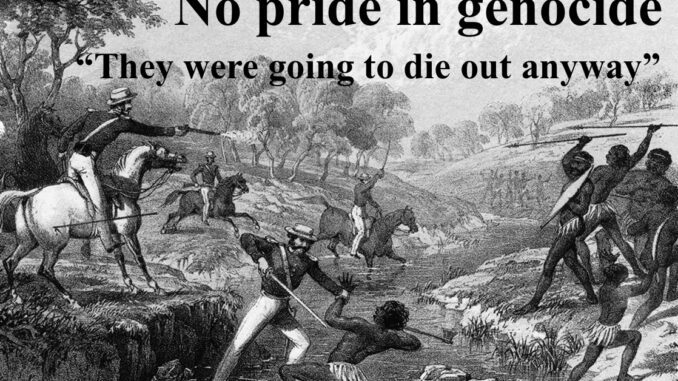
Was the total extermination of Australia’s Indigenous people deliberately intended?
I would argue that it was.
For much of Australia’s colonial history, it was considered acceptable to shoot Aboriginal people. Many colonists believed God had condemned the Aboriginal race to extinction and that they were merely hastening the inevitable. In their minds, they were not defying God’s will but carrying it out. It was genocide with divine approval – or so they believed.
By the latter colonial period, and later under the Commonwealth, the open massacre of Aboriginal people became increasingly unacceptable. Yet this did not mean governments had abandoned the belief that Aboriginal people constituted a doomed race. Rather, their role evolved from passive observers of extinction to active architects of it. If settlers believed they were doing God’s work, governments increasingly assumed the role of evolutionary custodians.
What changed was not the objective, but the method.
During the frontier period, the destruction of Aboriginal people was often physical. Massacres, poisonings, disease, starvation and the violent seizure of land combined to decimate entire communities. As colonial society became more organised and more conscious of its international reputation, overt violence gradually gave way to government policy. The language became more humanitarian, but the underlying objective remained strikingly familiar.
Instead of destroying Aboriginal people by force of arms, governments increasingly sought to destroy Aboriginality itself. The aim was no longer simply the elimination of lives, but the elimination of identity, culture, language, kinship and, ultimately, the existence of Aboriginal people as a distinct people. Protection, segregation and assimilation were presented as benevolent policies, yet each rested upon the same assumption – that there was no future for Aboriginal Australians as an enduring and separate people.
Whether one describes this as physical genocide, cultural genocide, or a combination of both, the central question remains unchanged: if a people are deliberately prevented from continuing as a people, how is that fundamentally different from extermination?
To understand how this occurred, we must begin with the intellectual climate of nineteenth-century Europe.
The scientific doctrine known as the Great Chain of Being arranged all living things in a hierarchy, beginning with the simplest organisms and ascending through the primates to human beings. Even within humanity, Europeans believed there were different levels of civilisation and intelligence. Europeans – being Christian, educated and technologically advanced – placed themselves at the summit, while Aboriginal Australians were relegated to the lowest rung of humanity, barely above the great apes.
These ideas travelled readily to the Australian colonies, where they reinforced existing prejudices. Long before Federation, they had become part of the accepted wisdom that shaped attitudes towards Aboriginal people. Aboriginal Australians were not viewed as equals but as evidence of an earlier, inferior stage of human development.
Alongside the Great Chain of Being emerged another powerful influence: Social Darwinism.
Extinction by destiny
Applying evolutionary theory to human society, Social Darwinism maintained that races, like species, competed for survival. Those considered less evolved were destined to disappear before more advanced peoples. For many nineteenth and early twentieth-century Australians, Aboriginal extinction was therefore regarded not as a tragedy but as a law of nature. Nothing could – or should – be done to prevent it.
Government policy increasingly reflected these assumptions. Beneath changing terminology lay a remarkably consistent objective: the disappearance of Aboriginal people as a distinct race. The extinction of the Aborigines was being explained away as “the design of Providence.” Social Darwinism gave such sentiments an aura of scientific legitimacy.
Previously Europeans had been convinced of the inferiority of the Aborigines, but that did not justify their extinction. Social Darwinism did.
Yet nature had not selected Aboriginal people for extinction. Only the colonists had.
Extinction by policy
Four principal policy phases – protection, segregation, assimilation and integration – are often presented as evidence of social progress. In reality, each was shaped by the same underlying assumption that Aboriginal people had no enduring future as a separate people.
Protection was founded upon the belief that Aboriginal people would inevitably die out following European settlement. Since extinction was considered unavoidable, governments concluded that all that remained was to feed and shelter them until the end. Aboriginal people were confined to missions and reserves, supposedly for their own welfare and protection from frontier violence, while they awaited what officials believed would be their inevitable demise.
Measured against its own assumptions, protection may have appeared humane.
When Aboriginal people refused to disappear, protection gradually evolved into segregation. The distinction between the two policies was subtle, but their purpose remained remarkably similar. First, Aboriginal people were isolated because they were expected to die out. Later, they were isolated because they had failed to do so.
The racial theories underpinning Australian society found their clearest expression in segregation. Australia effectively became two societies: one white and one Aboriginal.
Although Aboriginal people had survived, governments continued to argue that they had failed to “advance” since European settlement. Segregation therefore became a means of preserving what was described as white racial purity.
Its effects were pervasive. Aboriginal Australians were discouraged from joining churches and community organisations. Access to swimming pools, theatres and other public facilities was frequently denied. Businesses often refused service for fear of offending white customers. Perhaps most disturbing was the neglect shown by many medical practitioners, leaving Aboriginal communities without adequate healthcare.
In some jurisdictions these practices became enshrined in law. In South Australia, for example, Section 14 of the Police Offences Act 1953 criminalised certain associations between Aboriginal and non-Aboriginal people, reflecting policies that bore uncomfortable similarities to apartheid.
Yet even segregation failed to solve what officials increasingly described as the “Aboriginal problem.”
While so-called “full-blood” Aboriginal people remained confined to reserves, governments became preoccupied with those they classified as “half-caste”. These individuals increasingly resembled Europeans in appearance but maintained Aboriginal family, cultural and social connections. To many policymakers, this represented a failure of racial policy.
Their solution was assimilation.
Assimilation was not designed to preserve Aboriginal culture. Its purpose was precisely the opposite.
By absorbing lighter-skinned Aboriginal people into the wider population, governments hoped Aboriginal identity itself would disappear. Some policymakers openly advocated selective breeding to “breed out the colour” until Aboriginal people became indistinguishable from the white population.
Few policies illustrate the brutality of this objective more clearly than the removal of Aboriginal children from their families.
Under assimilation, Protection Boards assumed legal guardianship over Aboriginal children and exercised sweeping powers to remove them from their parents. Countless children were placed in institutions, foster homes or domestic service, often never to see their families again.
As the Commonwealth itself later acknowledged:
Children were taken away under government policies of protection and assimilation aimed at having Indigenous people adopt European culture and behaviour to the exclusion of their family and background. The assimilation policy presumed that, over time, Indigenous people would die out or be so mixed with the European population they became indistinguishable. – The Path to Reconciliation (1997), p. 24.
Genocide ordained
Whether by frontier violence or by government policy, the objective remained fundamentally the same.
If Aboriginal people could not be eliminated by the bullet, they would be eliminated by legislation; by policies designed to ensure that they would ultimately disappear – not necessarily as individuals, but as a people.
That is why I conclude that the extermination of Australia’s Indigenous people was not simply an unintended consequence of colonisation. It was pursued through different means at different times, but the destination remained constant: the disappearance of Aboriginal people as a distinct people.
For those who believed God had favoured the white race, they were simply carrying out His work. They were going to die out anyway.
Also by Michael Taylor
The World’s Most Admired Nation (According to One Man)
Keep Independent Journalism Alive – Support The AIMN
Dear Reader,
Since 2013, The Australian Independent Media Network has been a fearless voice for truth, giving public interest journalists a platform to hold power to account. From expert analysis on national and global events to uncovering issues that matter to you, we’re here because of your support.
Running an independent site isn’t cheap, and rising costs mean we need you now more than ever. Your donation – big or small – keeps our servers humming, our writers digging, and our stories free for all.
Join our community of truth-seekers. Please consider donating now via:
PayPal or credit card – just click on the Donate button below
Direct bank transfer: BSB: 062500; A/c no: 10495969

We’ve also set up a GoFundMe as a dedicated reserve fund to help secure the future of our site.
Your support will go directly toward covering essential costs like web hosting renewals and helping us bring new features to life. Every contribution, no matter the size, helps us keep improving and growing.

Thank you for standing with us – we truly couldn’t do this without you.
With gratitude, The AIMN Team

I wasn’t aware “Aboriginal people” were a “distinct people”, I have always read that their ancestors migrated here over many years from many sources! Waves of migration is a common occurrence and still taking place today.
There were two distinct “waves” but they were not from all over the world – they were from India. Even the dingo (brought here about 6,500 years ago) came from India.
So the Australian Aboriginals are not a “distinct people” are they?
But in fact a number of tribes, clans or mobs call them what you will.
I find it surprising in light of your claimed genocide, that there are more Australian Aboriginals today than there have ever been!
jonangel, your understanding of genocide is lacking crucial aspects.
From the UN
Article 2
In the present Convention, genocide means any of the following acts committed with intent to destroy, in whole or in part, a national, ethnical, racial or religious group, as such:
(a) Killing members of the group;
(b) Causing serious bodily or mental harm to members of the group;
(c) Deliberately inflicting on the group conditions of life calculated to bring about its physical destruction in whole or in part;
(d) Imposing measures intended to prevent births within the group;
(e) Forcibly transferring children of the group to another group.
You might have noticed in my article that the policies of genocide failed. And of course numbers have increased, for two reasons:
They had babies. They grew up into adults and they too had babies. Nothing groundbreaking there.
The Bureau of Statistics has confirmed that people who were once reluctant to tick the Aboriginal box on the Census, are now doing so.
This is difficult to comprehend:
Why?
Up until 9,500 years ago there was no land bridge to our island continent. I find it inconceivable that waves of people in canoes travelled here from all over the globe. They would have been geniuses in not only knowing there was a landmass here, let alone travelling across vast oceans to reach it.
The long neglected history, with admissions of ignorance on this touchy area, and glowing forthright uberconfident J Angel arrives, again, at inconclusions, errors, but perhaps even guarded hope of some enlightenment.., let it be. Anthropology is an ever challenging correction with revisions. Our indigenous people deserve more accuracy. (When young, I heard Prof. Peter Elkin on this.., wonderful.)
jonangel states, without evidence that “that there are more Australian Aboriginals today than there have ever been!”
Back your claim with factual evidence please, or stand accused, yet again, of promulgating wildly incorrect misinformation.
Thank you Micheal.
I listened yesterday to Bob Dylan’s ‘With god on our side’ it was youtube on the tv and the eords were shown, which along with the sneering nasal voice highlighted the sarcasm of the song.
With god on our side, the sense of superiority of Christian invaders in the colonial quest for domination is still being defended as thoughbit was a ‘manifest destiny’ that white Christian people were ordained to rule the world.
It’s not just here in Australia, throughout the colonised world the same has, and continues to occur.
Interesting readings for those who are interested include Henry Reynolds, any of his books really, and a recently published Empires of Violence: Massacre in a Revolutionary Age by four historians examining the violence of Imperialism in North America, South Africa, Australia and Napolionic Europe.
That explains the Australian government’s mute response to Israel’s Palestinian genocide.
Thank you Michael,
this thought provoking article raises many questions. Two of which are has the genocide been reckoned with or even finished, and the second, the similarities with the Israel-US genocide of the Palestinians.
Just yesterday, there was a report of the NT government lowering the thresholds for the removal of First Nations children from their families. I can’t access much information about it, so feel free to fill in the gaps.
The basic continuation of the stolen generations policy was also a controversy in South Australia recently.
For decades, not so long ago, Australia shamelessly pilfered Aboriginal culture for its own commercial gain whilst steadfastly trying to eliminate the rest of our First Nations peoples culture – the grotesque selling of boomerangs in souvenir shops for profit and the titillation of foreign tourists. Have things changed that much though? Have we just replaced the painted sticks in the souvenir shops with mass produced dot paintings from overseas?
I had the pleasure of visiting a regional art gallery where there was a series of First Nations paintings, and a brilliant volunteer to explain the works. It was amazing, but who does it serve?
Are we still treating Aboriginal culture as something for the rest of Australia to appreciate and perhaps exploit? Is it just another means to assimilate First Nations people and exterminate their own identities and cultures?
The similarities between the ethno-colonialist genocide of Australia’s First Nations people and that of the current ethno-colonialist genocide of the Palestinians by the Israelis with US, EU, Russian, Canadian and Australian support is striking.
The ‘massacres, poisonings, disease, starvation and the violent seizure of land combined to decimate entire communities’; we know of the massacres, poisoning of wells has been documented, but there are also suspicions that the food supply has been tainted with drugs to sterilize the population, the hospital and waste treatment infrastructure were targeted from the beginning, the starvation and violent seizure of land has been well-documented.
There is also the deliberate destruction of structures for societal survival common to both. The displacement of the authority of the elders and replacement with white man’s laws, and the murdering of Palestinian police and leaders by the Israelis. The attempted destruction of language; from what language is allowed to be taught to the naming of places.
That Labor allows those who think their feelings are more important than human life to conduct an extermination of Palestinian culture on Australian soil, and Labor’s calling of the UAE, who are involved in the genocide in Sudan, friends worthy of assistance in attacking its neighbour, shows a disturbing indifference and tolerance of genocide as long as it in the interests of Labor’s owners.
Dealing with the devastation of the settler genocide of our First Nations people is complex and perhaps difficult, but how hard is it to recognize the genocide of the Palestinians and abide by our obligations under the genocide convention and International law.
How hard is it to say genocide is bad and act accordingly?
Even if you won’t act, to lean on Caitlan Johnstone, you have to be all fucked up inside to support a genocide.
Max Gross.
Excellent insight.
One aspect of the tragic extermination of Aboriginal people and their culture and knowledge is that all Australians have lost a significant amount of valuable information about the continent, its food sources, weather, ecology/biodiversity and geology. These people knew how to read the world around them, and to use the knowledge to guide their activities throughout the year. If this plant was flowering, they knew that a particular food source would be available many kilometres away. The wood of one tree was excellent for making spears, the bark of that one was best for making containers. Weaving, the making of cloaks, many other skills have been ignorantly set aside by the European descendants of the first settlers, and are probably now irretrievable. Our loss.
“In the present Convention” please tell, why is this Convention any more reliable than past or future Conventions?
More to the point, can we really judge the past on todays standard?
Are you claiming there aren’t more Australian Aboriginals today, than in the past?
I suggest you prove me wrong.
“why is this Convention any more reliable than past or future Conventions?”
The Convention on the Prevention and Punishment of the Crime of Genocide (CPPCG), or the Genocide Convention, is an international treaty that criminalizes genocide and obligates state parties to pursue the enforcement of its prohibition.
It was the first legal instrument to codify genocide as a crime and the first human rights treaty unanimously adopted by the United Nations General Assembly on 9 December 1948.
Michael took the trouble to research his article.
Is it too much to ask you to research your criticism?
Thank you, Steve. And research I certainly did: going through old lecture notes, assignments, uni text books and pertinent websites.
@ Michael Taylor: Thank you for this thoughtful article. There has been a large literature about these topics, especially ”the clearances” and the incumbent strategies, one of the best is Bloomfield ”Baal Balboa the End of the Dancing” that sourced grazier’s logs for details. The local New England grazier successors were so upset that Bloomfield suffered considerable problems getting bank finance, and was eventually sent bankrupt.
@ jonangel: Perhaps you would have a better understanding of the English invasion and its consequences if you read any, or preferably all, of the works of Henry Reynolds.
Otherwise your comments on this topic could reasonably put you deep in the ”Black Armband” clique encouraged by Little Johnnie Howard as he attempts to assuage his ego for betraying Australian voters.
And then there was then stage prior to protection, the one that made colonisation possible, the one that classed the existing inhabitants of this land as being … irrelevant.
Thanks Michael for a neat well elucidated article
Yes, for any inclined to make sweeping statements on the subject, without evidence, re Oz, reading all of Henry Reynolds’ publications would be a good start. Aside from Reynolds, there’s a myriad of publications now available by reputable historians, academics and scientists.
In Oz, & across the globe, there’s almost endless peer reviewed, evidence-based material readily available on the pronouncement and spread of supremacist Christian doctrine & follow-on laws and actions. There’s no excuse now for prejudiced bias, despite that, vested interest legacy media continues to peddle it.
The timeline of Aboriginal people being in the country now known as Australia is being pushed back by scientific evidence. The land bridge theory has a few unexplained flaws, but its the best so far perhaps.
This article put occupation in Southern Victoria as probably 120000 years ago. https://www.abc.net.au/news/2020-09-05/moyjil-coastal-site-at-warrnambool-of-global-indigenous-heritage/12629934?
It would have taken a long time, and lots of babies born to populate the southern parts of Australia 120 thousand years ago if a handful of travelers crossed on the land bridge.
As for genocide of Indigenous Australians, the deaths in custody haven’t stopped, the child removal continues to increase, even the failed Invasion Day bombing in WA has been downplayed by the media.
Unbelievable.
On our Facebook page this post had over 120,000 views and attracted well over 2,500 comments. Mind you, most of the comments were to tell me to go and eff myself.