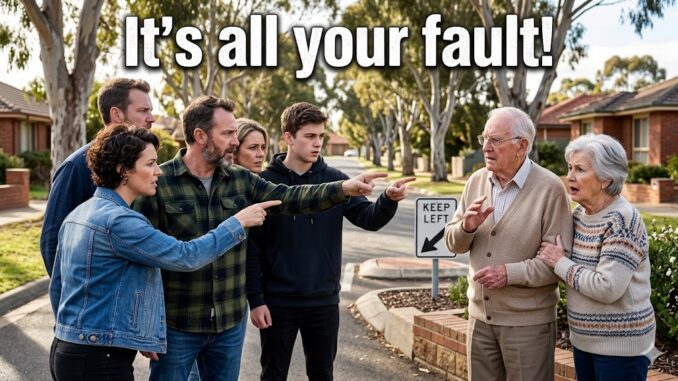
The modern stereotype of the Baby Boomer has become so familiar that people barely question it anymore.
Apparently we Boomers are all wealthy, own multiple investment properties, and of course vote conservative. We selfishly hoarded the prosperity while younger Australians struggle with housing affordability and insecure work. We sit around protecting our franking credits and lecturing everyone else about hard work.
The truth is, many – probably most – of us would be genuinely surprised to hear about this untold wealth we’re supposed to be sitting on. I know I certainly am.
At some point “Boomer” stopped being a simple description of when we were born and became a term of abuse.
What fascinates me is how easily millions of people can now be reduced to a punchline or an object of resentment.
We’re rightly told that stereotyping by race, gender, religion or sexuality is wrong. Yet age-based prejudice against older Australians has somehow become not just acceptable, but fashionable. Entire generations are talked about as if we all think the same, vote the same, and lived identical lives.
The reality is very different.
Baby Boomers include trade unionists, teachers, nurses, farmers, factory workers, artists, public servants, anti-war protesters, feminists, environmental activists, and plenty of lifelong Labor voters. Many of us never got wealthy. Some never owned a home. Quite a few are pensioners today, quietly struggling with rent and electricity bills while still trying to help their adult children.
The popular image of the retired Boomer sipping champagne on the balcony of a negatively geared beach house makes for an easy villain. But it’s not the reality for millions of us.
What younger generations often don’t realise is that many of us grew up in homes shaped by war. Our fathers came back from the Second World War and Korea carrying experiences most people today can barely imagine. There was almost no understanding of trauma or PTSD back then. Men were expected to shut up, get on with it, and never speak of what they’d seen.
But war doesn’t end when the fighting stops.
Many households lived with the invisible fallout: the long silences, the sudden anger, the emotional distance, the drinking, the nightmares. Not every veteran was broken; many were loving, decent men who carried their burdens with real dignity. But many others never fully recovered.
We, their children, grew up inside that atmosphere. It taught us early that life wasn’t always emotionally safe. A lot of us became determined to raise our own kids differently; to be more open, more affectionate, more present than our own fathers were able to be.
That part of our story is rarely mentioned when people casually throw out “OK, Boomer.”
The irony is that many of the social freedoms younger Australians now enjoy were hard-won by people in our generation. We marched against the Vietnam War, supported women’s rights, helped expand universities, campaigned for Medicare, and pushed for environmental protections and social reform. None of that excuses our mistakes, but it deserves to be remembered.
None of this means Baby Boomers are beyond criticism. Every generation gets things wrong. Housing affordability is a real and painful crisis. Economic inequality matters. Younger Australians face pressures many of us didn’t.
But painting millions of people with the same lazy brush isn’t analysis. It’s tribalism. And it’s politically convenient. The more we fight each other along generational lines, the less we look at the governments, corporations, housing policies, wage stagnation and economic choices that actually created many of these problems.
Perhaps that’s why the stereotype persists. It’s easier to blame a whole generation than face the messy complexity of history and power.
At the end of the day, we’re simply millions of ordinary human beings. We inherited an imperfect world, tried to survive it, and many of us honestly tried to make it a bit better than we found it. In the end, we’ve handed on an imperfect world to our children, exactly as every generation has done throughout history.
Keep Independent Journalism Alive – Support The AIMN
Dear Reader,
Since 2013, The Australian Independent Media Network has been a fearless voice for truth, giving public interest journalists a platform to hold power to account. From expert analysis on national and global events to uncovering issues that matter to you, we’re here because of your support.
Running an independent site isn’t cheap, and rising costs mean we need you now more than ever. Your donation – big or small – keeps our servers humming, our writers digging, and our stories free for all.
Join our community of truth-seekers. Please consider donating now via:
PayPal or credit card – just click on the Donate button below
Direct bank transfer: BSB: 062500; A/c no: 10495969

We’ve also set up a GoFundMe as a dedicated reserve fund to help secure the future of our site.
Your support will go directly toward covering essential costs like web hosting renewals and helping us bring new features to life. Every contribution, no matter the size, helps us keep improving and growing.

Thank you for standing with us – we truly couldn’t do this without you.
With gratitude, The AIMN Team

The bad boomer stereotype hides the older generations living in poverty, the older women who are homeless despite years of hard work caring for others, those older people whose body is damaged and worn out from a lifetime of physical labour that never paid enough to own their own home much less investment properties.
The bad boomer spin the media is using is a ploy to hide the fact that there are a small elite group of older generations who have benefited from the tax system aimed at supporting them. Blaming all boomers prevents those much smaller group of wealthy boomers.
The media is painting Boomers as one generic group to hide those wealthy few who have gained so much from tax and investment system put in place by the previous Howard and subsequent coalition governments.
Gee there isn’t even a discussion on how Howard put in place a dodgy way of supporting privately owned, for profit, private health companies by penalising over 30s. The medicare surcharge on high income that forces those earning a slightly higher income (not me) into buying junk private health cover that is useless or pay 3 times as much into a medicare surcharge. What a corporate welfare scam. This hides the fact that the medicare levy of 2% delivers a much higher actual dollar figure for higher income earners than lower income.
A great summary Michael.
Perhaps we also made the mistake of thinking that the post-war good times would last forever, and inadvertently passed that illusion on to our kids.
Hence the disillusion/frustration today.
Excellent article, Michael. There should be more of this to try to counter the nonsense about how easy boomers had it. I know many who struggled their entire lives, working hard for meagre wages, never having holidays, a new car, or many of the benefits today’s young people expect. I think young people have been screwed on the issue of housing but that wasn’t the fault of hard working boomers. I blame the all-pervading greed that has overtaken all generations and our governments who support the wealthy become even wealthier – often without the “hard work” factor, turning housing into wealth creation.
Anon. E. Mouse, what a brilliant set of comments you have made!
Loved the pic..
And who amongst our baby boomers did not exhort their aspirational off-spring to progress with thrift and caution, advice born of their own experience of hardship, war and recovery? And whom among the off-spring chose to ignore that advice and live a profligate life that included travel, credit driven debt and irresponsibility before belatedly trying to address the current problems in lifestyle choices?
Gimme a break!!
Good point, Mediocrates.
Mediocrates. … and you have statistics to back up that obvious generalisation?.
@TB: Didn’t you see the question marks? They are questions, not statements. If you have significant statistics, one way or another, I’d be interested to see them. lol
I’m an older “boomer” and I know how my parents and everyone we knew struggled to survive in post WW2 Riverina and many subsequently achieved once general economic standards improved during the 1950’s and 1960’s. But that all went sour again for many in 1980’s and 1990’s when agricultural industries took a dive.
At last some sense on this “Blame the Baby Boomers” for everything. While some in that generation have been greedy business people, in fact, Baby Boomers has had many counter-culture people who rejected greed.
Many have faced the same struggles, although many benefited from free education and universities and lower property prices. That is how it should be. Most Baby Boomers worked hard to ensure things got better, but they have got worse. The real culprits need to be identified.
It’s not an individual baby boomer character issue, but along with silent gens (81+ years) and older end of GenX, this cohort dominates and distorts demographically* and electorally due to increasing longevity (yippee!); about million?
However, this cohort can be leveraged by the RW MSM and now social media to oppose the future eg. anti-immigrant and anti-clesn energy; many retirees have different issues and concerns than working age.
*Imbalance is evidenced by rising old age dependency ratios of retirees 65+ vs working age 20-64 (latter includes temps et. international students); 2000 20% 2 vs 10, now 30% and mid century 40%+.
you forgot to mention that us baby boomers also had to endure 17% interest rates and the recession we had to have! many of us lost our businesses and houses and sold most of our possessions/collectables/ family heirlooms just to keep a roof over our heads!
Michael Taylor, what a wonderful discussion!! Such memories are too easily forgotten, or seldom discovered by media.
@Anon E. Mouse: An excellent post!!
@Canguro: It was not only the service men who suffered the deleterious effects of war. Think about the wives of returned service personnel who attempted unsuccessfully to nurse the PTSD men and their rages, and eventually bailed out with their kids to survive as sole parents in an unsympathetic paternalistic world.
Think solo mothers earning 40% of the male wage for the same job, while paying the same family rent. Think no government child care payments. Think the necessity of working two or three jobs concurrently to keep the bills paid. Baby Boomers had it easy?? Give me a break!!
@ Andrew Smith: And that changing population balance is exactly why the too long overdue correction of the Howard CGT and earlier Negative Gearing (NG) tax benefits are essential for Australian voters.
@eric taylor: I remember those years of money-grubbing by the banks. My first investment house at 14.5% pa fixed, rather than a floating point loan at 13.5% which made the Loans Officer laugh. Then watching the floating point interest rate ”float up” from 13.5% to 22% between purchase in March until December, then hold above 10% for a decade.
Fortunately, the fixed interest loan provided protection from financial ruin caused by the interest shortfalls of the 12 month fixed rental lease. So much for the Loans Officer laughing when I took the higher fixed interest rate in March.
We boomers had good times also.
if my rose coloured memories serve me correctly, we sat around the table after xmas lunch and listened (no moblie ohones to intrude)to the olds taught us about life in ww2 and during Austerity and before it, the Great Depression and even a previous one in the eighteen nineties
We learned about Chifley and we learned about how people and communities often cooperated against adversity and created real value in their lives.
Unfortunately, we boomers also had a membership of the community curtailed in the interest of tv commercialism and junk culture encouraging personal alienation and the “never-never” cult.
The millenials likewise dont really “get” the Bpoomer story.
Any more than we grasp millenial mobile phone culture and the challenges of high unemployment for the young in a world where truth and information are sent back into the jungle to die while people are left with only illogic for a companion as they watch global disasters unfold.
Divide and conquer, but few grasp that.
Great article Michael, more please!
And wonderful support for ‘us’ baby boomers whop are still doing it hard.
“OK Boomer” is about a mindset rather than strictly refering to an age-related generation. There are plenty of 20-60yr olds with the Boomer mentality.