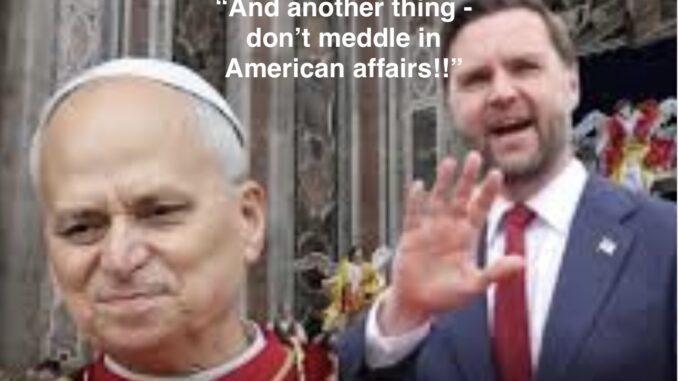
There are moments when irony is so perfectly formed, that it scarcely needs commentary. It simply waits – patiently – for someone to point at it.
This week provided one such moment.
Fresh from a visit to Hungary, where he had travelled to support Prime Minister Viktor Orbán, United States Vice President J.D. Vance returned home with a message of principle. The Pope, he suggested, should refrain from meddling in American affairs.
It is, on its face, a curious sequence.
Hungary is, after all, a sovereign nation. Its elections, its political direction, its internal debates – these are matters for Hungarians. Yet here was the American Vice President, crossing borders not as a neutral observer but as a participant, lending his presence to a leader whose political project has drawn both admiration and alarm across the democratic world.
Then, almost in the same breath, came the admonition: that Pope Leo – a figure without an army, without a vote, without any formal power in the American system – ought to stay in his lane.
One is left to wonder where, precisely, the boundary lies.
Perhaps it is not about borders at all, but about the nature of the voice crossing them. Political power, it seems, travels well. It is welcomed, even encouraged, when it aligns with familiar ideologies. It becomes “support,” “solidarity,” or the defence of shared values.
Moral authority, on the other hand, is treated differently. When it speaks in ways that challenge power rather than reinforce it, it is recast as interference – an unwelcome intrusion into domestic affairs.
The distinction is revealing.
For the Pope does not govern the United States. He cannot pass legislation, command troops, or sway an election by decree. What he can do is speak – to questions of justice, compassion, and responsibility. And it is precisely this kind of voice that has long crossed borders without passports or permission.
To object to that voice, while freely exercising one’s own across those same borders, is not a defence of sovereignty. It is something more selective.
Sovereignty, in this telling, becomes less a principle than a preference – invoked when convenient, set aside when not.
None of this is unprecedented. Politics has always had a flexible relationship with consistency. But there is something unusually stark about moments like this, where the contradiction is not buried in policy detail or hidden behind rhetoric. It stands in plain view.
And perhaps that is why it resonates.
Because in the end, the question is not whether leaders should speak beyond their borders. In an interconnected world, they inevitably will.
The question is whether they are prepared to extend to others the same freedom they claim for themselves.
Keep Independent Journalism Alive – Support The AIMN
Dear Reader,
Since 2013, The Australian Independent Media Network has been a fearless voice for truth, giving public interest journalists a platform to hold power to account. From expert analysis on national and global events to uncovering issues that matter to you, we’re here because of your support.
Running an independent site isn’t cheap, and rising costs mean we need you now more than ever. Your donation – big or small – keeps our servers humming, our writers digging, and our stories free for all.
Join our community of truth-seekers. Please consider donating now via:
PayPal or credit card – just click on the Donate button below
Direct bank transfer: BSB: 062500; A/c no: 10495969

We’ve also set up a GoFundMe as a dedicated reserve fund to help secure the future of our site.
Your support will go directly toward covering essential costs like web hosting renewals and helping us bring new features to life. Every contribution, no matter the size, helps us keep improving and growing.

Thank you for standing with us – we truly couldn’t do this without you.
With gratitude, The AIMN Team

Excellent!
I would expect nothing less than hypocrisy from the man who used his childhood story to affirm his own exceptionalism. Who believes his wife should convert to his chosen religion. Who fails to recognise the higher order of his wife’s faith compared to his American version of a faith lead by a man in a role he clearly has no respect for.
I mean look at what he did to the last pope?
I hate, strongly, absolutely, any deficient egotistical fantasising soulperverted boasting bullshit drenched inferior lump. Vance is more grubby than great, inferior rather than elevated, pompously pricky and not proudly poised, pungently pooish and not predatorily perverse, ethical, not effluent, aware and not a wanker, fastidious and not fascist, posthumous and not preposterous, departed and not depressing…
Excellent article!!
Makes Toxic Rabbott completely irrelevant to Australian politics rather than a FRWNJ pawn yapping on demand from the FRWNJ Murdochracy Media Manipulation Monopoly. Should we expect him to join the Red Ranga’s Political Company for Self Aggrandisement as the ”Suppository of Political Wisdom”? Nah ….. his many ”leadership talents” may challenge her corporate position as CEO of Ranga Incorporated.
Thanks for a fabulous analysis Roger.
This is reminiscent of Anthony Albanese’s participation in the one-word to describe someone moment, when he described Grace Tame as ‘difficult’ for the appreciation of a NewsCorp audience.