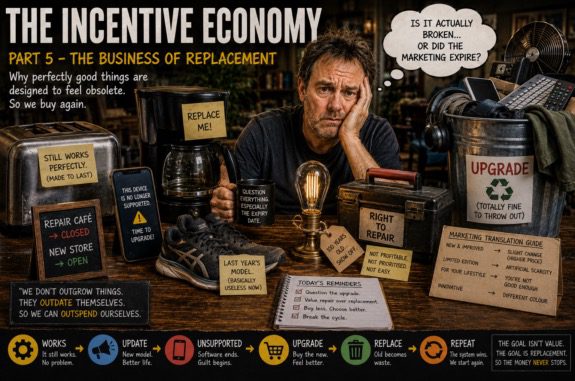
The Incentive Economy
Part 5 – The Business of Replacement
Built to Break?
Dad’s Test
Did I have this problem five minutes ago?
Who benefits if I believe I do?
What happens if I simply say… “No thanks.”
There was a time when buying something that lasted thirty years was considered good business.
Today it can be considered a design flaw.
My grandparents owned furniture older than I am.
My parents owned appliances that seemed determined to outlive civilisation itself.
Somewhere in my shed there’s probably a tool that’s older than ABBA.
It still works.
Annoyingly, from a shareholder’s perspective.
Imagine the conversation.
“Good news!
We’ve invented a washing machine that lasts forever.”
Silence.
Eventually someone from Finance raises a hand.
“… and what exactly are we selling next year?”
Whether or not every example stands up to scrutiny, The Light Bulb Conspiracy asks a fascinating question.
What happens when durability collides with growth?
If your business depends upon selling another product…
… products lasting forever become commercially awkward.
This isn’t to suggest every manufacturer secretly meets once a month beneath an inactive volcano.
Most engineers would probably love to build things that last forever.
Marketing would love to tell everyone about them.
Customer service would throw a party.
The shareholders…
… might ask a different question.
Every phone launch now follows a familiar script.
“This changes everything.”
Odd.
Because they said exactly the same thing last September.
Remember when televisions were furniture?
Now they’re software subscriptions with screens attached.
Cars receive firmware updates.
Your refrigerator has Wi-Fi.
Your toothbrush has Bluetooth.
I’m still trying to work out what my toothbrush desperately needed to communicate.
One day I fear my kettle will refuse to boil water until it downloads Version 14.7.
“Critical security update.”
For tea.
Then there’s fashion.
Apparently colours expire.
Sleeves migrate.
Jeans develop strategic holes costing significantly more than jeans without them.
I remain fascinated by the business model.
Manufacture trousers.
Charge extra for forgetting to finish them.
Genius.
Some replacement is obviously sensible.
Medical technology improves.
Cars become safer.
Computers become dramatically more capable.
Nobody is arguing we should all return to rotary telephones and typewriters.
The question is different.
How much replacement reflects genuine innovation…
… and how much reflects an economy that quietly depends upon us never quite reaching “enough”?
There’s another casualty.
Repair.
Some products are now astonishingly difficult to repair.
Special screws.
Glued batteries.
Unavailable parts.
Software locks.
Sometimes repairing an item costs almost as much as replacing it.
The market politely suggests,
“Perhaps you’d like a new one?”
This isn’t simply about money.
It’s about waste.
Resources.
Energy.
Packaging.
Transport.
Every replacement carries a footprint.
Sometimes invisible.
Always real.
Which brings me back…
Yes…
… to toothpaste.
You knew it was coming.
I’m becoming the Columbo of oral hygiene.
“Just one more thing…”
I still cut open toothpaste tubes.
Not because I expect to retire early on the savings.
Although if toothpaste prices continue rising, perhaps.
No.
Because every little act reminds me that products still have value after the marketing department has declared them finished.
Perhaps that’s the broader lesson.
Sometimes products wear out.
Sometimes fashion wears out.
Sometimes software decides they’ve worn out.
Those aren’t necessarily the same thing.
The Right to Repair movement fascinates me.
Not because I want to repair everything.
I absolutely don’t.
My attempt to repair a vacuum cleaner once resulted in two vacuum cleaners.
Neither worked.
But I admire the principle.
Ownership ought to mean ownership.
Not a temporary licence until the next software update.
Douglas Adams once imagined doors that sighed happily every time someone walked through them.
At the time it seemed ridiculous.
Today my printer sends me emotional notifications about toner levels.
Reality has developed a disturbing determination to outperform satire.
This series keeps reaching the same conclusion.
People respond to incentives.
If companies are rewarded for selling replacements…
they’ll sell replacements.
If consumers are rewarded with convenience…
they’ll choose convenience.
If governments reward repair…
repair grows.
If they don’t…
replacement wins.
Again.
Nobody needs a conspiracy.
The incentives do the coordinating.
So here’s Dad’s Test.
Before replacing something…
Ask:
Is it actually broken?
Or merely unfashionable?
Or simply unsupported because someone decided I should own a newer version?
Sometimes the answer will genuinely be,
“It’s time.”
Other times…
the only thing that expired was the marketing campaign.
Homework (Entirely Optional… But Highly Recommended)
Buy Now! The Shopping Conspiracy
Take a walk around your home.
Find the oldest thing you still use regularly.
Then ask yourself a dangerous question.
Why doesn’t anyone make them like that anymore?
See also:
The Incentive Economy: Part 1 – The Business of Dissatisfaction
The Incentive Economy: Part 2 – The Business of Consumption
The Incentive Economy: Part 3 – The Business of Outrage
The Incentive Economy: Part 4 – The Business of Productivity
The Incentive Economy: Part 6 – The Business of Philanthropy
Keep Independent Journalism Alive – Support The AIMN
Dear Reader,
Since 2013, The Australian Independent Media Network has been a fearless voice for truth, giving public interest journalists a platform to hold power to account. From expert analysis on national and global events to uncovering issues that matter to you, we’re here because of your support.
Running an independent site isn’t cheap, and rising costs mean we need you now more than ever. Your donation – big or small – keeps our servers humming, our writers digging, and our stories free for all.
Join our community of truth-seekers. Please consider donating now via:
PayPal or credit card – just click on the Donate button below
Direct bank transfer: BSB: 062500; A/c no: 10495969

We’ve also set up a GoFundMe as a dedicated reserve fund to help secure the future of our site.
Your support will go directly toward covering essential costs like web hosting renewals and helping us bring new features to life. Every contribution, no matter the size, helps us keep improving and growing.

Thank you for standing with us – we truly couldn’t do this without you.
With gratitude, The AIMN Team

Be the first to comment