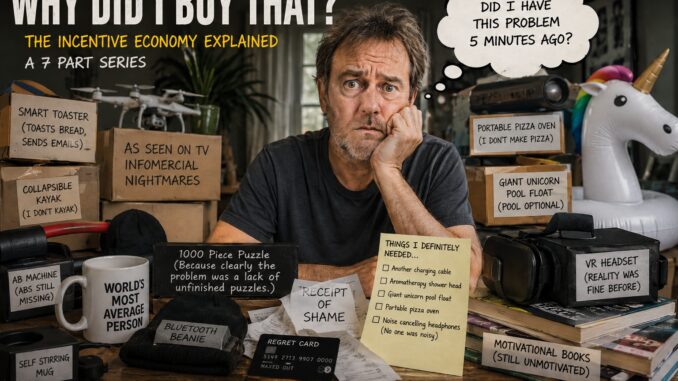
The Incentive Economy
Part 1 – The Business of Dissatisfaction
Did I Have This Problem Five Minutes Ago?
“Markets are brilliant at solving many human problems. They are also brilliant at creating incentives. Sometimes those incentives solve problems. Sometimes they create entirely new ones.”
Introduction
Dad had a theory.
He reckoned businesses used to make things people needed and then advertised them.
Then they started making things people didn’t need and advertised them until people thought they did.
I’ve often thought he was only half right.
Today we’ve gone one step further.
Now we create problems people never knew they had…
…and then sell them the cure.
Sometimes the cure creates the next problem, which is marvellously convenient because there’s already another product waiting to solve that one.
Once I started noticing the pattern, I couldn’t stop seeing it.
It was like buying a red car.
Suddenly everyone else owned one.
Now, before anyone accuses me of wanting to overthrow civilisation, let me make something clear.
I quite like civilisation.
Electricity is nice.
Antibiotics have been a solid investment.
Indoor plumbing deserves every award it ever received.
Business has transformed the world.
Innovation has transformed the world.
Advertising even serves a useful purpose.
If somebody invents a cure for Alzheimer’s, I’d quite like to hear about it.
This isn’t an article against business.
It’s an article about incentives.
Because incentives explain an astonishing amount of human behaviour.
It also explains why, despite being of Scottish ancestry, I occasionally cut open toothpaste tubes.
No… not because I’m trying to save another three cents.
Well… perhaps that’s a pleasant side effect.
My real motivation was packaging.
I became increasingly annoyed by buying a plastic tube inside a cardboard box, carrying something that would disappear in a fortnight while the packaging would outlive several generations of politicians.
For a while I even made my own toothpaste.
It was cheaper.
It produced far less waste.
It also required considerably more effort.
Eventually laziness defeated environmental idealism.
Then my dental hygienist politely explained there were good clinical reasons for using particular toothpastes.
Fair enough.
Back to the supermarket I went.
But I still squeeze every last bit from the tube.
Then I use one of those little gadgets that squeezes even more.
Eventually I cut the tube open.
Remarkably, there always seems to be another week’s worth hiding inside.
Apparently “empty” and “economically inconvenient to extract the remainder” are two very different concepts.
My tiny act of rebellion won’t save the planet.
It probably won’t even save a tube of toothpaste.
But it reminds me to ask a question.
One simple question.
Did I actually have this problem five minutes ago?
Congratulations!
Before breakfast you’ve probably discovered:
- a vitamin deficiency you didn’t know you had;
- an insecurity you somehow missed yesterday;
- three productivity hacks;
- two lifestyle subscriptions;
- a revolutionary water bottle;
- an app that helps organise your other apps;
- and an influencer who just “accidentally” found a product that changed their life.
Quite an achievement before 8 a.m.
Spend another ten minutes scrolling and someone will also explain:
- why you’re ageing incorrectly,
- why your kitchen is holding you back,
- why your dog deserves a mindfulness retreat,
- and why your phone, purchased only eighteen months ago, is now approximately the technological equivalent of a stone axe.
It’s exhausting.
Some parts of the beauty industry make an excellent living reminding perfectly normal people that ageing is apparently a medical emergency.
The fashion industry quietly informs us last year’s perfectly good clothes are now socially unacceptable.
Technology suggests our perfectly functional phone has become a museum exhibit.
Food companies compete to make products irresistibly tasty.
Diet companies compete to help us undo the consequences.
Social media assures us everyone else is happier, healthier, wealthier and somehow manages sunrise yoga before preparing organic breakfasts for photogenic children.
Influencers don’t simply sell products.
They sell aspiration.
Identity.
Belonging.
Fear of missing out.
The fascinating thing is that the product isn’t always the product.
Sometimes the product is dissatisfaction.
One of the reasons I enjoy Jacques Peretti’s documentaries is that he rarely asks,
“Who’s the villain?”
Instead he asks a much better question.
Who benefits?
It’s such a simple question.
Yet ask it often enough and you begin seeing patterns everywhere.
Who benefits if I feel permanently behind?
Who benefits if my perfectly good phone suddenly feels inadequate?
Who benefits if I become convinced my life would be complete if I just owned one more thing?
Who benefits if dissatisfaction quietly becomes normal?
Nobody needs to meet in a secret underground volcano lair wearing capes and stroking white cats.
The incentives do the coordinating.
Douglas Adams once joked that the marketing division of the Sirius Cybernetics Corporation consisted of “a bunch of mindless jerks who’ll be the first against the wall when the revolution comes.”
I don’t think he’d write exactly the same joke today.
These days marketing escaped the advertising department.
It hired behavioural psychologists.
Bought algorithms.
Recruited influencers.
Opened seventeen TikTok accounts.
Acquired three data analytics companies.
Subscribed to premium AI.
And now sends personalised advertisements to my phone moments after I’ve merely thought about buying a garden hose.
Honestly, if my kettle starts suggesting finance podcasts, I’m moving into the shed.
This isn’t an article against capitalism.
Nor is it an article against advertising.
Both have created extraordinary prosperity.
This is simply an invitation to pause.
To ask one small question before buying the next miracle product.
Did I actually have this problem five minutes ago?
Sometimes the answer will be yes.
Wonderful.
Buy the thing.
Sometimes the answer will be no.
That’s worth noticing too.
Because perhaps the world’s most profitable product isn’t toothpaste.
Or smartphones.
Or protein powder.
Or miracle anti-ageing cream.
Perhaps the world’s most profitable product humanity has ever invented…
… is dissatisfaction.
Homework (Entirely Optional… But Highly Recommended)
If this article has made you curious, these documentaries are well worth your time.
Jacques Peretti
- The Men Who Made Us Fat
- The Men Who Made Us Thin
- The Men Who Made Us Spend
- The Super-Rich and Us
- Britain’s Trillion Pound Island
Other documentaries
- The Light Bulb Conspiracy (planned obsolescence)
- The Century of the Self – Adam Curtis
- Buy Now! The Shopping Conspiracy (Netflix)
The Peretti Principle
Before buying the cure…
… ask whether someone first sold you the disease.
Before admiring the solution…
… ask how the problem arose.
Before believing the slogan…
… ask the simplest question of all:
Who benefits?
To be continued… The Incentive Economy: Part 2 – The Business of Consumption
Keep Independent Journalism Alive – Support The AIMN
Dear Reader,
Since 2013, The Australian Independent Media Network has been a fearless voice for truth, giving public interest journalists a platform to hold power to account. From expert analysis on national and global events to uncovering issues that matter to you, we’re here because of your support.
Running an independent site isn’t cheap, and rising costs mean we need you now more than ever. Your donation – big or small – keeps our servers humming, our writers digging, and our stories free for all.
Join our community of truth-seekers. Please consider donating now via:
PayPal or credit card – just click on the Donate button below
Direct bank transfer: BSB: 062500; A/c no: 10495969

We’ve also set up a GoFundMe as a dedicated reserve fund to help secure the future of our site.
Your support will go directly toward covering essential costs like web hosting renewals and helping us bring new features to life. Every contribution, no matter the size, helps us keep improving and growing.

Thank you for standing with us – we truly couldn’t do this without you.
With gratitude, The AIMN Team

DATA EMBEDDED in this month’s Budget confirm Australia’s finances are the envy of the world.
It is the only nation on the planet with jobless and inflation rates below 4.7%, and median wealth per adult above US$250,000 (AU$350,000). It is also the only economy with triple-A credit ratings, interest rates between 1% and 5% and government debt below 25% of gross domestic product (GDP).
Is there a neoliberal scale for happiness,contentedness, peace of mind,love for one another, acceptance of differences?
Numbers are the tools of the souless bean counters.
See whatsername of the RBA.
The series or film “The Corporation” is well worth watching too.
Or read the book by Joel Bakan.