THE INTERVIEW
A tribute to Bryan Dawe and the late John Clarke
DAWE: Prime Minister, welcome.
CLARKE: Good to be here, Bryan.
DAWE: Prime Minister, you said repeatedly before the election that you would not touch negative gearing or capital gains tax. How would you describe those statements now?
CLARKE: Weren’t the Socceroos fabulous against Paraguay?
DAWE: Prime Minister, it was a nil-all draw in one of the dullest, most unimaginative matches in modern FIFA history. And that’s saying something.
CLARKE: We’ve changed our position.
DAWE: Yes, but how would you describe the statements?
CLARKE: We’ve changed our position.
DAWE: The statements, Prime Minister. The ones you made.
CLARKE: They were statements that were made, and that’s why we’ve been up front that we’ve changed our position.
DAWE: Were they promises?
CLARKE: They were statements.
DAWE: Promises?
CLARKE: Statements.
DAWE: Is there a difference?
CLARKE: A statement is what was said. A promise is a commitment to a future course of action based on what was said. They’re related but distinct.
DAWE: And which were these?
CLARKE: They were statements that functioned, at the time, in the manner of commitments, yes.
DAWE: So promises.
CLARKE: Statements we’ve changed our position on.
DAWE: Right. Why?
CLARKE: Because we couldn’t sit back and watch young people being frozen out of the housing market, Bryan. Young Johnny. Young Mary. Locked out.
DAWE: Johnny and Mary.
CLARKE: Archetypal figures, Bryan. They represent a generation.
DAWE: You invented them.
CLARKE: I didn’t invent the problem. Johnny and Mary are a convenience, but the locked-out generation is real. Although I grant you Johnny and Mary themselves are doing the heavy lifting.
DAWE: And yet you yourself have negatively geared property.
CLARKE: We’ve changed our position.
DAWE: You personally –
CLARKE: Going forward.
DAWE: Right. Now, the government promised 1.2 million new homes by 2029.
CLARKE: Supply, supply, supply.
DAWE: The forecast is 938,000.
CLARKE: Supply.
DAWE: That’s 262,000 homes short.
CLARKE: Supply.
DAWE: Is “supply” a policy or just a talking-point?
CLARKE: It’s both, Bryan. It’s also resilience. And social cohesion. And the productive side of the economy. And quite possibly a productivity bonus.
DAWE: A productivity bonus from not building 262,000 homes?
CLARKE: From redirecting investment away from distorted asset classes and toward the Australian dream.
DAWE: Which is home ownership.
CLARKE: Which is home ownership. For young Australians. For Johnny. For Mary. Though as we’ve established, they’re doing a lot of work for two people who don’t technically exist.
DAWE: But house prices will keep rising under your changes?
CLARKE: They’ll continue to increase, yes, but at a slightly slower rate.
DAWE: So they’ll still be unaffordable.
CLARKE: They’ll be slightly less unaffordable. That’s the Australian dream, Bryan. We’re not going to stop dreaming.
DAWE: ACOSS says investors are buying almost twice as many homes as first home buyers.
CLARKE: Which is why we’ve changed our position.
DAWE: To allow investors to keep buying them.
CLARKE: To allow investors to keep buying new ones. Which is supply. Supply, supply, supply.
DAWE: When did you decide to do all this?
CLARKE: Very late in the process.
DAWE: How late?
CLARKE: Well, final decisions were taken very recently.
DAWE: After the election?
CLARKE: After a great many things. The global situation. The volatility. December the 14th.
DAWE: What happened on December the 14th?
CLARKE: We changed our position.
DAWE: About negative gearing.
CLARKE: About a great many things, Bryan. Fuel tax. Capital gains. The distortions created by the Howard government in 1999.
DAWE: Were you in parliament in 1999?
CLARKE: I was.
DAWE: Did you own investment property in 1999?
CLARKE: (pause) We’ve changed our position.
DAWE: Prime Minister, is there any position you haven’t changed?
CLARKE: Bryan, if you concentrate on good policy, the politics will look after itself.
DAWE: And if you concentrate on good politics?
CLARKE: Supply, supply, supply.
DAWE: Prime Minister, thank you.
CLARKE: The Australian dream, Bryan. For every Johnny. Every Mary. Going forward. Resilience.
DAWE: We’ll see you again at the Mid-Winter Ball? Is it true Angus has only seventeen percent acceptance on his dance card?
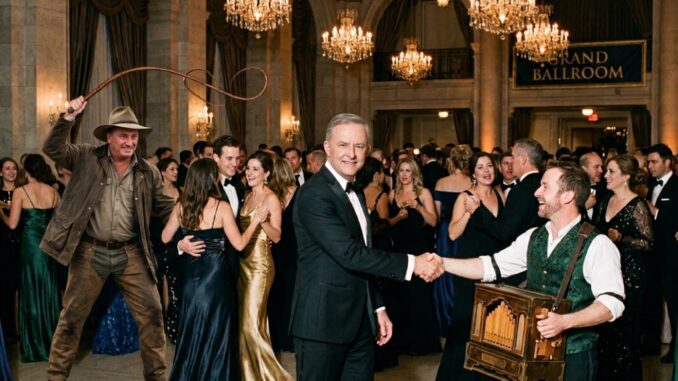
CLARKE: Barnaby’s cracking his stock-whip. Wouldn’t miss it for quids. And I’ll be tapping the odd investor-class organ-grinder’s monkey on the shoulder in the Excuse-Me Waltz. My oath, I will be. Be there with bells on.
This article was originally published on URBAN WRONSKI WRITES
Keep Independent Journalism Alive – Support The AIMN
Dear Reader,
Since 2013, The Australian Independent Media Network has been a fearless voice for truth, giving public interest journalists a platform to hold power to account. From expert analysis on national and global events to uncovering issues that matter to you, we’re here because of your support.
Running an independent site isn’t cheap, and rising costs mean we need you now more than ever. Your donation – big or small – keeps our servers humming, our writers digging, and our stories free for all.
Join our community of truth-seekers. Please consider donating now via:
PayPal or credit card – just click on the Donate button below
Direct bank transfer: BSB: 062500; A/c no: 10495969

We’ve also set up a GoFundMe as a dedicated reserve fund to help secure the future of our site.
Your support will go directly toward covering essential costs like web hosting renewals and helping us bring new features to life. Every contribution, no matter the size, helps us keep improving and growing.

Thank you for standing with us – we truly couldn’t do this without you.
With gratitude, The AIMN Team

Your enthusiasm is warranted and the facts bear it out, though a couple of the framings need tightening.
The 50% CGT discount was introduced by the Howard Government in 1999, following the Ralph Review of Business Taxation, ostensibly to encourage venture capital investment and a stronger investment culture. Instead of flowing into high-growth companies as Howard’s inquiry had envisaged, the money flooded into housing, which was simply easier to borrow against. So yes — 25-plus years of riding Howard’s coattails is accurate.
On benefit concentration — your instinct is right, but the “few multi-property landlords” framing slightly undersells it. The real scandal is income concentration, not just property numbers. Around 83% of the benefit of the current CGT discount goes to the top 10% of taxpayers by income. Investors earning more than $180,000 a year claimed roughly $1.3 billion in negative gearing deductions in 2021–22 alone. The structural reason is straightforward: a high-income professional on the top bracket saves $4,700 on every $10,000 of rental loss; so the higher your income, the sweeter the deal. Defenders love to cite nurses and teachers using it, which is true but statistically very marginal.
On what’s actually been announced — this is now Budget 2026 policy, not just a Shorten-era proposal. Lucky Jim Chalmers has confirmed that the 50% CGT discount will revert to the pre-Howard inflation-linked model with a minimum 30% tax rate, and negative gearing has been scrapped only for existing properties, with eligible new builds retaining the benefit. Existing arrangements remain unchanged for all properties purchased before 7:30pm on 12 May 2026, until they are sold: so nobody’s retrospectively dudded, which takes the wind out of the loudest objections. (Or so you’d hope.)
One thing to watch: 83% of new investor loans in 2025 went to existing property rather than new housing. Redirecting that incentive toward new builds is coherent housing policy, not just revenue-raising. Whether it actually shifts supply will be the test.
The reforms are overdue. The framing of “contributing to the common wealth after 20 years” is exactly right. And politically, it’s now law in progress rather than a defeated Shorten proposal.
@ David Tyler: Thank you for the additional information about the Shorten Chalmers Reforms to Residential Housing investment. I only wish I had kept the statistical data on the small proportion of high income beneficiaries of the Howard system.
Check out the lovely pic of the six Community Independent (Teals) MPs at the 2026 Mid Winter Ball in Canberra. Six highly successful ladies who, in their own right, have been very successful in their pre-politics life and careers.
Perhaps we should post that pic on every COALition pollies page simply because it must be the misogynist’s worst nightmare.
Could not give a toss about the Canberra bubble preening their feathers and self aggrandizing.