By Denis Hay
Description
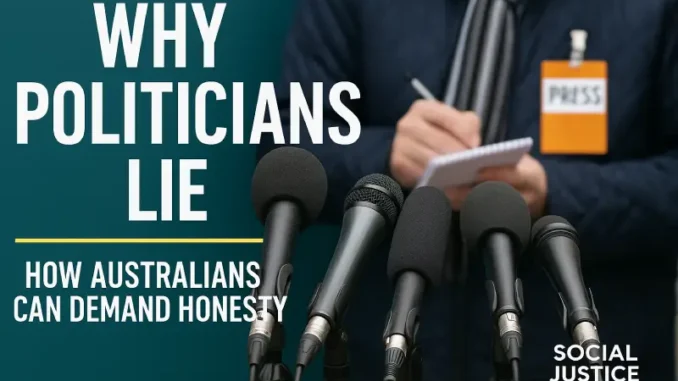
Why politicians lie is not random. Learn the real reasons, the hidden incentives, and how Australians can demand honesty.
🎧 Prefer to listen to this article? Press play
Introduction
Many Australians feel exhausted by the constant spin. Voters ask why politicians lie, why the media repeats misleading claims, and why broken promises are treated like everyday politics. The truth is simple. Politicians lie when lying works. They lie when there are rewards for dishonesty, and almost no penalties for misleading voters.
Australians ask why politicians lie when the truth should guide policy, not power.
Statistic Box:
- 71 per cent of Australians believe politicians rarely tell the truth.
Source: abc.net.au – Vote Compass trust survey.
If honesty had real consequences, fewer would lie. So how do we fix this?
The Problem: Why Australians Feel Stuck
Root Cause
At the heart of this crisis is power. Big donors, corporate lobbyists, and media interests receive help from spin. When truth threatens profit, secrecy becomes the preferred course of action. This is where truth in Australian politics breaks down. Political advertising can legally mislead voters because there is no national truth rule.
The lack of accountability explains why politicians lie to maintain control rather than risk exposure.
Internal link: Political reform and citizen power.
Reflective question: Why should ordinary Australians accept a system that rewards deception?
Power question: Who receives help from confusing the public?
Consequences for Citizens
Every misleading claim hides actual harm. Families feel the cost-of-living stress while politicians repeat slogans. People experience the results of why politicians lie every day, from shrinking services to growing distrust.
Workers hear promises of wage growth that never arrive. Ordinary Australians lose faith in democracy itself.
External source: grattan.edu.au – Hidden influence of political donations.
This is why people search for why politicians lie. They feel tricked.
The Impact: What Australians Are Experiencing
Everyday Effects
Lies are not harmless. They shape budgets, services, and lives.
- Housing affordability gets worse.
- Job insecurity grows.
- Public hospitals struggle.
- Aid programs are cut without warning.
This is where media accountability in Australia matters. When powerful media groups repeat government spin, the public hears the same message from every direction.
Internal link: media literacy.
Reflective question: How can people make informed choices if the information is false?
Rally line: We deserve honest leadership, not marketing slogans.
Who Benefits
When truth is weak, power wins. Lobbyists, donors, major corporations, and politically aligned media all gain freedom to influence Australian laws. Public money flows upward, while citizens carry the burden.
Understanding why politicians lie exposes the structure of power that rewards secrecy and punishes truth.
There is another aspect of this problem that most Australians are unaware of. Community organisations that rely on government grants often sign agreements that restrict their freedom of action. Some funding contracts include rules that ban criticism of the funding department. Others forbid advocacy on behalf of clients. If an organisation speaks out, its funding can be cut.
This matters because many of the problems Australians face are created by government decisions. For example, families dealing with housing stress, disability services, or unemployment are often struggling because of policy failures. Yet the organisations that see this harm up close are not allowed to say it. They cannot warn the community. They cannot ask for better laws. Silence becomes a condition of survival.
When frontline voices are gagged, only politicians and aligned media outlets are heard. The truth becomes hidden, and accountability disappears.
Rally line: A fair society cannot exist if honesty is punished.
The Solution: What Must Be Done
Australia’s Monetary Sovereignty and Reform
Australia has dollar sovereignty, which means we can fund public purposes without relying on wealthy donors or foreign interests.
Imagine:
- A publicly funded fact-check body.
- Truth in political advertising laws.
- Real transparency for political donations.
- A strong NACC with unlimited reach.
Internal link: public money.
The truth is that a better democracy is affordable. We need the courage to demand it.
Policy Solutions and Demands
- Truth in political advertising.
- Real-time donation disclosure.
- Caps on corporate lobbying.
- Strong public media funding.
- Community-owned journalism.
- Criminal penalties for serious political deception.
Future vision: Imagine an Australia where leaders respect the people, not donors.
Frequently Asked Questions
Q1: Why do politicians lie to voters?
The primary reason is incentives. Without strong laws, lying is safer than honesty. This is the core of why politicians lie.
Q2: What is a truth-in-advertising law?
It is a rule that bans misleading political claims and introduces real penalties. Countries like New Zealand already apply versions of this.
Q3: Who checks political donations?
Transparency International and the Australian Electoral Commission track disclosures, but delays and loopholes weaken accountability.
Q4: What is Media Accountability Australia?
It refers to reforms that hold media companies responsible for misleading or biased content, especially during elections.
Final Thoughts
Australia does not have to accept deception. We know why politicians lie, and we see how it harms everyday people. The next step is action. With better laws, stronger media regulation, and public money used for public purposes, honesty becomes the safer path.
Australians deserve leaders who tell the truth, not excuses. Knowing why politicians lie helps us demand better.
What is Your Experience
Have you seen an example of a political lie that affected your life? Share your experience in the comments. Your voice matters.
Call to Action
We’d Love to Hear from You
If you found this article insightful, explore more about political reform and Australia’s monetary sovereignty on the Social Justice Australia website.
Please share your thoughts through our Reader Feedback form, check out what others are saying on our Testimonials page, or scroll down and leave a comment below. Your voice helps shape future content.
Spread the Word
Change starts with conversations. Share this article with friends, family, or your social networks so more Australians can see what’s possible. Every share helps build momentum for a fairer society.
Keep Independent Journalism Alive
We’re 100% reader-supported, no ads, no corporate strings, just honest, truth-driven journalism. If our work has informed or inspired you, we invite you to consider contributing. Even $5, or whatever you can spare, helps us keep publishing and reaching more Australians.
Donate Now – one-time or monthly.
Already donated? Share the love by leaving us a quick review on Google to help others find us.
This article was originally published on Social Justice Australia
Keep Independent Journalism Alive – Support The AIMN
Dear Reader,
Since 2013, The Australian Independent Media Network has been a fearless voice for truth, giving public interest journalists a platform to hold power to account. From expert analysis on national and global events to uncovering issues that matter to you, we’re here because of your support.
Running an independent site isn’t cheap, and rising costs mean we need you now more than ever. Your donation – big or small – keeps our servers humming, our writers digging, and our stories free for all.
Join our community of truth-seekers. Donate via PayPal or credit card via the button below, or bank transfer [BSB: 062500; A/c no: 10495969] and help us keep shining a light.
With gratitude, The AIMN Team


Chris Bowen said today “When the Coalition left government in May 2022, the monthly average wholesale electricity price was $317 — in May 2025 [at the time of the election] it was $108 and in October [2025] the monthly average wholesale price was $67.”
This was after Sussan Ley was reported as saying: “Under Labor, power bills are up nearly 40 per cent, household budgets are stretched to the limit, and industry and small businesses are collapsing under the weight of rising costs. Australians deserve an energy policy that puts them first.”
The problem we have is not so much politicians telling lies but our media not questioning them.
Anybody know what the above statements actually mean to the average energy consumer ?
My electricity is ok, but they’ve had a good munch with gas bills.
You’re absolutely right, Terry. The real issue is media accountability. When journalists report political claims without context, citizens are left confused about what’s true.
Wholesale prices reflect the costs that energy companies pay before adding retail markups. The average consumer pays retail rates, which include network fees, retailer margins, and profit. So, while wholesale prices have dropped, power bills haven’t followed because privatised networks and retailers pocket the difference.
That’s why we argue that Australia needs publicly owned energy systems and independent media that challenge both sides, rather than repeating talking points.
Paul
Good point, Paul. Gas prices are a major problem. Even though Australia exports more gas than almost any other nation, locals pay international market prices. It’s another case where public resources are sold for private profit.
If governments utilised Australia’s dollar sovereignty to invest in public energy and maintain price stability, ordinary Australians wouldn’t be penalised every time global markets fluctuate.
thanks for comments, Dennis Hay.
I think this children’s fable holds the clue….
https://medium.com/interfaith-now/the-scorpion-and-the-turtle-a-short-sermon-on-wholeness-and-hate-d13fcff5ea2b