By Denis Hay
Description
Australia’s rare earth deal with the US fuels its military industry, not our sovereignty. Here’s why that matters.
🎧 Prefer to listen to this article? Press play
Introduction: Australia’s Strategic Crossroads
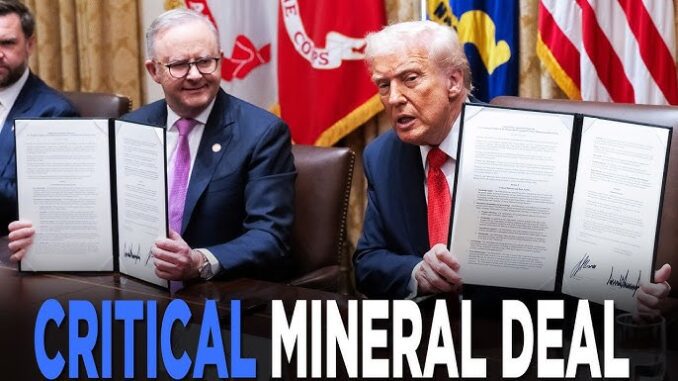
In October 2025, Prime Minister Anthony Albanese signed an $8.5 billion rare earth deal with the United States, promising closer economic and security ties. The agreement appears to be an opportunity to boost Australia’s resource sector. Yet beneath the surface, it reveals a deepening alignment with the US military-industrial complex through the AUKUS alliance.
As China restricts exports of key rare earth metals used in advanced weaponry, the US is turning to Australia for supply. The question is simple but profound: is the rare earth deal Australia signed a path to sovereignty, or servitude?
The Problem: How the Deal Strengthens Dependence
1. The Geopolitical Trigger – China’s Ban and US Pressure
China’s export controls on critical minerals such as gallium and germanium were a strategic response to the US using them for missile guidance systems, fighter jets, and submarines. Washington needed a reliable alternative, and Canberra complied.
Through the AUKUS alliance, Australia is being drawn into the US defence supply chain, undermining our ability to chart an independent foreign policy. Rather than investing in peaceful manufacturing and clean-energy industries, our resources are now fuelling a global arms race. (ABC News)
2. Resource Exploitation Without Return
Australia holds about 20% of the world’s rare earth reserves, yet most of our minerals are exported raw and processed overseas. This deal continues that pattern, foreign corporations’ profit while Australians bear the environmental costs. Public money is used to subsidise foreign ventures instead of funding domestic processing plants that create local jobs. (AP News)
The Impact: What Australians Are Experiencing
3. From Mining Boom to Dependency Economy
Despite decades of booms, Australia is still a “dig-and-ship” nation. The rare earth deal Australia signed solidifies our position as a key supplier of raw materials to the US military supply chain. Communities see little benefit while regional inequality and labour insecurity grow.
See also “The Case for a Job Guarantee: Australia’s Next Big Economic Reform.”
4. Who Really Benefits
The true winners are US defence contractors like Raytheon and Lockheed Martin, who depend on steady rare earth supplies for weapons production. Under AUKUS, Australia is obliged to supply these resources for military use while receiving limited technology transfer. Once again, public money serves private foreign interests. (Politico)
Who Owns the Processors: and Who Gets the Profits
The Albanese government’s rare earth deal, which Australia signed with the United States, has been presented as a boost to local industry. Yet a closer look at who owns the companies processing these critical minerals shows the profits often flow overseas or to private shareholders, not the Australian public.
1. Iluka Resources – Eneabba, Western Australia
Iluka runs Australia’s first integrated rare-earth refinery, funded by a $1.65 billion public loan from the federal government’s Critical Minerals Facility. The project includes a “no-China” clause to satisfy US and UK defence interests. Although Iluka is ASX-listed, profits go to private and institutional investors, not the public, while its supply contracts serve foreign markets.
2. Lynas Rare Earths – Kalgoorlie and Malaysia
Lynas, another ASX-listed firm, runs processing plants in Kalgoorlie and Malaysia. It received early investment from Japan’s Sojitz and JOGMEC, who keep offtake rights. A substantial part of Lynas’s refined output is exported to Japan and US defence manufacturers, making Australia a supplier in the AUKUS alliance rather than an independent producer.
3. Arafura Rare Earths – Nolans Project, Northern Territory
Arafura promotes itself as an Australian company, but binding offtake agreements with Hyundai, Kia, Siemens Gamesa, and Traxys cover most of its planned production. This means much of its revenue will come from foreign contracts, while Australian taxpayers help fund infrastructure and environmental oversight.
4. Alpha HPA – Gladstone, Queensland
Alpha HPA’s high-purity alumina project has been hailed as a clean-tech success, supported by hundreds of millions in government loans. However, its customers are primarily offshore electronics and battery manufacturers, meaning the profits leave Australia even though public funds help build the facilities.
5. Australian Strategic Materials (ASM) – Dubbo, New South Wales
ASM’s Dubbo project has strong ties with a South Korean consortium, with potential equity and offtake arrangements already in place. While the plant is in Australia, most of the downstream manufacturing and profit realisation will occur in Asia.
The Sovereignty Gap
While several companies are headquartered in Australia and listed on the ASX, the real issue is who controls the value chain. With foreign investors and defence-aligned buyers dominating the market, Australia captures little of the long-term benefit.
Despite processing more at home, the profits and strategic control remain offshore, perpetuating the dependency model that the AUKUS alliance reinforces.
Australia’s monetary sovereignty gives our government the power to invest directly in publicly owned processing facilities, ensuring the nation, not foreign corporations, reaps the rewards of our natural resources.
What Are Offtake Rights?
Offtake rights (or offtake agreements) are long-term contracts that guarantee a buyer, often a foreign company or government, the right to buy a project’s output before it’s even produced.
In Australia’s rare-earth sector, these deals are common. Companies such as Lynas and Arafura sign binding agreements with foreign manufacturers like Hyundai, Kia, and Sojitz, ensuring that a large share of future production is already sold offshore.
While these contracts give mining firms financial security, they also mean:
- Foreign buyers control supply and pricing for years ahead.
- Australia loses flexibility to use its resources for domestic industries.
- The real profits are realised overseas through manufacturing, not at the mine site.
In short, offtake rights often transform Australia’s role from resource owner to resource supplier – while other nations reap the strategic and economic gains.
The Solution: Building Sovereign Capacity
6. Using Australia’s Dollar Sovereignty to Invest at Home
As a monetarily sovereign nation, Australia can create the funds needed to build domestic processing plants, train a high-skilled workforce, and invest in clean-tech manufacturing. There is no financial need to depend on foreign capital or AUKUS partnerships to develop these industries.
See “Where Does the Money Go? Understanding Australia’s Billions.”
7. Policy Path Forward – For a Peaceful and Independent Future
- Create a National Rare Earth Authority to oversee public ownership and ethical export controls.
- Use public funding to develop clean-energy and circular-economy industries.
- Mandate that critical minerals serve civilian and environmental goals, not foreign militaries.
- Strengthen regional processing and training to build secure, well-paid employment.
Australia can be a leader in peaceful innovation if we use our dollar sovereignty for the public good.
Frequently Asked Questions
Q1. Why did China ban rare earth exports to the US?
These metals are used in advanced weapon systems. China sought to limit military applications of its resources.
Q2. How does AUKUS tie to the rare earth deal Australia signed?
The AUKUS alliance integrates defence industries between the US, UK, and Australia. The rare earth deal feeds materials into that shared supply chain.
Q3. Can Australia process its own rare earths using public funding?
Yes. With monetary sovereignty, the federal government can fund public processing facilities and research to keep value onshore.
Final Thoughts: Reclaiming Our National Purpose
The rare earth deal Australia signed with the US is not a path to self-reliance, it’s a reinforcement of foreign control. Australia’s resources and currency should serve our citizens, not foreign military goals. It’s time to reclaim our economic and moral sovereignty by investing in industries that build peace, prosperity, and public well-being.
What’s Your Experience?
Do you believe the rare earth deal Australia made strengthens our nation or sells it short? Share your thoughts below.
Call to Action
We’d Love to Hear from You
If you found this article insightful, explore more about political reform and Australia’s monetary sovereignty on the Social Justice Australia website.
Please share your thoughts through our Reader Feedback form, check out what others are saying on our Testimonials page, or scroll down and leave a comment below. Your voice helps shape future content.
Spread the Word
Change starts with conversations. Share this article with friends, family, or your social networks so more Australians can see what’s possible. Every share helps build momentum for a fairer society.
Keep Independent Journalism Alive
We’re 100% reader-supported, no ads, no corporate strings, just honest, truth-driven journalism. If our work has informed or inspired you, we invite you to consider contributing. Even $5, or whatever you can spare, helps us keep publishing and reaching more Australians.
Donate Now – one-time or monthly.
Already donated? Share the love by leaving us a quick review on Google to help others find us.
This article was originally published on Social Justice Australia
Keep Independent Journalism Alive – Support The AIMN
Dear Reader,
Since 2013, The Australian Independent Media Network has been a fearless voice for truth, giving public interest journalists a platform to hold power to account. From expert analysis on national and global events to uncovering issues that matter to you, we’re here because of your support.
Running an independent site isn’t cheap, and rising costs mean we need you now more than ever. Your donation – big or small – keeps our servers humming, our writers digging, and our stories free for all.
Join our community of truth-seekers. Donate via PayPal or credit card via the button below, or bank transfer [BSB: 062500; A/c no: 10495969] and help us keep shining a light.
With gratitude, The AIMN Team


Australians need to do their homework on what “processing” of rare earths entails
Historically it has been a pretty filthy business, leaving vast areas of land unusable, radioactively polluted, and creating “cancer villages”
You’re absolutely right, Noel. Rare-earth processing has a grim history of radioactive waste and contamination. That’s why any move toward onshore processing must include strict environmental standards, transparent oversight, and public ownership to prevent profit-driven shortcuts.
I see that Albanese wants to rush new Federal environmental laws through Parliament and that the US is in a great hurry to replace the weapons that require parts that are made with these rare earths. Rare earths that China will no longer supply to it.
In its over-enthusiasm the US has depleted its weapons stockpile fighting the war it created to extend Russia in Ukraine and also with its collaboration in Israel’s genocide of the Palestinian people in Gaza, as well as its pre-planned actions against Iran. Now it has Venezuela in its sights, and of course it needs more missiles if it is ever going to get its much-desired war with China up and running. But China won’t cooperate, so up jumps lap-dog Albanese like Lassie coming to the rescue.
I don’t see much hope for any strict environmental standards protecting the environment from damage caused by extracting and processing these rare earths. Not with both government and opposition eager to collaborate with the most egregious warmongering criminals in history. There have been a great many such criminals throughout the ages but none of them stand out as clearly and as brazenly as this lot do.
You’ve raised powerful points, B. The rush to supply rare earths for military use does seem to come at the expense of environmental care and moral responsibility. Australia should never trade its values or the health of its land to support a warmongering nation that poses a serious threat to world peace. Public transparency and strong environmental laws are the least we should demand before any project proceeds.
The main difference between the Liar’s government and Abalone’s, is that the latter are far more discrete and sneaky,having learned from the in-your-face corruption of the former rabble.
Forked tongued politicians still rule,despite the Labor apologists failing to spot the rank bullshit going on.
Nothing really meaningful will happen until they are gone.The duopoly needs to be punted into oblivion…unless the Orange Orifice beats them to it.
re. “Australia should never trade its values or the health of its land to support a warmongering nation that poses a serious threat to world peace.”… but we already do, Denis!
Pine Gap via Alice Springs, NT,
Naval Communication Station Harold E. Holt, Exmouth, WA,
HMAS Stirling, Garden Island WA,
Logistics depot, Albury-Wodonga (NSW/Vic),
RAAF Base Tindal, Katherine, NT,
Shoalwater Bay Joint Exercises, Capricorn Coast, Qld.
Them damn Yankees already dang gone and got them there hooks into us, ain’t it so? Tell me it ain’t so, brother. Tell me it ain’t gonna be ferever.
You’re right, Harry, both major parties have lost touch with the public. Real change starts when voters back independents who put people before donors. Let’s use our dollar sovereignty and collective power to rebuild democracy from the ground up.
MP Email Template
Subject: Demand for Transparency and Accountability in Government Deals
Dear [MP’s Name],
As your constituent, I’m deeply concerned about the lack of transparency in recent trade and defence deals, especially those involving rare earths and foreign interests.
Australia deserves open disclosure of contracts, environmental standards, and long-term impacts on sovereignty. Please confirm your position on:
Public ownership of strategic industries.
Full transparency of government contracts.
Commitment to peace-focused foreign policy.
I look forward to your response and actions on these urgent issues.
Kind regards,
[Your Name]
[Your Postcode]
You’re right, Canguro, the US already has deep military reach across Australia. Those bases make us a forward platform for their wars, not a partner for peace. The real question now is how long Australians will accept this loss of sovereignty before demanding independence in defence and foreign policy.