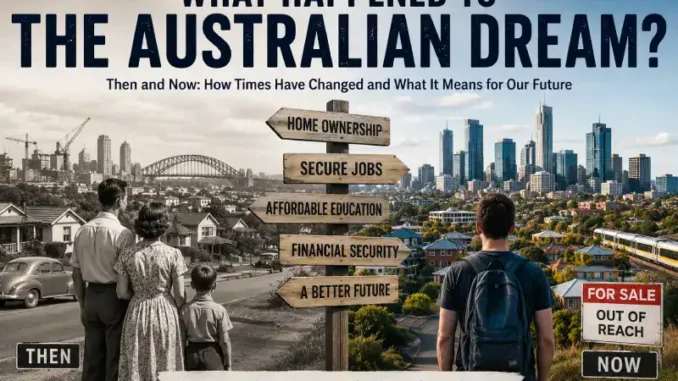
By Denis Hay
Description
Australian Dream: What changed? Explore housing, jobs, education and living standards, and whether the dream can still be achieved.
Introduction
When I left school at 15 in 1957, finding work was not a major concern. Government departments, public utilities, railways, banks, and private employers actively recruited young people. Training was often provided on the job. Many workers expected that if they worked hard, saved carefully, and contributed to their communities, they could buy a home, raise a family, and retire with dignity.
That vision became known as the Australian Dream.
Today, many Australians wonder whether that dream still exists. Home ownership is becoming more difficult for younger generations, secure employment is less common, and the cost of living continues to rise faster than many household budgets. At the same time, Australians enjoy technological advances, better healthcare, and opportunities that previous generations could scarcely imagine.
So, what happened to the Australian Dream? Was life easier decades ago, or has the nature of the dream simply changed?
The answer lies somewhere between nostalgia and reality.
If You Value Independent Analysis
If you value independent, fact-based analysis that explores the issues shaping Australia, please consider supporting Social Justice Australia.
👉 Support independent analysis at:
https://socialjusticeaustralia.com.au/support-social-justice-australia/
What Was the Australian Dream?
The Australian Dream was never simply about owning a house.
It represented the belief that ordinary Australians could build a secure and comfortable life through effort, opportunity, and community support.
Home Ownership Was Within Reach
For much of the post-war period, housing costs were lower relative to household incomes than they are today. Many families could purchase a modest home on a single wage.
According to the Australian Bureau of Statistics, home ownership rates remained high for decades, helping families build financial security and pass assets to future generations.
Secure Employment Was Common
Permanent full-time employment was the norm rather than the exception. Large employers frequently provided training, apprenticeships, and long-term career pathways.
Government agencies actively recruited school leavers and invested heavily in workforce development.
Education Opened Doors
The technical education system provided practical skills that employers valued. University education was heavily subsidised or free during parts of Australia’s history, making higher education accessible to many students regardless of family income.
Retirement Appeared Achievable
Australians expected that steady employment and home ownership would provide a reasonable retirement.
While life was far from perfect, many people felt confident about their future.
Was Life Really Better Then?
The answer depends on what aspect of life is being examined.
Advantages Earlier Generations Enjoyed
Many Australians who entered adulthood between the 1950s and 1980s experienced:
- Lower housing costs relative to income.
- Greater job security.
- Lower household debt.
- Stronger wage growth.
- More affordable education.
Advantages Modern Australians Enjoy
Today’s Australians benefit from:
- Longer life expectancy.
- Advanced medical treatments.
- Greater workplace protections.
- Expanded rights for women and minorities.
- Instant communication and global connectivity.
- Access to vast educational resources.
Avoiding the Nostalgia Trap
Every era has challenges.
Earlier generations faced discrimination, limited career opportunities for many groups, fewer consumer choices, and lower living standards in several areas.
The question is not whether the past was perfect. It is whether opportunities available to ordinary Australians have become harder to attain.
The Australian Dream Then and Now
| Area | Earlier Generations | Today |
| Home ownership | Generally more affordable | Often requires much larger deposits |
| Employment | More permanent positions | Growth of casual and contract work |
| Education | Lower financial barriers | Significant student debt for many |
| Household debt | Relatively modest | Among the highest in the world |
| Retirement | Home ownership more common | Greater financial uncertainty |
| Cost of living | Lower housing burden | Housing dominates many budgets |
Why Many Australians Feel They Are Falling Behind
Housing Costs Have Surged
Housing affordability has become one of Australia’s most significant economic challenges.
Data from the Reserve Bank of Australia and the Australian Bureau of Statistics show that house prices have increased much faster than wages over recent decades.
For many younger Australians, saving a deposit can take years.
Secure Employment Has Declined
The labour market has become more flexible, but flexibility often comes with uncertainty.
Many workers now move between temporary contracts, casual employment and gig economy work rather than enjoying long-term employment with a single employer.
Cost of Living Pressures Continue to Grow
Australians face rising costs across many essential areas:
- Housing.
- Insurance.
- Electricity.
- Healthcare.
- Childcare.
- Groceries.
Even when wages increase, households often feel little improvement because living expenses consume much of the additional income.
Household Debt Has Expanded
Australia now has one of the highest household debt levels among developed nations.
Large mortgages have become a normal part of life for many families, increasing financial vulnerability when interest rates rise.
The Policies That Changed Australia
Major economic and political changes have shaped modern Australia.
Economic Deregulation
Beginning in the 1980s, Australia adopted reforms designed to increase competition, improve efficiency, and integrate more closely with global markets.
Many economists argue these reforms improved productivity and economic growth.
Critics argue that some benefits flowed disproportionately to those who already owned significant assets.
Privatisation
Governments sold or corporatised many public assets and services.
Supporters argue this improved efficiency.
Critics point to rising costs, reduced accountability, and diminished public control over essential infrastructure.
Housing Policy
Housing policy has become increasingly controversial.
Debates continue regarding:
- Housing supply.
- Planning regulations.
- Investment incentives.
- Public housing availability.
- Infrastructure planning.
Labour Market Reform
Workplace reforms created greater labour market flexibility but also contributed to the growth of insecure employment for some workers.
The Australian Dream Through the Decades
1950s and 1960s
Rapid economic growth, expanding public infrastructure and strong employment opportunities characterised this period.
1970s
Social reforms expanded educational opportunities and social protections.
1980s and 1990s
Economic deregulation, financial liberalisation, and privatisation reshaped the economy.
2000s
Property values accelerated rapidly, increasing wealth for some households while making home ownership more difficult for others.
2010s to Today
Housing affordability, cost-of-living pressures, and insecure employment emerged as major concerns across the political spectrum.
Why Younger Australians See the Future Differently
Many younger Australians delay major life milestones because of financial pressures.
These delays can include:
- Purchasing a home.
- Starting a family.
- Building savings.
- Planning retirement.
The result is a growing perception that each generation may have fewer opportunities than the one before it.
Whether that perception is entirely accurate remains debated, but it has become a significant social and political issue.
Can the Australian Dream Be Rebuilt?
The Australian Dream is not necessarily lost.
However, rebuilding confidence requires policy choices that expand opportunity.
Increase Housing Supply
A combination of public, community and private housing development could improve affordability.
Invest in Skills and Education
Strong education and training systems remain essential for economic mobility.
Encourage Secure Employment
Policies that promote workforce stability can help households plan for the future.
Build National Infrastructure
Infrastructure investment improves productivity and supports long-term economic growth.
Focus on Real Resources
A key question is not simply whether governments can afford to act, but whether Australia possesses the labour, materials, skills, and productive capacity needed to achieve desired outcomes.
As a nation with its own sovereign currency, Australia’s practical limits are often determined more by available real resources than by financial constraints alone.
What Can Citizens Do?
Australians are not powerless.
Citizens can:
- Stay informed about public policy.
- Engage with local representatives.
- Participate in community organisations.
- Support transparency and accountability.
- Vote based on evidence and long-term outcomes.
Democracy works best when citizens remain actively engaged.
Frequently Asked Questions
Is the Australian Dream dead?
No. Many Australians still achieve home ownership, career success, and financial security. However, many pathways have become more challenging than they were for previous generations.
Why is housing less affordable today?
Factors include population growth, planning constraints, investment demand, land costs, and decades of rising property values.
Did earlier generations have it easier?
In some areas, particularly housing affordability and job security, many indicators suggest they did. In other areas, modern Australians enjoy significant advantages.
Can younger Australians still succeed?
Yes. However, success often requires navigating a more complex economic environment than previous generations faced.
What role does government policy play?
Government decisions regarding housing, education, infrastructure, employment, and taxation can significantly influence opportunities available to citizens.
Conclusion
The Australian Dream has not disappeared, but it has changed.
For many Australians, the path to home ownership, secure employment and financial stability has become more difficult than it was for previous generations. At the same time, modern Australians enjoy advances in healthcare, technology, and social progress that earlier generations could scarcely imagine.
Understanding what happened to the Australian Dream requires moving beyond nostalgia and examining the evidence. The future will depend on the choices Australia makes regarding housing, education, employment, and economic development.
The Australian Dream remains possible but ensuring that it remains achievable for future generations is one of the most important challenges facing the nation.
Call to Action
If you found this article insightful, explore more about political reform and Australia’s monetary sovereignty on Social Justice Australia: https://socialjusticeaustralia.com/.
Share this article with your community to help drive the conversation toward a more just and equal society.
Click on our “Reader Feedback” menu. Let us know how our content has inspired you. Submit your testimonial and help shape the conversation today!
Additionally, leave a comment about this article below.
Remember: as a nation with dollar sovereignty, Australia can invest public money to serve public purpose, tell your MP you support that.
Question for Readers
What part of the Australian Dream do you think has become hardest to achieve today, home ownership, secure employment, affordable education, or retirement security?
References
Bank of Japan: Monetary Policy Framework https://www.boj.or.jp/en/mopo/outline/qqe.htm
SIPRI Military Expenditure Database https://www.sipri.org/databases/milex
worldbank.org – China Infrastructure & Development Overview https://www.worldbank.org/en/country/china/overview
This article was originally published on Social Justice Australia
ALSO BY DENIS HAY:
Keep Independent Journalism Alive – Support The AIMN
Dear Reader,
Since 2013, The Australian Independent Media Network has been a fearless voice for truth, giving public interest journalists a platform to hold power to account. From expert analysis on national and global events to uncovering issues that matter to you, we’re here because of your support.
Running an independent site isn’t cheap, and rising costs mean we need you now more than ever. Your donation – big or small – keeps our servers humming, our writers digging, and our stories free for all.
Join our community of truth-seekers. Please consider donating now via:
PayPal or credit card – just click on the Donate button below
Direct bank transfer: BSB: 062500; A/c no: 10495969

We’ve also set up a GoFundMe as a dedicated reserve fund to help secure the future of our site.
Your support will go directly toward covering essential costs like web hosting renewals and helping us bring new features to life. Every contribution, no matter the size, helps us keep improving and growing.

Thank you for standing with us – we truly couldn’t do this without you.
With gratitude, The AIMN Team
1957?
Yeah, back then everybody paid this thing called tax.
More money for education, jobs, health, jobs, housing, jobs…
Can you see where I’m going with this?
Fifty years of neoliberal dogma would do that.
I dream my Aussie dreams, but, Abbott, Morrison, B Joyce, Murdoch, Rinehart, Hanson, so awake in fright for my poor fella country…
Issues are monetisation of houses or homes, and demography, but not immigration.
We know Howard made friendly changes for investors, but that in itself was demographically driven politics.
Taking advantage of and for the silent generations and the boomer ‘bomb’ who are the last of the high fertility generations.
With better health and increasing longevity means they dominate above median age vote in regions, and more generally hold property longer leading to slower turnover; impacts younger house buyers.
This is till about now after a decade+ of stagnating values as prices did not double 2014-24 (7% pa test), boomers hit 80 years of age and in several years, ‘the big die off’ will commence and continue till mid century, the rebalance including ‘the great replacement’.
Who is responsible according to the RW FIRE MSM, LNP, ON and ALP? Immigrants and population growth, as do white Christian nationalists and neo-eugenics movement.
Most of the present financial problems for younger generations have resulted from the policies implemented by Little Johnnie Howard.
The GST, a sell-out by the then Democrats leader to benefit her Liberal boyfriend,
CGT discounts to encourage ”investors”,
destroying unions to benefit bosses,
ignoring the needs of regional & remote Australia,
selling out to the American armaments industry,
providing government mercenaries for foreign imperialist adventures to benefit others rather than Australia, the list goes on …..
Rather than fix the problem by re-organising national priorities, the deck chairs under the Canberra Bubble are shuffled about while political ”leaders” bask in the glory of their exorbitant salary packages, access to Parliamentary Allowances with impunity and ”retirement benefits scheme”.
Meanwhile, vested interests, the banks, real estate agents and governments perpetuate the problems rather than solve them.
There is considerable evidence that the COALition is the least capable political entity to manage the Australian economy. Now it requires the best qualified entity to quickly get around to fixing the problems created by their opponents,
limiting Negative Gearing to new builds only,
insisting that wealthy individuals gambling on the stock exchange or property banking pay tax on their profits rather than only splurge on champagne & caviar diets interrupted by regular European trips,
next make ”political donations” 24/7/365 instantly reported publicly disclosing the source of funding including the details of the individual donor.
This are only starting suggestions …..
Thank you all for the thoughtful comments.
While there are different views about which governments, policies or political parties are most responsible, there seems to be a common concern running through many of the comments. Many Australians feel that homeownership, secure employment and financial security are becoming harder to achieve than they were for previous generations.
The purpose of this article was not to suggest that the past was perfect, nor that one political leader is solely responsible for where we are today. Australia’s current challenges have developed over many decades and under governments of different political persuasions.
The important question is not simply who to blame, but what policies can improve opportunities for current and future generations. How do we make housing more affordable? How do we create secure jobs? How do we ensure education, healthcare and retirement remain accessible for ordinary Australians?
These are the discussions that matter most because they focus on solutions rather than simply assigning responsibility.
I appreciate everyone who has contributed to the conversation and look forward to hearing more perspectives.