By Denis Hay
Description
Why Australia wars of choice fail the self-defence test under international law, alliance pressure, and moral responsibility.
Introduction: The Problem Australians Were Never Asked to Question
For decades, Australian governments have told citizens that overseas military deployments were necessary for national security. These conflicts were framed as defensive, unavoidable, and essential to protecting our way of life.
Yet when measured against international law, historical evidence, and strategic reality, most modern deployments fall into a different category. They are best understood as Australia wars of choice, not acts of genuine self-defence.
This pattern reflects a broader problem in Australian politics, where alliance loyalty often overrides democratic debate and public consent, as explored in How US Power Came to Dominate Australian Sovereignty.
The Problem: What Self Defence Actually Means
International Law Sets a High Threshold
Self-defence is clearly defined under Article 51 of the United Nations Charter. Military force is lawful only in response to an actual or imminent armed attack.
This definition exists to prevent wars based on fear, ideology, or political convenience.
Under international law:
- Preventive war is unlawful.
- Regime change is not self-defence.
- Alliance loyalty does not justify force.
- Political alignment does not equal legal obligation.
Source: United Nations: UN Charter Article 51
The Impact of Australia Wars of Choice in Practice
Vietnam – Ideology Replacing Defence
Australia involvement in Vietnam is one of the earliest modern examples of Australia wars of choice. The conflict was driven by Cold War ideology and alliance loyalty rather than any credible threat to Australian territory or citizens. No evidence ever showed Vietnam intended to attack Australia, yet the war was repeatedly framed as defensive.
This mirrors later conflicts where political alignment replaced national interest, a recurring theme examined in Why Australia Blindly Follows US Wars.
Source: Australian War Memorial: Australia and the Vietnam War
Iraq 2003 – A War Built on False Claims
The 2003 invasion of Iraq is widely recognised as one of the clearest cases of Australia wars of choice. Claims of weapons of mass destruction were used to justify participation, despite no imminent threat to Australia. When those claims collapsed, so too did the legal and moral basis for calling the war defensive.
Australia faced no threat from Iraq, and the invasion lacked explicit UN Security Council authorisation.
Source: Chilcot Inquiry: The Iraq Inquiry
Afghanistan – From Retaliation to Mission Drift
Australia involvement in Afghanistan followed the 2001 attacks on the United States. While framed as collective defence, Australia itself was not under attack.
Over two decades, the mission expanded into counterinsurgency and nation-building. The Taliban’s return to power raises serious questions about purpose and honesty.
Source: Lowy Institute: Australia and Afghanistan
The Impact: ANZUS Alliance Pressure and Lost Sovereignty
A central driver behind many Australia wars of choice has been ongoing ANZUS alliance pressure. While often presented as unavoidable, participation in US-led conflicts is not legally mandated by the ANZUS Treaty. Instead, it reflects political decisions shaped by alliance expectations rather than Australian self-defence needs.
Contrary to public belief, the ANZUS Treaty requires consultation, not automatic military involvement. Participation in US led wars is a political choice.
Source: The Australian Institute: ANZUS Explained
This dynamic reinforces a system where Australia repeatedly commits public money and military personnel to conflicts that do not defend Australian territory, an issue also raised in US Threat to World Peace.
The Impact: Human Cost of Australia Wars of Choice Fail the Self-Defence
Civilian Harm
Independent estimates show hundreds of thousands of civilian deaths across Iraq and Afghanistan. Many resulted from airstrikes and bombing campaigns far removed from any direct defensive necessity.
Source: Iraq Body Count: Civilian Casualty Data
Australian Veterans
Australian veterans returned with physical injuries, post-traumatic stress, and moral injury. Veteran suicide rates stay alarmingly high.
Source: Royal Commission: Veteran Suicide and Mental Health
The Impact: How Australia Wars of Choice Play Out in Practice
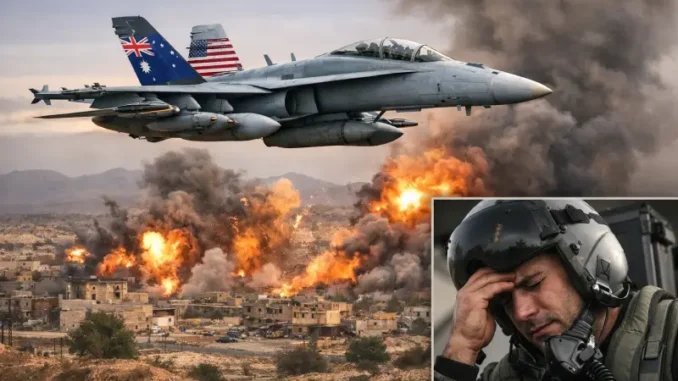
One of the least discussed consequences of Australia wars of choice is how they are experienced by those ordered to carry them out. Australian and American military pilots are tasked with executing bombing missions in conflicts that often have no direct connection to defending their own country, creating long-term ethical and psychological strain.
Moral Injury and Ethical Conflict
Many pilots later report deep moral conflict when reflecting on bombing missions that killed people who had never harmed Australia or the United States.
Psychologists describe this as moral injury, a form of distress rooted in guilt and betrayal of personal values.
Source: Australian Psychological Association: Moral Injury in Military Service
Source: Armed Forces Community: Moral Injury and Combat Stress
The Solution: Economic Reality and Dollar Sovereignty
Australia has spent hundreds of billions of dollars on overseas military operations and weapons procurement. This means the enormous public money devoted to Australia wars of choice represents a deliberate political choice, not an economic necessity.
Source: sipri.org: Military Expenditure Database
As a nation with dollar sovereignty, Australia is not financially constrained like a household. The true constraint is political choice.
Final Thoughts
The evidence is clear. Australia wars of choice have repeatedly been framed as self-defence despite failing legal, moral, and strategic tests.
The historical record shows that Australia wars of choice have repeatedly been presented as self-defence despite failing legal, moral, and strategic tests. Recognising this pattern is essential if Australia is to restore democratic accountability, protect its sovereignty, and avoid asking future generations to fight wars that never defended the nation.
Call to Action
We want to hear from you
- Please share your thoughts through our Reader Feedback form.
- Visit our Testimonials page to see how others are engaging.
- Leave a comment below; every voice helps shape future content.
Explore more
Find more writing on political reform and Australia’s dollar sovereignty at Social Justice Australia.
Share this article
Articles like this only create change when they are shared. If it stays with one reader, the message stops. Sharing helps this message reach more Australians who want a fairer, more responsible society.
Support independent journalism
Running this site costs around $2000 a year, and reader donations have helped cover $807 so far. Every contribution helps keep this work online, accessible, and independent.
If you find value in these articles, please consider supporting the site. Even a few dollars help.
Donate now, one time or monthly.
Already donated? A quick Google review helps others discover the site.
This article was originally published on Social Justice Australia
Keep Independent Journalism Alive – Support The AIMN
Dear Reader,
Since 2013, The Australian Independent Media Network has been a fearless voice for truth, giving public interest journalists a platform to hold power to account. From expert analysis on national and global events to uncovering issues that matter to you, we’re here because of your support.
Running an independent site isn’t cheap, and rising costs mean we need you now more than ever. Your donation – big or small – keeps our servers humming, our writers digging, and our stories free for all.
Join our community of truth-seekers. Donate via PayPal or credit card via the button below, or bank transfer [BSB: 062500; A/c no: 10495969] and help us keep shining a light.
With gratitude, The AIMN Team




All at the expense of Australia’s national sovereignty and transfer of vital resources for the purchase of military techno hardware at the expense of essential priorities at home and development assistance abroad. A timely reminder, Denis.
We are just Buffalo Soldiers for the rich people across the ocean.
The Timidity has been suffocating.
Denis Bright
Exactly. Those choices weaken sovereignty and divert public money away from housing, health, and genuine development assistance.
Paul
That feeling comes from decisions being made far from the public. It’s why accountability and independent policy matter.
Decades of subservience, firstly to Britain and currently to the USA has been the cause of the deaths of thousands of Australians. Has it made Australia safer? NO, if anything it has made us a target in any future international conflict.
Thanks, Dennis. Iagree and see it as part of a process begun some time ago, to vector then replace the old Australia with an americanised version willing to idiot grin while it turns the nations will and wealth over to offshore interests.
jonangle
That’s the uncomfortable question. There’s no evidence these choices made Australia safer. In many ways, they increased risk while reducing sovereignty.
paul
It does feel like a long-term shift. When policy serves offshore interests over public purpose, democratic control and national identity erode.
Denis, thank you for your thoughtful perspective and excellent articles; merry Christmas.