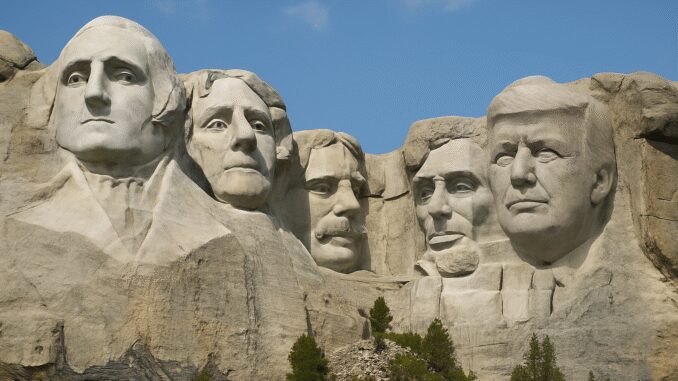
In a healthy democracy, loyalty is earned through service, results, and truth. But what we’re witnessing in today’s Republican Party is not loyalty in the traditional political sense – it’s something deeper, more unsettling. It’s a kind of devotion that bends reality, rewrites history, and recasts failure as triumph. Donald Trump is no longer treated by his supporters in Congress as a controversial president, but as a chosen figure whose flaws must be ignored, whose failures must be justified, and whose ego must be fed at any cost.
The recent flurry of symbolic bills introduced by Republican lawmakers says it all. From putting Trump’s face on the $100 bill to renaming airports and carving his image into Mount Rushmore, the focus isn’t on policy, reform, or rebuilding trust in government – it’s on glorifying the man:
- “Best president in my lifetime… And I can’t think of a better way to honor somebody than to cement their place in history by naming an international airport in our nation’s capital after him.
- Rep. Anna Paulina Luna of Florida, who wants the Interior secretary to arrange for Trump’s likeness to be carved into Mount Rushmore alongside Washington, Lincoln, Thomas Jefferson and Teddy Roosevelt, said through two assassination attempts and a “sham impeachment,” Trump has “shown not just resiliency in character but also to have been able to do what no other president has been able to accomplish.”
- Rep. Brandon Gill of Texas is sponsoring a bill to put Trump’s picture on the $100 bank note. His legislation stated no $100 bill printed after Dec. 31, 2028, could be printed without Trump’s portrait on the front.
- A proposal from Rep. Greg Steube of Florida would rename Washington’s subway system the Trump Train. There’s also a bill from Rep. Claudia Tenney of New York combining Trump’s birthday with Flag Day to designate June 14 a federal holiday.
- Rep. Joe Wilson of South Carolina carries a pamphlet he gives to colleagues asking them to sponsor a bill that would direct the Bureau of Printing and Engraving to design and print a $250 bill bearing Trump’s image. The honor would coincide with the 250th anniversary of the United States declaring its independence. “I believe the president has served in a such a manner that he deserves it.”
These gestures aren’t just cringeworthy – they’re revealing. In the absence of governing ideas, what remains is hero worship.
To be clear, none of these proposals are likely to pass. They face legal and practical hurdles, and most are designed to appeal to a base that thrives on spectacle. But that’s precisely the problem: politics has become a performance, not a pursuit of progress.
Trump lost the popular vote – twice. His first presidency ended in violence at the Capitol. He faced multiple criminal indictments. He alienates allies, mishandled crises, and undermined basic democratic norms. And yet, the louder his critics get, the louder his supporters cheer. They don’t just defend him; they compete to outdo one another in fealty. What we’re seeing isn’t politics – it’s a personality cult.
In this environment, truth becomes negotiable. Institutions lose independence. The role of public servants shifts from serving the people to serving the man. The Department of Justice is expected to shield him. The press secretary parrots misinformation. Loyalists are rewarded not for competence but for obedience. And those who question him – no matter how conservative – are labeled traitors.
This shift is not just dangerous – it’s unsustainable. Democracies require checks and balances, not yes-men. They rely on institutions that outlast individuals. They depend on citizens and lawmakers who prize integrity over ideology. When those foundations are eroded by sycophancy and showmanship, the result isn’t just dysfunction. It’s decay.
History warns us what happens when political movements place one man above all else. It’s rarely about governing. It’s about control. And that control, once normalised, is hard to reverse.
The Republican Party faces a choice: continue down the path of hollow symbolism and blind loyalty – or remember what public service is meant to be. The future of American democracy – and global stability – may depend on how they answer.
Dear reader, we need your support
Independent sites such as The AIMN provide a platform for public interest journalists. From its humble beginning in January 2013, The AIMN has grown into one of the most trusted and popular independent media organisations.
One of the reasons we have succeeded has been due to the support we receive from our readers through their financial contributions.
With increasing costs to maintain The AIMN, we need this continued support.
Your donation – large or small – to help with the running costs of this site will be greatly appreciated.
You can donate through PayPal or credit card via the button below, or donate via bank transfer: BSB: 062500; A/c no: 10495969


President SScheisskerl the most stupid, ridiculous, evil, untrustworthy, perverted, crooked, rancid, foul, maggoty, wants GLORY. Far Canal (Venice).
My sympathies are with the Texas Democrats who, to avoid electoral redistributions and the entrenchment of the Republican Gerrymander in that state, have physically left the state and left the legislature without a quorum.
I lived through the Bjelke-Peterson Gerrymander in Queensland with gritted teeth in the 1970’s and ’80’s as the state’s electoral boundaries were corrupted to favour the then Country Party at the expense of both Labor (and the Liberals).
In the May 1972 election, Bjelke-Petersen’s Country Party emerged victorious with him as Premier despite only receiving 20% of the vote, a smaller percentage than the Liberals (22.2%) or Labor (46.7%). But due to the malapportionment of electoral boundaries the Country Party won 26 seats. Combined with the Liberals’ 21 seats, this gave the Coalition 47 seats to Labor’s 33, consigning Labor to opposition even though it won far more actual votes.
It was a sickening time for many Queenslanders to have a blatant Gerrymander gifting government to an inept and corrupt Country Party rump and with no Upper House they ruled supreme. Many of us see what is happening in Texas and the US generally as a stark reminder of what had previously occurred in Queensland.
Fortunately, when the corruption and criminality became too much for Queenslanders and thanks to Tony Fitzgerald’s report, Bjelke-Peterson was forced to resign. An incoming Goss Labor government was able to introduce electoral reforms in the state with a return to the principle of one person, one vote with individual electorates having no more than a ten percent variance.
We need to value our democracy !
Terry,
Whenever I see Joh’s name mentioned I always think of the nickname a bunch of us gave him in the late 70’s (I finally left Queensland after living there from ’73 – 2013): Joh Bonkers Bananas. Who can forget the horrendous “Joh for PM” campaign?
Terry, the Republicans quickly forget that they shut down Congress for six weeks to avoid voting on release of the Epstein files.
Michael, the repugs, like the LNP here, suffer from chronic selective amnesia, which unfortunately is incurable.
Trump has unleashed the worst of the GOP frustrations on women, blacks and democracy.
ps
jo’s gerrymander followed a monstrous labor gerrymander.
pps
We got tv in 75 and it came via microwave towers link from qld.
Till Trump, Jo was the most corrupt and obnoxious politician on the box.
There’s an old book from 2007, updated in 2024, called The Cult of the Presidency, that (as far as I can see from the description) seems to put its finger on the problem. Coming from the Cato Institute, and written during Obama’s ascendancy, it doesn’t appear to be a product of so-called “radical left lunatics.” The author, Gene Healy, argues that Americans have come to expect the President of the United States to possess and exercise extraordinary powers. Whether these powers are justified in the Constitution is beside the point; a “cult of the presidency” has developed, and it makes it easier for a President to act like a dictator. Or like a king, if you prefer.
If this is right, then the “No Kings” movement ought not to be about Trump’s antics specifically; it ought to be a self-examination of what Americans really expect from a President, and by extension from their system of democracy. By the lights of this book, a king is exactly what they’re looking for.