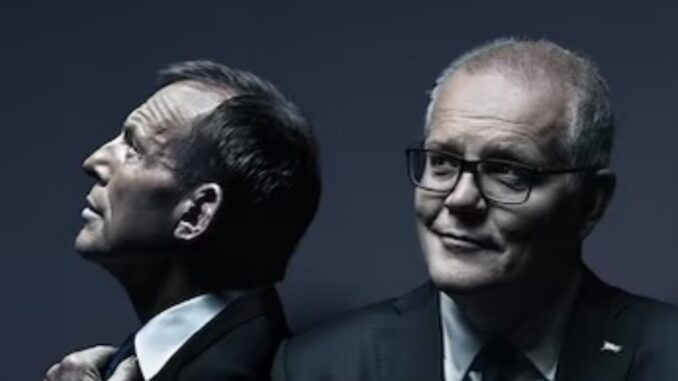
There was a time when I genuinely believed things were getting better.
I remember the election of Barack Obama in the United States. After the years of George W. Bush, the wars, the divisions and the sense that America had lost its way, Obama’s election seemed to represent something different.
It wasn’t simply that a Democrat had defeated a Republican.
It felt like a rejection of a particular kind of politics.
Here was a Black man becoming President of the United States, speaking about hope, change and the possibility of bringing people together. For many of us watching from the other side of the world, it was difficult not to believe that perhaps history really was moving forward.
I experienced something similar here in Australia when Kevin Rudd and Labor defeated John Howard’s Coalition government in 2007.
Howard had been in power for more than a decade. The Tampa affair, the “children overboard” controversy, the wars in Iraq and Afghanistan, the treatment of asylum seekers and the continuing failure to resolve the question of reconciliation with Indigenous Australians had left many Australians wanting something different.
And then came Rudd.
Again, it felt like a turning point.
The conservative government had been rejected and a Labor government had arrived promising a different Australia.
For a while, I allowed myself to believe that perhaps the pendulum had finally begun to swing in the direction of something better.
Perhaps governments could be compassionate without being weak.
Perhaps nations could be powerful without constantly reaching for war.
Perhaps politics could be about improving the lives of ordinary people rather than protecting the interests of the powerful.
Perhaps we had finally learned something from history.
Then, in the blink of an eye, it was gone.
When the pendulum swung back
It is impossible to understand what happened next without considering the influence of powerful media organisations on Australian politics.
Our media landscape had become increasingly concentrated, and some of Australia’s most influential newspapers and commentators were capable of shaping political debate, setting the agenda and determining which issues received attention and which were largely ignored.
Politics was no longer simply about what governments did.
It was increasingly about how those actions were presented to the public.
And then, in 2013, Tony Abbott’s Coalition won government.
For me, this was where much of the optimism began to disappear.
The Abbott Government came to office promising to dismantle much of what the previous Labor governments had introduced.
Climate initiatives were torn up.
Labor’s National Broadband Network was substantially changed from the original model.
And programs and policies developed under the previous government were discarded, sometimes seemingly because they carried the fingerprints of the previous government.
One decision in particular has stayed with me.
The pandemic plan
Following the scares surrounding swine flu and bird flu, the Howard Government had developed a national pandemic preparedness plan.
It was a serious piece of work.
When Kevin Rudd’s government came to office, it did not simply discard it. It strengthened it, committing to further develop Australia’s preparedness.
I know this because I was there.
I was my department’s representative on the team working on the preparedness arrangements.
We were looking at what would happen if Australia faced a serious pandemic and how government could continue functioning under circumstances in which normal face-to-face contact might no longer be possible.
Among the measures being developed was a move towards Centrelink operating without its normal face-to-face services. People would increasingly deal with Centrelink electronically, including lodgements and other transactions over the internet.
Remember, this was before the internet infrastructure we take for granted today.
What not to do in a pandemic
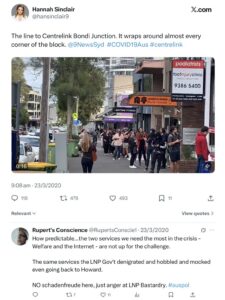
We were thinking ahead.
The plan also included measures for people entering Australia, including thermal scanning of passengers arriving by plane or boat.
It was not perfect. No plan ever is.
But it was a plan.
And more importantly, it was being continually developed because governments understood that some threats are worth preparing for even when you don’t know when – or whether – they will arrive.
Then came the Abbott Government.
Much of that preparedness work was allowed to lapse.
Years later, COVID-19 arrived.
Suddenly, the world was confronted with precisely the kind of crisis that governments had spent years warning about.
I have often wondered what might have happened if the work we had undertaken had been maintained, updated and built upon.
I don’t claim that it would have prevented every problem Australia subsequently experienced.
But I do know this:
- Australia had already been thinking about a pandemic.
- People had already done the work.
- People had already considered how government would operate.
- People had already considered what would happen at our borders.
I know because I was one of them.
That experience taught me something about government that has stayed with me.
Governments inherit more than buildings, budgets and bureaucracies when they win office.
They inherit knowledge.
They inherit experience.
And they inherit the work of thousands of public servants who spend years preparing for problems that may never happen.
Good government doesn’t throw that knowledge away simply because it was developed by the political party that previously held office.
It builds upon it.
Because governments change.
Viruses don’t care who won the election.
The Hockey Budget
Joe Hockey’s 2014 Budget exemplified the Abbott Government.
It was presented as an exercise in economic responsibility, but to many Australians it appeared to place much of the burden on people who could least afford to carry it.
For me, it seemed to reflect a broader problem.
The government appeared to have difficulty explaining exactly what kind of Australia it wanted to build.
- It was easier to dismantle than to construct.
- Easier to attack than to explain.
- Easier to blame than to plan.
I had retired just before the 2013 election.
About two weeks after the election, I was strolling through the centre of Canberra with my wife when I noticed a number of my former departmental colleagues sitting around in outdoor cafés.
I stopped and asked them what the go was.
Their answer surprised me.
They had nothing to do.
According to them, the new government had no plans, no policies and no clear idea of what it wanted the public service to deliver.
Now, that is only one person’s recollection of one moment.
But it has stayed with me because it seemed to symbolise something much larger.
Governments are not elected simply to occupy ministerial offices.
They are elected to govern.
And governing requires ideas.
It requires preparation.
It requires competent administration.
Most importantly, it requires an understanding that the machinery of government doesn’t exist for the benefit of the politicians sitting inside it.
It exists to serve the people.
The Abbott Government also demonstrated how easily race could become a political weapon.
Ministers used asylum seekers and questions of national identity to appeal to fear and division.
Instead of asking how Australians could be brought together, politics increasingly discovered the electoral usefulness of dividing them.
- Us and them.
- Australian and foreigner.
- Taxpayer and welfare recipient.
Those divisions were politically useful because fear is an extraordinarily effective political commodity.
After two years, Abbott was gone.
Malcolm Turnbull replaced him.
For a brief moment, many Australians hoped that a change of leadership might bring a return to moderation, competence and perhaps a little political sanity.
Turnbull certainly offered a friendlier face.
But changing the face of a government does not necessarily change the government itself.
The internal divisions remained.
Political instability remained.
And before long, Turnbull was gone too.
Then came Scott Morrison.
And somehow, the situation became even more extraordinary.
Morrison’s Coalition won the 2019 election against expectations.
What followed was one of the most turbulent periods in recent Australian political history.
There were serious questions about the government’s economic management.
Then came COVID-19.
There was the government’s handling of the pandemic, the confusion over responsibilities between governments, and the extraordinary spectacle of a prime minister secretly appointing himself to multiple ministerial portfolios (when not holidaying in Hawaii or not holding a hose).
There was Robodebt, a scheme that pursued welfare recipients for alleged debts and which was ultimately found by a Royal Commission to have been unlawful.
There was the government’s attempt to bring religion more prominently into Australian schools.
And through it all there was an increasingly familiar pattern: political management seemed to matter more than good government.
By this point, something had changed in me.
I was no longer simply disappointed with individual politicians.
I was beginning to question the system itself.
Because perhaps the problem wasn’t Tony Abbott.
Perhaps it wasn’t Malcolm Turnbull.
Perhaps it wasn’t even Scott Morrison.
Perhaps something much more fundamental had happened to Australian politics.
Perhaps governments were increasingly asking a different question.
Not:
What is in the best interests of the Australian people?
But:
What will keep us in power?
Those are two very different questions.
And once political survival becomes more important than public service, democracy begins to change.
Government becomes a contest between competing interests rather than an instrument for the common good.
Ordinary Australians begin to wonder whether the system belongs to them at all.
And that brings me back to the thought that began this whole journey.
I had once believed that changing governments could change the direction of a country.
I believed that when people rejected an unpopular government and elected something different, they were demanding something better.
But perhaps I had misunderstood what was happening.
Perhaps the real change was not simply from Labor to Coalition.
Perhaps it was the gradual realisation that governments were no longer necessarily governing for the people, but increasingly governing for those with the greatest power and influence.
And if that was true, then the question I began with – What went wrong? – had become something much bigger.
Who was government actually working for?
To be continued…
Keep Independent Journalism Alive – Support The AIMN
Dear Reader,
Since 2013, The Australian Independent Media Network has been a fearless independent voice – holding power to account and delivering journalism that matters.
Running this site isn’t cheap. Rising costs mean we need your support now more than ever. Every donation, big or small, keeps our servers running, our writers working, and our stories free for everyone.
Donate here:
PayPal or credit card – just click on the Donate button below
Direct bank transfer: BSB: 062500; A/c no: 10495969

We’ve also set up a GoFundMe as a dedicated reserve fund for hosting and future improvements.

Thank you for standing with us. We couldn’t do this without you.
With gratitude,
The AIMN Team

Michael
Thanks for those reminders.
I have to say I have been encouraged by Albanesse being more muscular in hauling Hanson back into line after her nasty comments about his deceased mother.
Neither Hanson or Joyce have yet indicated whether they will stand for Lower House seats in 2028. In some ways I hope they do as they will get more scrutiny and with any luck we can rid ourselves of their malignant stain.
I have also warmed to the integrity demonstrated by Andrew Hastie in tackling the full-frontal attack coming from Hanson and it seems Rinehart; they actually seem to be saying that he should perjure himself by not giving evidence in the upcoming trial of Ben Roberts-Smith and calling him a traitor – what grubs.
In my view it is people like Hastie that the Liberals need to rebuild their integrity as a credible political party.
I have been joking with a US based relative and suggesting that he use his $5000 Tump Dividend to come out and visit us. He is no Trump fan and suggests that if he gets the Trump Dividend he will come out and bring us a unicorn.
Great article Michael.
You would know better than I, but from media reports of the time, Abbott started off his half-term as PM by also supposedly sacking the head of any department that had done a good job under Labor, on the basis that they had worked with Labor and so couldn’t be trusted.
Meaning, if any public servant did their job under a Labor government, they’d get sacked under the next Coalition government. So, if Labor got into power, public servants were supposed to down tools. WTF?
One thing that depressed me, was that Abbott was being touted by mainstream media as the best opposition leader ever on the basis that he said ‘no’ to everything. Opposition for opposition sake is not in the interests of the people.
Look forward to the continuation.
Thanks, Thommo.
Give me a few days while I decide whether to do more on Australia or talk about the United States.
Terry, ask him for a Bigfoot. They make better guard dogs.
Thanks Michael,
My brother has very similar stories to tell about the government in Tasmania.
I was ecstatic when the odious and clearly deranged Morrison was booted but whatever hopes I had for unequivocal progressive government were soon dashed as Albappeasey continued to tread water rather than forge ahead. More than four years on I look at the Labor government and despair.
Michael; I know it takes heart, soul, time and effort but please.. when you can, post chapter 2!! I eagerly await your key strokes.
Brilliant article Michael Taylor, and Albanese is an exemplar of what has gone wrong,it’s no more than a continuation of the same ,visionless, timid, reactionary politics, with a marginally better face.Little wonder the misinformed ,and unhappy, are turning to a squeaking, grievance shrew who would struggle to know her arse from her elbow,or her face , for that matter.
Oh dear Michael, I remember the same political events with the same joyous anticipation ….. and (like Thommo) despair at the gutless, do nothing, keep me in power for life, NOtional$ disease that has apparently infected too many LABOR politicians.
@ uncletimrob: Back in Brisbane where the one masthead owned by the Murdochracy Media Manipulation Monopoly re-constructs to truth to suit the proprietor’s latest whim …..
The one term Newman FRWNJ COALition misgovernment similarly went through all government offices purging any employee who was capable of thinking, including my brother-in-law, a known LABOR sympathesiser.
It was irrelevant that he had an exemplary record of innovations strongly supported by Brisbane City Council staff. Perhaps it was his early career deployment to the Goss ”Clean Up Team” that discovered cupboards full of bank notes in NOtional$ members Parliamentary offices that influenced the decision ….
Even Newman signed the Certificate of Thanks signed by every surviving BCC staff member BiL received after he was given 10 minutes to clear his desk and leave the building.
But we must remember that politicians are the career for the wastrel off-spring of the wealthy classes ”who know the rules” for giving & receiving reciprocal favours.
@ Terry Mills: Beetrooter is deliberately dithering about his future political plans. Current advice is a NSW Senate attempt to get six years of regular too much income before retirement.
Beetrooter ALWAYS looks after his personal interests. Local advice has his automatic NOtional$ pre-selection for the 2028 election removed, possibly because he has become toxic, or more likely his ”political mates” have retired from local political intrigue.
Other advice has the New England NOtional$ pre-selection already promised to the underwhelming Armidale Regional Council Mayor as a return political favour for his father-in-law, Bob Katter Snr, MP for Leichhardt, a 50+ year political veteran who is owed plenty of favours by the COALition.
Brilliant article Michael, and post the second ASAP.
As for what went wrong, I think indolence has a big part to play here, its all been tick a box mentality.
There was intelligence and rigor up until The Dismissal.
Pauline Oppo-Plodda will surely not lead by attempting to get in the H. of Reps, where her lazy idiocy would be exposed. She bludges, takes, fails to turn up and work, a lazy, shitty, angry subnormal inferiority complex. Nobody decent, normal, honest, well meaning could support a political poser who is lower than a maggot’s Mort’s Dock. Barnaby Blathering-Bladder is just as worse.
Thank you Michael.
You named everything I remember and felt. When Rudd was voted in I walked around a village and breathed a new dawn. 18 months later it was in the gutter. I found a list of Rudd’s vision for the coming 10 years and cried at the loss the fools created. My sister rang me with joy:”Our first Female PM!!!” I said nearly yelling down the phone:”No no NOT YET.Too early.” WHAT A BLOODY WASTE.
The rest you notated was correct but nothing has broken my heart since Albanese has taken the reins. I am sick with grief of what could have been. Now at 73 I will never vote ALP again. It has broken me!!
I could not believe Labor could have been so stupid as to execute a coup against Rudd so near to an election.
Factional rubbish preceded the national interest. Also Rudd had health probs at the time..
Terry Mills’ thoughtful comment.I agree with most of it.
Common good; ha ha ha ha haar!
Elections rarely now for the better, but options for worse or worser.
Halls of Power workings muted and filtered via toxic bubbles
Good intentions soon brought to heel
There’s so much money, fame and infamy available
In the shadows, that’s how it’s framed
Getting into the act is irresistible
Sinecures abound ten-a-penny
Upper house, Lower house, Ministries?
Nah, the trade all happens in the pits
At light speed through black holes:
Factions & flunkies
Donors & lobbyists
Consultants
Corporatized foreign media
Cyberwar
Blackmailers & Fraudsters
Activists
Influencers
Focus Groups
Pollsters
A plethora of pusillanimous internecine gobbledegook
So many arses to wipe
Failure to attend sees players rendered to worm holes
So much to do, and so little time for common good governance.
A pity that the “Like” button no longer works on this site
Noel, it’s being moody. It works for some, but not for others. 🤷🏻♂️
Tried every trick in the book but couldn’t fix it, so I’ve turned it off. Will seek expert advice tomorrow.