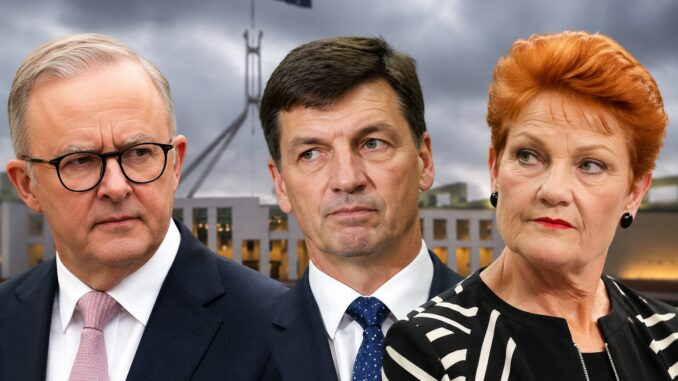
Opinion polls are snapshots, not predictions. Governments have recovered from dreadful polling before, and oppositions have turned seemingly hopeless situations into election victories. Yet sometimes polling reveals something deeper than the fortunes of individual leaders. It reveals structural change.
That may be what we’re witnessing now
The latest polling has delivered two important messages. The first is that Opposition Leader Angus Taylor has failed to make an immediate connection with voters, his approval rating falling sharply soon after taking the leadership. The second is that Pauline Hanson’s One Nation, while no longer climbing at breakneck speed, has largely held on to the support it accumulated over recent months rather than surrendering it back to the Coalition.
Those two developments are closely related
Traditionally, dissatisfied conservative voters who drifted away from the Liberal and National parties eventually returned at election time. That pattern can no longer be taken for granted. One Nation is no longer merely a protest vote for many Australians; for an increasing number of voters it has become their political home. Polling throughout 2026 has consistently shown the party maintaining historically strong support, even after its spectacular surge slowed.
That presents Angus Taylor with an unenviable dilemma
If he shifts further to the right in an attempt to recover One Nation voters, he risks alienating moderate Liberals in metropolitan seats. If he moves towards the political centre to broaden the Coalition’s appeal, he risks losing even more conservative voters to Pauline Hanson. It is a balancing act that has become progressively harder with every election.
The irony is that Labor cannot afford to feel comfortable either
While Anthony Albanese remains Prime Minister, his government’s polling hardly suggests widespread enthusiasm. Cost-of-living pressures continue to frustrate many households, and dissatisfaction with both major parties remains stubbornly high. Australians increasingly appear to be voting less out of loyalty and more out of disappointment with the alternatives.
This is perhaps the most significant trend of all
Rather than Australia becoming a contest between Labor and the Coalition, it is slowly evolving into a contest involving Labor, the Coalition, One Nation, the Greens and a growing number of independents. The two-party system still exists on paper, but voter behaviour is becoming increasingly fragmented.
That fragmentation creates unpredictable elections
A government could secure fewer primary votes yet retain office through preference flows. Minor parties could determine the outcome in dozens of electorates without winning many seats themselves. Independents may once again become kingmakers in a closely divided parliament.
For the Coalition, the maths are becoming particularly difficult
Winning government requires not simply increasing its own vote but also persuading enough One Nation supporters to return while simultaneously retaining moderate Liberal voters in city electorates. Those objectives often pull the party in opposite directions.
Meanwhile, One Nation faces a different challenge
Maintaining a high level of support is one thing; converting that support into lower-house seats is another. Our preferential voting system rewards geographically concentrated support, not merely a healthy national vote. Unless One Nation can translate polling strength into victories in individual electorates, much of its influence may continue to come through preference negotiations rather than parliamentary numbers.
The Albanese government also faces a warning
Governments that win comfortably can sometimes mistake the weakness of the opposition for enthusiasm about their own performance. The current polling suggests that many Australians remain dissatisfied generally rather than passionately committed to either side of politics. If Labor assumes its position is secure simply because the Coalition is struggling, it may discover that voter frustration has a habit of finding new political outlets.
Perhaps the biggest lesson from these polls is that Australian politics has entered an era where traditional assumptions no longer apply.
Leadership changes no longer produce an automatic honeymoon. Protest votes are becoming permanent votes. Minor parties are becoming established players rather than temporary irritants. Whether that ultimately produces another Labor victory, a Coalition recovery or an even more fractured parliament will depend less on today’s polling than on which party can convince Australians that it has genuinely listened.
At the moment, the electorate appears to be telling every major party exactly the same thing:
“We’re still waiting.”
Also by Michael Taylor
Politics has a habit of changing slowly… until it doesn’t
The Inheritance of Fear: From the Cold War to Trump’s World
Consent and conquest: the legal foundation of British sovereignty in Australia
Keep Independent Journalism Alive – Support The AIMN
Dear Reader,
Since 2013, The Australian Independent Media Network has been a fearless independent voice – holding power to account and delivering journalism that matters.
Running this site isn’t cheap. Rising costs mean we need your support now more than ever. Every donation, big or small, keeps our servers running, our writers working, and our stories free for everyone.
Donate here:
PayPal or credit card – just click on the Donate button below
Direct bank transfer: BSB: 062500; A/c no: 10495969

We’ve also set up a GoFundMe as a dedicated reserve fund for hosting and future improvements.

Thank you for standing with us. We couldn’t do this without you.
With gratitude,
The AIMN Team

I fail to understand how Victorian voters can be rallying around the One Nation flag when ON has no Victorian leadership and no announced candidates for the forthcoming state election.
It seems that One Nation campaign against migration is the centre piece to their policy platform and we now need to hear clearly from all parties, particularly the government what their plans for ongoing migration are.
One Nation have made much of the ABS statistic that people born in India have officially overtaken those born in England to become Australia’s largest overseas-born migrant group. Data released by the Australian Bureau of Statistics (ABS) confirms this historic demographic shift. For the first time since Australia’s federation in 1901, England is no longer the top country of birth for the nation’s foreign-born population.
Pauline Hanson used this fact when in England recently and will undoubtedly use it to create a scare campaign in Victoria and nationally.
Albanese cannot remain silent.
It’s got me beat how anybody can give their precious vote to a party which supports a country committing genocide. What is wrong with Australians? We need to get some humane standards. Until then, not much will change.
Hanson and ON’s worst enema…enemy…is Hanson and ON.
from the essay above: “.. sometimes polling reveals something deeper than the fortunes of individual leaders. It reveals structural change….”
Therefor I propose 2 questions for pollsters.
1.) “Do you support PM Albanese’ appointment of a Special Envoy to Combat Anti-Semitism without seeking Parliamentary approval or permission?”
2.) “Do you approve of Special Envoy Julia Segal’s proposal to mandate anti-semitism education into Australian universities, high and primary schools, state and local government agencies, including and health and human services?”
The results of such a poll could well determine Albanese’ fate at the next federal election.
NO, to both !) & 2)
Pollsters could also ask if they support the Mayor of New York’s move to mandate a 10% discount for people using self serve checkouts.
I remember when Poorline first got into parliament. She was saying the same things about Asians. Gee she was even too racist little John Howard.
Its a pity the media is not so vocal about ON being controlled totally by Poorline, none of that lefty democracy crap for her.
One sure thing is Vic elections will be an interesting one to watch.
Legacy msm couldn’t help itself ceaselessly driving sensation since the Beetrooter turned to PHON looking for a sinecure, and as the LNP attempted suicide. It drove its sensation wagon straight at Hanson & her droogs and Wagina. – of course it was careful what it said about Wagina.
This unleashed the wild horses which the pollsters of course latched onto.
All in all, this created a mess of self-perpetuating BS. It has certainly given rise to the reactionary transition to Ben Carroll as Vic Labor premier only 3 months out from the Vic state elections. So in Vic there’s a mangled Liberal Party with yet another newby vacuous boss, a desperately clinging Labor Party, and a PHON with no state policies, dredging a pool of never-heard-of pretenders also hopeful of a sinecure.
That there’s a cost-of-living crisis worldwide driven mainly by US neo-liberal/neo-conservative capture-capitalism made worse by the horrendous bankrupt, tarrifing, warmongering Trumpian regime, may not provide the connective dots sufficient for the comparatively spoilt and wealthy blind-eyed electors of Vic, the alleged ‘progressive state’.
After massive Sydney-centric population growth, infrastructure binge and affordability crisis, Sydney was overflowing, and the most significant population growth was assigned to Melbourne. So Vic entered into huge infrastructure development so as to increase productivity and maintain a competitive edge, with Dan Andrews trying to bring it out of years of the doldrums. Then came the wrecking train of the covid pandemic, and post-pandemic roll-on effects with all actions, plans, timetables and budgets become fodder for the trashcan.
After 12 years of Vic Labor, the worldwide cost-of-living crisis, and the covid/post-covid chaos, it is almost inevitable that the electorate would be primed to blame & kick out Labor.
But none of that gives cause to elect PHON, with its no-policy, shrill grievance-based, racist, anti-immigration, elite-based anti-worker hostility. The population growth and projections alone don’t support her narrative, which if implemented in govt, would foist a governance, economic and cultural disaster upon Vic and Oz as a whole.
So, indeed, we’ll just have to see how it goes between now and November.
A long career in education areas illustrated the cross section of Australian society, from the sublime to the ridiculous, from the Horne observations to the lying realities of politics, advertising, media. This is an adolescent place, barely balanced and sensible; so we get a dyedred dill doing well in polls.., to whom? why? Hansonism is social pox, and illiterate politically, yet, it has attracted support. ‘poor bugger, my country’.., for huge slabs of waste in time and effort are needed now. Hanson adolfing away at undesirable media critics is vomitous, so NSDAP, and should be loudly, fully, widely condemned.