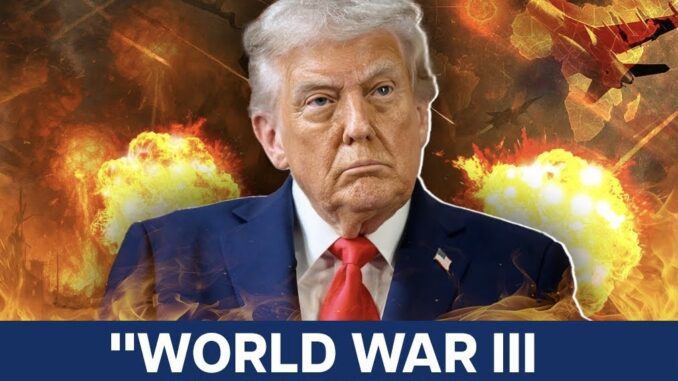
I was a young boy during the Cuban Missile Crisis, but I remember the feeling clearly.
Even as children, we knew something was wrong. The adults spoke in hushed tones. The news carried a sense of urgency. At school, the playground chatter wasn’t about games – it was about war. The kind that could end everything.
By my final year, the fear had become personal. Among the boys, we spoke about conscription – about being called up to fight in the Vietnam War. It wasn’t abstract anymore. It was waiting for us.
That was the world we inherited.
And now, it seems, the next generation is inheriting something disturbingly familiar.
Recent polling shows that fear of a major global conflict is no longer a fringe concern. In the United States, nearly half of respondents – 46% – believe a world war is likely within the next five years, with similar fear echoed across Britain, Canada and France. Across Europe, between 41% and 55% of people think another world war is likely within a decade.
Among younger people, the anxiety runs deeper still. A global Red Cross survey found that almost half of millennials believe a third world war is likely in their lifetime. And here in Australia, new research suggests that young adults are among the most anxious about national security threats, with many expecting conflict within years rather than decades.
This is not abstract fear.
It is generational.
But there is a difference between then and now.
The Cold War was terrifying, but it was also structured. Two superpowers, locked in a tense but calculated standoff. There were rules – dangerous ones, but rules nonetheless.
Today, the fear feels less ordered. Less predictable. More dependent on personalities than systems.
And that is where Donald Trump enters the picture.
To his supporters, he is decisive – a leader unafraid to act. But to many others, particularly younger people watching from a distance, he represents something far more unsettling: volatility. A willingness to escalate, to threaten, to test boundaries not as a last resort, but as a demonstration of strength.
In some international polling, even allied populations now cite the United States itself – under Trump’s leadership – as a potential source of global instability.
That perception matters.
Because fear is not driven solely by events, but by expectations – by what people believe might happen next.
And for a generation raised on a constant stream of crisis – pandemics, climate change, economic instability, and now rising global tensions – the idea that a single leader’s impulses could tip the balance is deeply unsettling.
Unlike our childhood, there is no buffer. No evening news that ends at six o’clock. No space between events and reaction. Every threat is immediate. Every escalation is live-streamed. Every rumour amplified.
There is no off switch.
And so the fear settles in – not always as panic, but as something quieter and more corrosive. A sense that the future is unstable. That the world is being shaped not by steady hands, but by unpredictable ones.
We have seen this kind of fear before.
We lived through it.
But today’s version carries an added uncertainty – not just about what might happen, but about who might make it happen.
For younger generations, that may be the most unsettling thought of all.
Keep Independent Journalism Alive – Support The AIMN
Dear Reader,
Since 2013, The Australian Independent Media Network has been a fearless voice for truth, giving public interest journalists a platform to hold power to account. From expert analysis on national and global events to uncovering issues that matter to you, we’re here because of your support.
Running an independent site isn’t cheap, and rising costs mean we need you now more than ever. Your donation – big or small – keeps our servers humming, our writers digging, and our stories free for all.
Join our community of truth-seekers. Please consider donating now via:
PayPal or credit card – just click on the Donate button below
Direct bank transfer: BSB: 062500; A/c no: 10495969

We’ve also set up a GoFundMe as a dedicated reserve fund to help secure the future of our site.
Your support will go directly toward covering essential costs like web hosting renewals and helping us bring new features to life. Every contribution, no matter the size, helps us keep improving and growing.

Thank you for standing with us – we truly couldn’t do this without you.
With gratitude, The AIMN Team

The U.S. has a war scheduled with China next year. It’s been in the works for a while. On analysis.news a while back, Col. Larry Wilkerson was interviewed. When he was working under Gen. Colin Powell around the time of 9/11, he said they ran six war games with China as the theme. All of them went nuclear.
The Mainstream Media Manipulation Monopoly have decided to mislead Australian voters by describing the USA (Undemocratic Sewer of Apartheid) as our ”greatest ally” because US General Douglas MacArthur needed a large Form Up Place to assemble the US military forces to defeat the Japanese ….. back in the distant 1942-1945 era ….. after he had abandoned his American troops in the Philippines.
In the modern world since Australian PM Gough Whitlam opened political dialogue with PRC China, our growing trade links to that country are more important, resulting in a political tight-rope, with Australian policy clinging on to the past in the vain hope that history might repeat itself, if required, in future.
The return of the geriatric, demented, corrupt, convicted felon to the White House makes that repetition implausible given his preference for dumping anybody who has been useful as soon as possible, and at their cost.
As both Whitlam & Keating determined, Australia’s future lies in Asia rather than Europe or the USA (Undemocratic Sewer of Apartheid).
Europe wants Australia as a market for their high end glamour products, especially cars, and preferably no balancing of trade for primary produce because European farmers are too well protected financially from their own inefficiency. Who sold Australian primary producers the myth that production without subsidies was the best way forward??
The Americans want everything Australian that is not secured with chrome vanadium bolts, especially all mineral deposits, all fossil fuel sources and indeed anything that can generate ”profit”.
However, it seems unlikely that the current crop of self-serving politicians will grow the political testicles to make the necessary changes. Indeed, they presently allow themselves to be dictated to by European farmers ”protecting” their geographic naming of produce.
Don’t get me going on Scummo’s USUKA sub debacle to ”earn” the least competent Prim Monster since 1901 a non-executive Directorship with a US military supplier. Now who would have thought that possible in a modern democratic society???
Michael, unlike yourself, I saw the Cuban crisis through an adults eyes and did not like what I saw. Cuba was and still is a sovereign country. After years of a USA supported dictatorship the Castro lead revolution had taken control. As a way of defending itself from the likes of the Bay of Pigs invasion, they turned to the USSR for support and weapons of defense (missiles are a great deterrent).
The USA as a result became home to those Cubans who fled the revolution and subsequently put pressure on government to do something? JFK and his administration saw the missile instillation in Cuba as a threat to the USA and demanded there removal, result the “Cuban Crisis”.
Cuba had in my view every right to defend itself however it saw fit, sadly, it has suffered USA imposed sanction ever since, Trump is just carrying on a long tradition of USA lording.
What is far worse, much of the claimed Free World Democracies either support them or look the other way. don’t you love Democracy?
“…I was a young boy during the Cuban Missile Crisis, but I remember the feeling clearly…”
I was a young adult in the 1960s and wondered why Khrushchev provoked USA by placing nuclear capable missiles on Cuba which is 90 miles from Florida? What we were not told was the fact that USA had already placed nuclear capable missiles in Turkey, well within range of the then USSR and the Russians were simply telling the Americans to “back off”.
I was also sceptical of Australia’s instant commitment to Viet Nam – there was never a chance that the “yellow hordes” (China) would come south via the “domino ” effect however, our dutiful Australian politicians fell into line and so young Australians, unaware of the geopolitical truth, were dispatched to the Asian front line with disastrous consequences. At 82 years age I remain sceptical.
jonangel, I was a very young lad on Kangaroo Island where news from around the world was lucky to reach us. The missile crisis snuck in, so that’s all people had to talk about. The next big piece of news was the Beatles coming to South Australia. And JFK being assassinated.
It was even hard to get the footy scores from Adelaide.
@ Mediocrates: Kruschev’s comment about JFK in his autobiography was short and respectful.
The too quick stupid entry of Australia was to assauge Menzies’ guilty conscience for resigning his Australian Army commission on the first day of WWI ….. according to his Army Service Record.
Then there was always the anticipation of 19th century world imperialism by a committed Royalist toadie who allowed Australian troops to remain in North Africa (Tobruk) while the Japanese cycled down the Malay Peninsular to receive the surrender of English commanding coward at Singapore without the English firing a shot in defiance.
@ New England Cocky… without wishing to defend Menzies in any way whatever, your comment on his resignation of his army commission is inaccurate as to the date mentioned.
The Wikipedia page on Robert Menzies outlines the background, including the reasoning in the Menzies family as to why he didn’t go off to fight in the war. [see section ‘University’]. A student at Melbourne Uni throughout the period of WWI, he served in compulsory military service in the University Rifles, was commissioned as a Second Lieutenant, and resigned that commission with effect from 16 February 1921.
I thought the fact that Robert Menzies did not enlist for WW1 was a family decision, to keep him safe, as his brothers had enlisted, have I got this wrong?
I remember all the fuss on tel, but did not find out for decades, the reasons for it.
The Soviets had located US nukes, I think in Turkey, in the late fifties of last century and felt deeply threatened
( by an odd coincidence, the back groud in Ukraine before that war, when NATO wanted to move nukes near the Russian border).
Menzies? Whatever. It was PM Holt who giggled as he stated publicly to the President of USA: “…all the way with LBJ…” and thus the fate of Australian military personnel was sealed in Viet Nam. I will never forgive him for such fawning obsequious chicanery.
@ Canguro: Thank you for the comment. Back in the late60s while serving in the Australian Army, the Admin office people pulled Menzies file. I have held it in my hand and read the page personally. The later date is incorrect.
In fairness to Wikipedia, the content material is available for public editing.
Remember, Menzies only time without a comeback to a heckler was at a Sydney University meeting, when a student walk silently down the centre aisle with a sign saying (verboten); ”If war is so good why did you resign your Army commission?”‘
@ paul walter: Agreed. In fact, ”JFK” moved the Turkeye missiles to Crete, causing all sorts of difficulties for the Greek (Christian) and Turkish (Islam) divided population.
@ Mediocrates: Thank you for the edit. It was Holt (before he allegedly committed suicide in the surf). I have not checked the dates recently (seniors memory).
This article from Wall Street Journal via Robert Reich….
https://robertreich.substack.com/p/a-report-you-need-to-read?
@ NEC, thank you. Especially so for highlighting Wikipedia’s inaccuracy.
Thanks for the link heather, whilst not on the same scale the same abuse of the system is going on here in Australia, primarily against protestors.
Since October 7, 2023, I have seen a troubling trend in Australia where individuals are being charged with offences that, from the outset, have no reasonable prospect of success.
These cases are based on often weak or politically motivated allegations, which are routinely withdrawn or struck out when they reach court. However, the victory is short lived. The real punishment begins when a withdrawn charge appears on a Nationally Coordinated Criminal History Check (NCCHC), a stain that can damage reputations and opportunities.
This bureaucratic weaponisation of the justice system inflicts a double injustice. First, public resources are wasted prosecuting cases designed more to intimidate and silence dissent than to legitimately pursue justice. Police resources, prosecution’s effort and precious court time are expended on matters doomed to fail.
Second, and more concerning, the state then uses its own flawed system of the NCCHC to continue punishing the individual. The police check, a tool meant to ensure safety, becomes punitive, branding a person for an allegation that was legally insufficient to proceed.
https://www.deepcutnews.com/p/australian-police-are-using-criminal