By Peter Brown
On the morning of Saturday, February 28, 2026, the United States and Israel launched Operation Epic Fury – a sweeping, coordinated assault on Iran targeting nuclear facilities, missile infrastructure, naval assets, and the country’s senior leadership. By evening, President Trump had confirmed what had seemed almost unthinkable: Ayatollah Ali Khamenei, Iran’s Supreme Leader of nearly 35 years, was dead. The world reacted with a mixture of alarm, condemnation, cautious support, and – in pockets of Los Angeles, where the Iranian diaspora runs deep – open celebration in the streets.
At home and abroad, however, the dominant questions were not merely about whether the strikes would work. They were about whether they were legal at all.
A Constitutional Earthquake
At the heart of the domestic controversy is a question as old as the republic itself: who has the power to take America to war?
Article II authority has long been understood to allow the president to repel sudden attacks – it was never intended to allow a single person to launch a premeditated, preventive war. Yet that is precisely what Trump did. The strikes were launched without a declaration of war, without a formal Authorization for Use of Military Force, and – according to critics – without genuine congressional consultation.
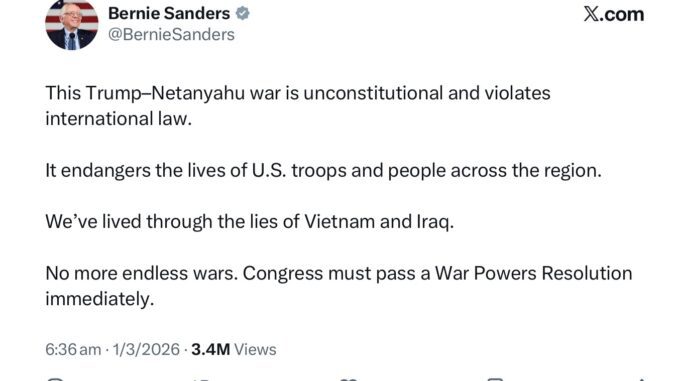
Democratic House Minority Leader Hakeem Jeffries was unequivocal: “Donald Trump failed to seek Congressional authorization prior to striking Iran.” Senator Bernie Sanders went further, invoking the ghosts of past American misadventures: “This Trump–Netanyahu war is unconstitutional and violates international law. We’ve lived through the lies of Vietnam and Iraq. No more endless wars. Congress must pass a War Powers Resolution immediately.”
Senator Tim Kaine and the libertarian Republican Senator Rand Paul moved to bring a war powers resolution to the floor – a rare bipartisan alliance. In the House, Representatives Thomas Massie and Ro Khanna pushed a parallel measure. Yet the opposition was far from unified. Republican Senate Majority Leader John Thune praised Trump, saying Iran’s “nuclear ambitions, its expanded ballistic missile inventory, and its unwavering support for terror groups have posed a clear and unacceptable threat,” and commended the president for finally taking action.
The White House, for its part, argued that Trump had legal authority under Article II of the Constitution and had briefed select congressional leaders in advance – a position critics dismissed as wholly inadequate. Experts at the Stimson Center called the operation “unconstitutional, unwise, and a betrayal of his promise to put the interests of the American people first,” pointing out that it was a premeditated campaign, not a defensive response to an imminent threat.
The public appeared to share their reservations. An initial YouGov poll conducted on the day of the strikes found that only 33 per cent of American adults approved of the attack, while 45 per cent disapproved. Among Democrats and independents, approval was just 10 and 21 per cent respectively, though 68 per cent of Republicans expressed support.
The World Watches – and Condemns
If the domestic picture was divided, the international one was almost uniformly critical – with few exceptions (Australia among the exceptions).
China’s Foreign Minister Wang Yi called the strikes “unacceptable,” condemning what he described as the “blatant killing of a sovereign leader and the incitement of regime change.” He warned that U.S. and Israeli actions could push the Middle East into “a dangerous abyss” and argued they violated international law and the basic norms governing relations between states.
Russian President Vladimir Putin called the targeted killing of Khamenei a “cynical murder,” according to Russian state media. Wang and Russian Foreign Minister Sergey Lavrov spoke by phone, jointly calling for an immediate cessation of hostilities.
Oman’s Foreign Minister Badr al-Busaidi – who had served as a quiet but crucial mediator between Washington and Tehran – said he was “dismayed” that “active and serious negotiations had yet again been undermined,” adding that “neither the interests of the United States nor the cause of global peace are well served by this.” His statement carried particular weight: negotiations had been ongoing as recently as Thursday in Geneva, and Iranian Foreign Minister Abbas Araghchi had reportedly tabled proposals that included suspending uranium enrichment for several years. Analysts at the Council on Foreign Relations noted that Iran was trying to be imaginative in addressing U.S. concerns – and that all of that had now ended, the Trump administration having opted for military action while talks were still unfolding.
Mirjana Spoljaric Egger, president of the International Committee of the Red Cross, warned that the military escalation was “igniting a dangerous chain reaction across the region, with potentially devastating consequences for civilians,” adding that humanitarian aid cannot match the scale of suffering caused by continuous conflict.
The International Atomic Energy Agency called for “restraint to avoid any nuclear safety risks,” saying it was closely monitoring developments in the region – and noting, pointedly, that there had been no evidence of any radiological impact from the strikes.
Iran Hits Back – and the Region Trembles
Iran’s response was swift and wide-ranging. Iran launched retaliatory strikes on Israel and on U.S. bases in Bahrain, Qatar, the UAE, Saudi Arabia, Jordan, and Kuwait. In Dubai, smoke was visible rising from the world’s busiest international airport and its major port, while debris from intercepted drones caused injuries in residential areas. In Karachi, Pakistan, twenty-two protesters were killed after storming the U.S. Consulate in fury at American military action.
Inside Iran, the picture was more complex. Cheers broke out in parts of the country upon news of Khamenei’s death – but pro-regime crowds gathered simultaneously in Tehran to mourn. A Tehran resident reached by NPR described internal security forces flooding residential streets on motorbikes. “They want to create fear,” she said.
Can Bombs Deliver Democracy?
The deepest skepticism about Operation Epic Fury concerns not its legality but its logic. Trump’s stated goal – regime change – has almost no historical precedent as an outcome achieved through airpower alone.
Experts at the Stimson Center pointed out that despite a century of promises to the contrary, airpower has never by itself toppled a government. What strategic bombing campaigns reliably produce, across that century of evidence, is not rebellion but solidarity.
Analysts at the Atlantic Council argued that if the U.S. and Israel were serious about regime change, they would need to do far more than bomb – including material aid to the Iranian people, coordination with dissidents on the ground, and carefully considered plans for what comes after. The Trump administration, they noted, appeared not to have such a plan.
For now, the bombs are still falling. Trump has promised they will continue “throughout the week, or as long as necessary.” The constitutional debate rages. World capitals are issuing urgent calls for restraint. And the American people, by a clear majority, never wanted this war to begin with.
Whether history vindicates or condemns Operation Epic Fury may take years to determine. What is already clear is that the United States has once again crossed a threshold – and this time, with no obvious path back.
Keep Independent Journalism Alive – Support The AIMN
Dear Reader,
Since 2013, The Australian Independent Media Network has been a fearless voice for truth, giving public interest journalists a platform to hold power to account. From expert analysis on national and global events to uncovering issues that matter to you, we’re here because of your support.
Running an independent site isn’t cheap, and rising costs mean we need you now more than ever. Your donation – big or small – keeps our servers humming, our writers digging, and our stories free for all.
Join our community of truth-seekers. Please consider donating now via:
PayPal or credit card – just click on the Donate button below
Direct bank transfer: BSB: 062500; A/c no: 10495969

We’ve also set up a GoFundMe as a dedicated reserve fund to help secure the future of our site.
Your support will go directly toward covering essential costs like web hosting renewals and helping us bring new features to life. Every contribution, no matter the size, helps us keep improving and growing.

Thank you for standing with us – we truly couldn’t do this without you.
With gratitude, The AIMN Team
The USA (United states of Apartheid) starts a ”short war”….. when??
Get real, the US military industrial complex makes too much profit from the US government agencies like the CIA meddling in foreign politics to insure the best outcomes for American multinational corporations.
Korea?? Nope ….. still no armistice ….. since 1952.
Vietnam?? Ran from 1962 to 1975 when the North Vietnamese chased the US military our of Saigon from the US Embassy roof as the NV tanks rolled through the gates.
Iraq?? Thanks to the CIA WMD ”intelligence” that turned out to be ”Words of Mass Deception” without any basis of the asserted nuclear preparation claims ….. 2003 to 2021(date?)
Afghanistan?? Ran on from Iraq to maintain the demand for weapons manufacturing & supply to grow profits.
Now Iran ….. the hot war exchanges have cleared out many of the weaponry stocks of the US and Isrevil that will need re-stocking ….. great news for corporate profits!!