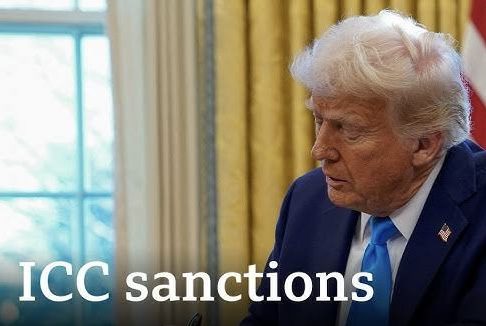
In a move that has reignited tensions between the United States and the International Criminal Court (ICC), the Trump administration has announced the imposition of sanctions on four ICC officials: two judges and two deputy prosecutors. This action expands on previous sanctions and underscores ongoing U.S. opposition to the ICC’s investigations involving American and Israeli interests.
These sanctions blocks any property or interests in property of these individuals within the U.S. or under U.S. control and prohibit American persons from engaging in transactions with them without special authorisation from the Office of Foreign Assets Control. This follows earlier U.S. measures, including sanctions in February 2025 on ICC Chief Prosecutor Karim Khan and other judges, bringing the total to at least ten ICC officials affected since the Trump administration’s return to power.
The U.S. Department of State justifies these sanctions as a response to what it perceives as “malign efforts” by the ICC that threaten American and Israeli sovereignty. Secretary of State Marco Rubio described the ICC as a “national security threat” engaging in “lawfare” against the U.S. and its allies, emphasising that neither country is a party to the Rome Statute, the treaty establishing the ICC. The U.S. argues that the court lacks jurisdiction over non-member states and that such probes undermine peace efforts and national judicial processes.
Is This Political?
The sanctions are widely regarded as politically motivated, rooted in the U.S.‘s long-standing skepticism of the ICC and its desire to shield itself and allies from international scrutiny. Critics, including the ICC itself, label them a “flagrant attack” on judicial independence, aimed at intimidating court officials and deterring investigations that could embarrass powerful nations.
The timing – amid ongoing Middle East tensions and U.S. domestic politics – suggests a strategic effort to bolster support among pro-Israel constituencies and assert American exceptionalism. Allies like France have urged the U.S. to retract the measures, while the United Nations has warned that they undermine global justice. Experts note that while framed as protecting sovereignty, the sanctions selectively target probes involving the U.S. and Israel, sparing others like the ICC’s case against Russia for Ukraine, which the U.S. supports.
What Does it Mean?
The sanctions signal U.S. defiance of multilateral institutions, potentially eroding the ICC’s credibility and operational capacity.
On the international stage, this escalates a clash between unilateral power and the rules-based order. It may hinder the ICC’s ability to pursue high-profile cases, including those against Russian officials, by fostering a chilling effect on judges and prosecutors. Victims of international crimes worldwide could suffer if the court is perceived as vulnerable to superpower influence. Conversely, it reinforces U.S.-Israel ties but risks isolating America diplomatically, as even allies like Canada and France – home to sanctioned officials – express dismay.
Will It Stop There?
History suggests not. This is the latest in a series of escalating U.S. actions against the ICC, following initial sanctions in 2020 and expansions earlier in 2025. The State Department’s announcement frames the sanctions as part of an ongoing response to the ICC’s “threat,” implying further measures if the court persists with contentious investigations. Potential next steps could include sanctions on additional ICC staff, restrictions on U.S. funding to supportive organisations, or legislative efforts like the proposed “Illegitimate Court Counteraction Act” to broaden penalties.
However, pushback from the international community, including calls from the UN and EU for the U.S. to reconsider, might temper escalation. The ICC’s resilience – continuing operations despite past sanctions – indicates it won’t back down easily. Ultimately, the trajectory depends on geopolitical developments, such as progress in Middle East peace talks or shifts in U.S. domestic politics ahead of future elections.
In summary, these sanctions highlight the fraught intersection of power, justice, and politics. While they aim to neutralise perceived threats to U.S. interests, they risk weakening the global fight against impunity, raising questions about the future of international accountability.
Dear reader, we need your support
Independent sites such as The AIMN provide a platform for public interest journalists. From its humble beginning in January 2013, The AIMN has grown into one of the most trusted and popular independent media organisations.
One of the reasons we have succeeded has been due to the support we receive from our readers through their financial contributions.
With increasing costs to maintain The AIMN, we need this continued support.
Your donation – large or small – to help with the running costs of this site will be greatly appreciated.
You can donate through PayPal or credit card via the button below, or donate via bank transfer: BSB: 062500; A/c no: 10495969


Go back to 1812-15 and the subsequent Monroe Doctrine, and the swelling young USA claimed absurd special status in setting legalities affecting its “Hemisphere” and interests. Trump is a sewer, trench, drain, potty, anything but a golden chalice. May law win eventually, and not ignorant crookedness.
Rather than self-justify, (“…the U.S. Department of State justifies these sanctions as a response to what it perceives as “malign efforts” by the ICC that threaten American and Israeli sovereignty…”), why won’t USA at least internally investigate these allegations in a transparent environment? What are they afraid of? False allegations or the truth? So far the ICC has made certain allegations – definitive verdicts are yet to be announced. Sanctioning ICC personnel simply perverts the course of justice. Judge not lest ye be judged.
If the ICC do succeed in bringing Netanyahu to justice and if the charges of crimes against humanity are proven, questions could well be asked as to who supplied the weaponry to commit genocide on the Palestinian people and the destruction of Gaza: the answer to those questions could cause some serious embarrassment for the US whether they are signatories to the Rome Statute of the ICC or not – they are complicit !