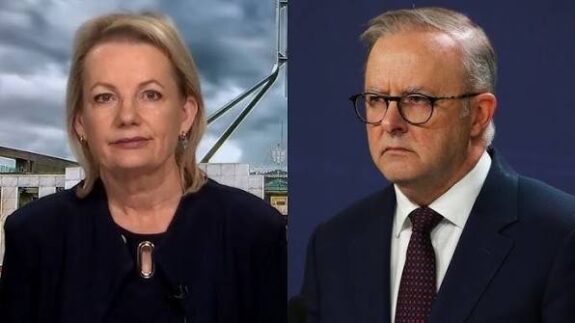
As the next federal election drags through its long, low-boil prelude, a quiet unease is settling over Australian voters. It’s not the usual tribal brawl of competing visions; it’s a hollow space where inspiration ought to be. This isn’t just sour grapes from the onlookers – it’s the sound of both sides falling short of giving people a real reason to care.
While swapping notes with fellow politics tragics, one line has stuck in my head: “The Opposition has done nothing to show why they should be returned to government, and the Albanese government has not done enough to show why they should be re-elected.” It’s a razor-sharp observation that nails the flat mood of Australian politics right now. Let’s unpack it – starting with the double negative that flips the whole thing on its head.
The Opposition’s Small Target: A Strategy of Absence
As Opposition Leader, Sussan Ley took on a straightforward mission: repair the Coalition’s battered reputation after a heavy defeat and position it as a credible alternative government. She’s advanced on the first front, though barely, unifying her party and honing its critiques. On the second, the evidence is scant.
The Coalition has waged a disciplined, laser-focused opposition, hammering the government’s vulnerabilities – the cost-of-living crunch and immigration – with relentless success. But critique isn’t a blueprint. To date, the Coalition is defined more by its no’s – the Voice, the 2030 emissions target – than by a fleshed-out, costed, and optimistic plan of its own.
Its abrupt climate U-turn – abandoning the legislated 2030 target and effectively ditching the 2050 net-zero pledge – crystallises the ambiguity. It fires up the faithful, yet leaves a gaping question: what comes next? This classic small-target ploy – skirt details, starve the government of ammo, and frame an election as a referendum on the incumbents – is textbook. For many voters, however, it reads less like cunning and more like an ideas vacuum, dodging the killer question: “What precisely would you do differently, and why would it work better?”
The Government’s Competent Incumbency: Is Stewardship Enough?
On the other side of the ledger, the Albanese government faces a different, but equally potent challenge. It is far from a do-nothing government. Its list of delivered promises is substantial: legislating a 43% emissions reduction target, establishing a National Anti-Corruption Commission, delivering wage rises for low-paid workers, implementing cheaper childcare, and successfully navigating a surplus.
Their case for re-election is built on a platform of competent stewardship: “We are a stable, adult government cleaning up the mess and managing the economy responsibly.”
Yet, for a significant portion of the electorate, this feels like it is not enough. The primary reason is the visceral, daily pressure of the cost-of-living crisis. Despite government measures – energy rebates, cheaper medicine – many households feel no better off. When people are struggling to pay their bills, a list of legislative achievements can feel abstract and distant.
Furthermore, the government’s brand has been tinged by a sense of promise fatigue, most notably the broken commitment on the Stage 3 tax cuts. While the change was politically popular, it reinforced a cynical view that all promises are temporary. For voters who hoped the re-election of the Albanese government would bring transformative change, the reality of cautious, managerial governance has been underwhelming.
The Consequence: A Leadership Vacuum
The combined effect of these dynamics is a profound sense of political dissatisfaction. Discontent with the government does not automatically translate into enthusiasm for the opposition. This leaves a vacuum where leadership and vision should be.
The government asks for credit for its management, but struggles to make voters feel managed. The opposition asks for power based on the government’s shortcomings, but refuses to fully show its hand.
The risk for Australian democracy is an election decided not on hope for the future, but on resignation and grievance. The Albanese government has time to bridge the gap between its record and the public’s perception of it. The Coalition has time to move from a critique to a compelling alternative.
The question for both is whether they can, or will, offer the nation something more than the lesser of two disappointments. Until one of them does, the great Australian discontent will only grow.
Keep Independent Journalism Alive – Support The AIMN
Dear Reader,
Since 2013, The Australian Independent Media Network has been a fearless voice for truth, giving public interest journalists a platform to hold power to account. From expert analysis on national and global events to uncovering issues that matter to you, we’re here because of your support.
Running an independent site isn’t cheap, and rising costs mean we need you now more than ever. Your donation – big or small – keeps our servers humming, our writers digging, and our stories free for all.
Join our community of truth-seekers. Donate via PayPal or credit card via the button below, or bank transfer [BSB: 062500; A/c no: 10495969] and help us keep shining a light.
With gratitude, The AIMN Team


Somehow, we have to make it possible for another party/individuals to have a chance at running Australia, not just swapping side to side of the two majors, neither of which is offering anything close to what Australians need and crave.
When did the Federal Government become so directly seen as responsible for the costs of living? I am pretty sure that many of us who are struggling are still able to feed and clothe ourselves adequately, keep paying our rent or mortgage, registering and insuring our two cars, and enjoying a coffee with friends or a beer in the pub.
Those who cannot have borrowed too deeply, chosen to live expensively, and become addicted to consumerism. Nobody speaks of having a frugal lifestyle any more.
And if the price of eggs rises, it’s the government’s fault
Lyndal, that’s the Liberal’s trademark: blame Labor even if it isn’t their fault.
As a labor voter I don’t have an issue with the “broken promise” regarding the stage 3 tax cuts and I am aware that the federal government has few levers to use in the cost of living and the the organisations that could deal with it have few teeth with which to do so. One which they have used is the rebate of $450 for electricity users, which has been helpful for the poor as well as the well heeled but has not helped those who are stuck in the poverty cycle of social “security” benefits payments.
As a labor voter I am disappointed that this government, with the mandate that it has, and few governments have had a greater one, has not taken the opportunity to right some of the wrongs that desperately need to be addressed. Some of that could be down to the fact that although they have a huge majority in the House of Representatives, they don’t have a majority in the senate, and from where I am sitting they wont have that while ever they don’t tackle the big issues, and both the House and Senate will continue to attract independents and eat away at both major parties voter base.
But that disappointment, at this time and place within the election cycle, would not change my vote.
I expect this labor government to get off its collective a5ses and govern as a labor government should, rather than as an outlying liberal government.
Australia needs to stop its, what seems to be an inexorable march towards Australia becoming another USA. Medicare needs to be properly funded so that people are not having to pay out of their own pockets to visit a doctor, private health insurers need to have their government payments cut back and those who want to buy private health insurance should pay what it costs instead of everyone funding their private health insurance but not getting any benefit from it. Social security benefits need to be lifted to at least the poverty line. The private employment and training scam, oooops I mean scheme, needs to be wound back and a modern version of the old CES needs to be reinstated and training through TAFE needs to be increased. Fossil fuel subsidies need to be wound down over a period of time. The tax system needs an entire overhaul, I know, it is a very difficult task but like anything, if you don’t start you will never make any headway. International corporations that make billions in income from Australia and Australians need to be paying an amount of tax that reflects their income, those loopholes that have been written into the tax legislation that allows them to transfer income back to parent companies and allied companies so as not to show any profit need to be closed. It beggars belief that a corporation that has an income of several billion dollars ends up have no profit or taxable income. It is absurd that nurses, police and average workers are paying more income tax than foreign corporations that have billions in income.
And a whole heap of other things. What I see currently is that the labor government is fluffing about around the edges and make teeny changes that really don’t change anything much and definitely do not address the big issues that need to be addressed.
I could be wrong, someone will surely tell me that I am, but this government has something that most governments would die for and they are not using it for the benefit of the people or the future of this country.
Come on labor, get of your backsides and deal with the big issues.
Sorry, Michael, it was a trite, made up statement sounding good but is meaningless bullshit. Albo has juggled, an anti-labor media, a hostile senate, seat seeking loonies, a lying opposition, a trump, a failed referendum and AUKUS. How could any sensible observer see any LNP politician with such qualities???????????????? (10 to the 0.301) to the fourth.
As it tries to tackle the tripling of world population from end WWII and the stranglehold of coercive neo-liberal/neo-conservative economics in play since the 1980s, the whole world (particularly the ‘west’) has been struggling with cost-of-living. Other than the ‘west’ others have been so struggling since the imperial invasions, subjugation and extraction.
The realization of it as a ‘crisis’, is an awakening to a covert multi-national supremacist war that has now become overt in the ‘west’. It has become overt by its quests for energy and the roll-on effects on water, nature’s ecology and climate change, all just to fill the coffers of those of aggregated extreme wealth and also to sustain their dishing out of wasteful bling with propaganda. They are the ones that are waging the war against ordinary citizens.
It has adopted psychological operations against ordinary citizens and govts alike, and since the covid pandemic and noticeable climate change, their war has become increasingly desperate giving rise to damaged supply chains, a roll-on of goods scarcity and paranoiac profit gouging.
These wars of the ‘west’ are depleting their people’s treasuries, reducing services and starving essential infrastructure. They result in reduced confidence in the democratic levers and the govts that ordinarily operate them. But those govts have been captured and weakened by the warriors. These ‘greed’ wars have become stuck in war for the sake of war without detente, and are giving rise to the rapid crumbling of the ‘west’.
The reactionary populist push has brought back the ‘othering’ of the middle ages, a suitable diversionary device for the warriors. And that has brought the world, Trump in America, and his puppet masters’ doubling down on conflict driven authoritarianism, the antithesis of detente and repair.
By Trump, America is being gutted, and the whole world put at extreme risk because of his loser brutal transactional protectionism. Thank goodness China is standing up to his stupidity.
Oz being primarily a resource export economy trying to modernize away from that sole dependency, its foreign policy is of aver-arching importance, and it has to be very judicious and careful about how it responds to the current geopolitical chaos lest it gets caught in the chains of Trump’s global divide and conquer.
Whilst it is precarious, Labor is doing a very sound job of progress, whilst hampered by having to wear moccasins against the wiles of the warrior mainstream media and capture by the brutal and labile Trump administration.
Labor, like all parties is prone to the vicissitudes of politics, but its current cautious managerial government is just what is needed in the prevailing circumstances. And experience ought reveal that it is very aware of the voter counter-balance needed to retain government.
Whereas the LNP (leaning into PHON), with its latest energy and immigration (non-)policies, has revealed it is fully captured by the warrior class and its guile and authoritarianism. Even though it has the financial backing of the offshore christo-fascists and fossil fuelers, it seems likely to have an increasingly uphill battle mustering the right weasel words – they don’t wash well in Oz.
Sorry, wam, but I have no idea what you’re talking about.
There will never be anything about the Coalition as a credible alternative Government, their complete economic and intelligent collapse is beyond comprehension.
There will never be anything about the Labour Party of being progressive and people oriented when it has lost all belief of its founding principles that Ben Chifley inspired, (although he was in essence a racist against the very cultural cuisine that dominates Australia today) he was the man of the times and we currently don’t have that in Albanese or anyone currently in Cabinet, noses firmly planted in the troughs.
What we need is several Mamdani’s and that you can start finding that via Independents.
sorry and thanks, Michael
Your post revolves around:
“… the Albanese government has not done enough to show why they should be re-elected.”
And mine around your ‘It’s a razor-sharp observation…’
It is on the ball with an lnp floating aimlessly but dribbles into no more than trite comparison between lnp and albo.
My guess it was a quote from a greenie spouting their usual bullshit.
The (10 to the 0.301) to the fourth is for canga but for non-maths people (10 to the 0.301) is 2, to the fourth is 16, the number of ?s.
The rest are a few suggestions illustrating why I think Albo has done enough to be re-elected