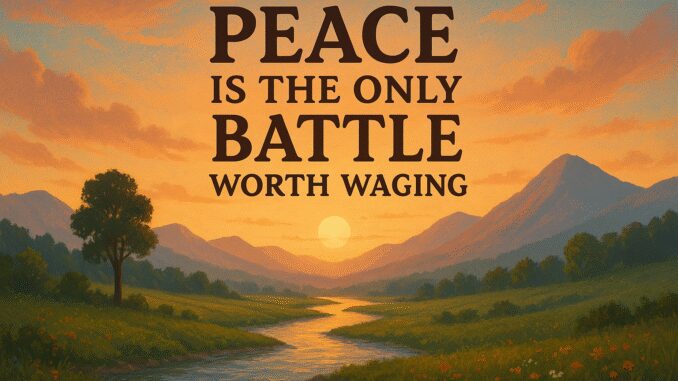
A wise voice recently posed a challenge: the first step toward peace is to discard all language having to do with war. This is not a call for polite speech, but for a radical act of cognitive liberation. The language of war is not merely metaphor; it is the operating system of a civilisation built on domination. It structures our thoughts, defines our problems, and limits our solutions to variations of violence.
Before a single bullet is ever fired, peace is the first casualty of our words.
The Pervasive Invasion: War as Our Mother Tongue
We are so immersed in the lexicon of conflict that we no longer hear it. We speak of a “war on cancer,” a “war on drugs,” and a “war on poverty.” In business, we “capture market share,” “launch a campaign,” “target an audience,” and accept “collateral damage.” Our entertainment is a glorification of this paradigm – from children’s cartoons where violence is the primary solution to blockbuster movies where the hero’s journey is a path of righteous annihilation.
This language is not neutral. It is programmatic. It subtly trains the mind to accept a series of toxic assumptions:
- That complex issues have a single, enemy-like cause that must be “defeated.”
- That victory for one side necessitates the total loss of the other.
- That unintended suffering (“collateral damage”) is an acceptable, calculable cost.
The Psychological Architecture of “Us vs. Them”
The language of war is the primary tool for constructing the “Other.” It creates a psychological chasm where once there was only difference. By framing another person, group, or nation as a “target” or a “threat,” we strip them of their humanity and their complexity. They are reduced to a problem to be eliminated.
This linguistic frame makes violence not only thinkable but logical. If the problem is a “monster” or a “cancer,” then eradication – not understanding, negotiation, or healing – becomes the only rational response. It is a self-fulfilling prophecy, written in the words we use before breakfast.
The Patriarchal Operating System: A Grammar of Dominance
This linguistic prison is sustained by what can be called the Patriarchal Operating System. This is a social model based on rigid hierarchy, competition, and the belief that power is the ability to control and dominate. This system is inherently adversarial; it cannot function without an “other” to conquer.
Its language is the language of the pyramid:
- Winners and Losers
- Command and Control
- Dominance and Defeat
Contrast this with the language of the network – the Matriarchal Principle based on connection, nurture, and ecosystemic health:
- Collaboration and Cooperation
- Understanding and Mediation
- Nurturing and Healing
The former seeks victory. The latter seeks balance and justice. One system creates endless cycles of conflict; the other builds resilient, adaptive communities.
Prescribing the Antidote: A New Lexicon of Peace
To dismantle this system, we must be deliberate in forging a new lexicon. This is not about “soft” language; it is about precision language that describes reality without defaulting to violence.
We must replace the vocabulary of war with a vocabulary of sovereign action:
- Instead of a “War on Poverty,” we initiate a “Mobilisation for Prosperity” or a “Campaign for Dignity.”
- Instead of “Fighting Crime,” we focus on “Building Community Safety” and “Fostering Social Rehabilitation.”
- Instead of “Defeating the Enemy,” we work toward “Neutralising a Threat” or, more profoundly, “Resolving a Conflict.”
- Replace “Target” with “Focus.”
- Replace “Collateral Damage” with the honest, grievous term: “Unacceptable Civilian Harm.”
This new lexicon reframes our mission from destruction to construction. It shifts our identity from conquerors to stewards.
A Call for Conscious Communication
The task before us is to become linguistically conscious. We must audit our own speech, call out war-language in our media and politics, and teach our children the language of the network.
Every time we choose “connection” over “conquest,” “dialogue” over “demolition,” we are not just being polite. We are actively deprogramming a millennia-old script of violence and writing a new one for a future of peace.
The battle for a peaceful world will not be won on a battlefield. It will be won in the quiet moments when we choose a different word. Let us choose wisely. Let us choose peace.
Keep Independent Journalism Alive – Support The AIMN
Dear Reader,
Since 2013, The Australian Independent Media Network has been a fearless voice for truth, giving public interest journalists a platform to hold power to account. From expert analysis on national and global events to uncovering issues that matter to you, we’re here because of your support.
Running an independent site isn’t cheap, and rising costs mean we need you now more than ever. Your donation – big or small – keeps our servers humming, our writers digging, and our stories free for all.
Join our community of truth-seekers. Donate via PayPal or credit card via the button below, or bank transfer [BSB: 062500; A/c no: 10495969] and help us keep shining a light.
With gratitude, The AIMN Team


I really connected with this piece. It captures something we rarely acknowledge, that long before any real conflict begins, our language has already trained us to think in terms of enemies, battles, and winners and losers. It is remarkable how often we default to warlike language without even realising it.
What stands out to me is how much this shapes our politics as well. Once everything is framed as a fight, genuine dialogue becomes almost impossible. We lose sight of cooperation, shared humanity, and the possibility of solutions that lift everyone. As the article says, peace is often lost in the words we choose long before it is lost in the world.
If we want a more peaceful society, then changing our language feels like a practical first step. It costs nothing, yet it opens space for connection and understanding instead of division. I appreciate articles like this that remind us of the power of our everyday language.
I couldn’t agree more. For a long time now, our mainstream media has being playing up war. AUKUS has brought nuclear-powered submarines into our sphere, Channel 10 showed a programme about why we are heading for war with China. Our government is now targeting high school leavers, to join the armed forces, desperate to swell the ranks. Even ABC uses words of war. We are cosying up to the US and the UK, both with a war-like history. This isn’t a game. When war comes, we can’t say “Stop, we didn’t mean it!” People like you and I, are going to die, or worse. I feel this war narrative is intended to normalise war. It needs to stop.
I’d go so far as to suggest that for the greater majority, the choice of words used in expression is rarely questioned. Words tumble out of our mouths without so much as a critical observer at the gate and on guard as to what is actually being said, a guard that is aware of the potential consequences as a result of a poorly framed choice of phrase or word, and thus acts as a handbrake on speech that might be, as it were, as petrol is on an already lit fire.
The American psychologist and psychotherapist, Albert Ellis, who was the founder of the therapeutic discipline known as RET – Rational Emotive Therapy – was keenly aware of the impact of speech and language patterns at both the monologue and dialogue levels of expression. He coined the term ‘Musterbation,’ which referred to the use of modal verbs… words & phrases such as ‘must,’ ‘should,’ ‘have to,’ ‘ought to,’ ‘need,’ and cautioned against their casual usage based on the insight that their careless use often led to unnecessary distress and neurosis or worse.
It’s a commonplace observation that language is a minefield and Andrew Klein’s observations are a timely reminder that mindfullness is a most useful endeavour and a profitable asset in the communicative toolbox.
I totally agree with the substance of this essay. I believe that progress towards truth in this matter will only occur if and when journalists and politicians refrain from using language that creates fear and confusion.
So it has always been, we used to die for “God, King and Country” any one, or group who opposed war, was jeopardizing the nations security.
War turns a dollar for a select group in our society, who continually pressure both politicians and to some degree the media, hence the language used.
History proves war and truth are diametrically opposed and always have been, will we change? It’s up to you.
History is always written by the victors – they have command of the language.