
Buybacks and Bonuses: The 21st Century Robber Baron Scam Hits Its Breaking Point
By Sue Barrett
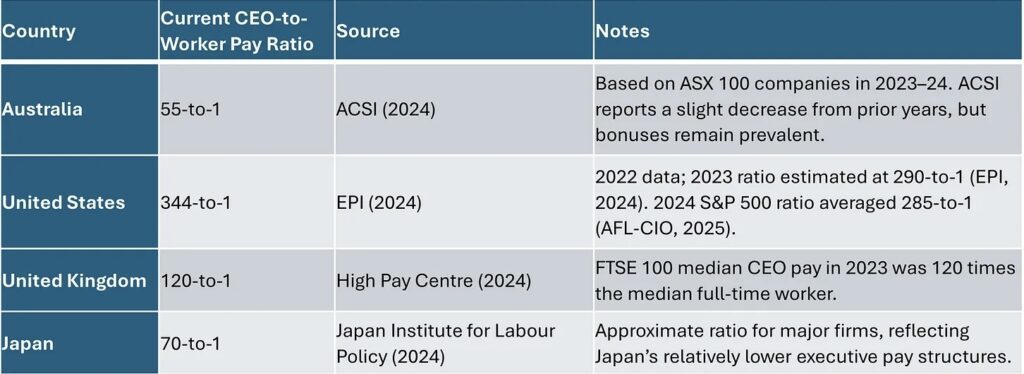
Imagine skipping meals to pay rent while corporate CEOs, from Sydney to Silicon Valley, jet off in private planes, pocketing millions in bonuses even when their companies falter. This is 2025, where corporate profiteers otherwise known as “elites” cash in through share buybacks, AI-driven job cuts, and bloated not-for-profit (NFP) salaries. In Australia, ASX 100 CEOs earn 55 times the average worker’s wage, up from 17-to-1 in the 1990s (Australian Council of Superannuation Investors [ACSI], 2024). In the US, the gap is 344-to-1, with Apple’s Tim Cook at 672-to-1 (Economic Policy Institute [EPI], 2024). The UK’s 120-to-1 and Japan’s 70-to-1 ratios follow (High Pay Centre, 2024; Japan Institute for Labour Policy, 2024). Their aim? Self-enrichment, not company success, exploiting workers, smaller businesses, economies, and communities.
This isn’t envy. It’s fury at inequality. Not all businesses play this game, but many listed firms do, risking societal collapse. Peter Drucker, management’s pioneer, would demand better. This article is just about exposing the heist, it’s about a fight for fairness, and rebuilding better systems for all.
The Roots of Corporate Greed
The 1980s ignited this fire. US deregulation, including the 1982 legalisation of share buybacks under SEC Rule 10b-18, let companies inflate share prices and CEO pay (Securities and Exchange Commission [SEC], 1982). Australia’s Hawke-Keating reforms, deregulating markets, followed suit, fostering greed (Kelly, 1992). Bonuses shifted from modest perks to stock-option windfalls tied to share prices, not company health. In 2024, 91% of ASX 200 CEOs received bonuses, even in failing firms (ACSI, 2024).
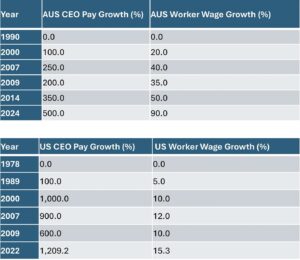
Globally, US CEO pay surged 1,209.2% from 1978 to 2022, while workers’ wages grew 15.3% (EPI, 2024). Boeing’s David Calhoun earned $32.8 million in 2023 despite $2.2 billion losses (Boeing, 2024). In Australia, Qantas’s Alan Joyce cashed $21.4 million in 2017 while cutting jobs (Qantas, 2017). Woolworths’ Brad Banducci pocketed $11.3 million in 2023 amid $400 million buybacks, as shoppers faced price hikes (Woolworths, 2024). BHP’s Mike Henry earned $16.7 million in 2024, with $2.1 billion in buybacks despite coal price dips (BHP, 2024).
This isn’t talent-driven, it’s a rigged system.
Share Buybacks: A Corporate Scam
Share buybacks are a core scam, inflating share prices to boost CEO payouts, often 80% of their compensation. ASX 200 firms spent $12 billion on buybacks from 2020–2023; S&P 500 companies spent $341.2 billion (S&P Global, 2024; ACSI, 2024). Globally, US firms led with $7.6 trillion over 15 years, versus $4.6 trillion for wages (Bank of America, 2022). Australian workers’ wages have stagnated less severely than the US’s, flat since the 1970s (ABS, 2024; EPI, 2024). These funds, diverted from innovation and wages, enrich profiteers. Public outrage, evident in X’s #FairPayNow campaign and shareholder “first strikes” at firms like Whitehaven Coal (Allens, 2024), signals a turning point. Regulatory scrutiny, like the US’s 1% buyback tax (Inflation Reduction Act, 2022) and Australia’s proposed 2% tax (Greens, 2024), suggests the scam’s days are numbered.
AI and Automation: Jobs Cut, Wages Stagnate while Bonuses Soar
AI and automation fuel corporate profiteering, slashing jobs and stagnating wages while inflating CEO bonuses. Coles trials robot checkouts, Japan’s banks deploy AI tellers, and Amazon’s US warehouses rely on robots, funnelling savings into share buybacks rather than worker pay (McKinsey, 2024). A 2024 McKinsey report predicts AI could automate 30% of jobs by 2030, threatening livelihoods. Amazon’s Andy Jassy pocketed $29.2 million in 2023 as AI-driven cuts eliminated thousands of jobs (Amazon, 2024). In Australia, a July 2025 X post exposed a retailer automating 20% of its workforce, boosting its CEO’s bonus by $2 million despite flat profits (@FairWorkAU, 2025).
As discussed in my recent article on The New Pricing Scam: How Surveillance Pricing Exploits Us All, algorithmic pricing, flagged by the ACCC and US FTC in 2024, exploits consumers with inflated costs, further eroding household budgets (ACCC, 2024; FTC, 2024). While Ross Gittins and Harvard’s Dani Rodrik argue workers prioritise good jobs -secure, autonomous, respectful- over marginal pay rises, this doesn’t mean workers don’t want fair and decent wages (Gittins, 2025; Rodrik, 2024). A 2024 ACTU survey found 68% of Australians value job security over wages, yet fair pay remains critical (ACTU, 2024). Corporate profiteers, however, widen the pay gap: US workers’ wages have stagnated since the 1970s, while S&P 500 CEOs earn 344 times the average worker, compared to Australia’s 55-to-1 ratio (Economic Policy Institute [EPI], 2024; Australian Council of Superannuation Investors [ACSI], 2024). In the US, lax regulations exacerbate this inequality, enabling CEOs like Jassy to amass millions as workers struggle. In Australia, wage growth lags behind CEO pay, with ASX 200 bonuses rising 12% in 2024 despite flat worker salaries (ACSI, 2024). This wage disparity, driven by automation and greed, undermines fairness and fuels public outrage.
The NFP Sector: Charity or Corporate Clone?
Greed infects the NFP sector too. To attract CEOs, Australian charities are paying around $500,000, US ones $1.5 million, and UK NFPs £300,000 (Charity Navigator, 2024; NCVO, 2024). These salaries divert funds from missions, turning charities into corporate clones. Justifying high pay as ‘market necessity’ betrays purpose, fuelling outrage over inequality, not envy. In Australia, public anger on X in 2025 targeted NFP executive pay, with #CharityNotProfit trending (X Post, @CommunityVoice, 2025).
Moral Disengagement: How Profiteers Justify Excess
How do profiteers justify millions while workers struggle? Albert Bandura’s moral disengagement explains: they claim pay is ‘earned’ for ‘value creation’ (moral justification), call bonuses ‘incentives’ and layoffs ‘efficiencies’ (euphemistic labelling), or blame boards (displacement of responsibility) (Bandura, 1999). They argue ‘market necessity’ demands high pay, yet ACSI’s 2024 report shows 30% of ASX 200 firms missed profit targets while CEOs pocketed bonuses (ACSI, 2024). Boeing’s Calhoun and Qantas’s Joyce exemplify this, earning millions despite losses. By ignoring inequality’s harm (disregarding consequences) and treating workers as numbers (dehumanisation), profiteers sleep soundly as society frays.
The Great Injustice: When Greed Fractures Society
Fairness is society’s glue. When bosses’ pay spirals, history shows collapse. The 19th-century US robber barons, Rockefeller and Carnegie, amassed fortunes through monopolies and worker exploitation, sparking labour uprisings and antitrust laws. The French Revolution (1789) and Russian Revolution (1917) erupted when aristocrats’ wealth crushed peasants. In the 1920s, US inequality, executives earning 100 times workers, fuelled the Great Depression’s unrest.
Gender and diversity deepen the chasm: female ASX 200 CEOs earn 20% less than males, Indigenous workers 30% less than non-Indigenous peers, and only 10% of Fortune 500 CEOs are women (WGEA, 2024; ABS, 2024; Fortune, 2024). A 2018 University of Oxford study found people tolerate a 20-to-1 income ratio; beyond that, it’s unjust. A 2021 Nature study shows humans demand change -protests, strikes, revolutions- when fairness is violated. Australia’s 55-to-1 ratio, the US’s 344-to-1, and the UK’s 120-to-1 shatter this limit. Social media posts in 2025 show global fury from Sydney, London, to New York, demanding wealth taxes and pay caps. Bonuses for failing firms scream injustice, not envy. This greed risks chaos.
Why Expose This Heist?
Why write this? Because the current system is not fair. I refuse to call these people “elites”, instead they’re corporate profiteers, like 19th-century robber barons, rigging the system for personal gain while exploiting the majority. The majority -workers, small businesses, customers, communities- are exploited by a corporate culture infected with greed. Businesses have become money-making machines for profiteers, not vehicles for building better societies or viable systems of community and commerce. CEOs like Boeing’s Calhoun or Qantas’s former CEO Joyce pocketed millions while firms falter, workers lose jobs, and communities suffer.
Greed erodes trust, threatening collapse. This is drastic: corporate greed is destroying our systems. If nothing’s left, no trust, no cohesion, what do we do? We must call this out to stop the collapse. Exposing this is a fight for fairness, for systems serving everyone, not just profiteers.
Not All Businesses, But Many Chase the Scam
Not every business plays this game. Firms like Australian Ethical prioritise fair pay and ethical investing, avoiding buyback scams and excessive CEO payouts. But many companies, especially those chasing ASX or NYSE listings, exploit these mechanisms to enrich profiteers. Listing often signals intent to leverage buybacks and stock options for short-term gains, as seen with Qantas and Boeing. This isn’t universal, but the trend is clear: public listings amplify greed, diverting resources from workers and innovation.
The Role of MBA Programs: Breeding Greed?
MBA programs, particularly in the US, have much to answer for. Since the 1980s, schools like Harvard and Wharton have championed shareholder primacy, teaching executives to prioritise short-term stock gains over societal good. Rakesh Khurana’s 2007 book From Higher Aims to Hired Hands critiques how MBAs shifted from stewardship to self-interest, with courses on stock options and buybacks normalising these scams. Australian MBAs often adopt US models, spreading this mindset. Graduates learn to manipulate earnings per share to trigger bonuses, even in failing firms, fuelling profiteering.
Compromised Governments and Politicians
Governments and politicians are often complicit. In the US, insider trading scandals, like senators profiting from stock trades during the 2020 COVID crisis under the STOCK Act, show politicians benefiting from corporate schemes. Lobbying by firms like PwC and Goldman Sachs ensures lax buyback and tax rules, with $7.6 million spent in 2023 (OpenSecrets, 2024). In Australia, regulatory capture risks are evident in the PwC tax scandal, prompting a 2024 Senate inquiry. While Australia’s ASIC and “two-strikes” rule offer accountability, US regulators lag, worsening the 10-fold inequality crisis.
What Should Governments Do?
Governments can act:
- Tax Buybacks: The US’s 1% excise tax on buybacks (2022) is a start; Australia could adopt a 2% tax, as proposed by the Greens (2024).
- Cap Pay Ratios: EU-style 20-to-1 pay ratio caps could apply in Australia and the US, as Drucker urged.
- Strengthen Governance: Enforce Australia’s “two-strikes” rule globally and mandate transparent pay reporting (SEC proposals, 2024).
- Regulate AI: Tax AI-driven job cuts to fund retraining, as per ACTU proposals (2024).
- Curb Lobbying: Limit corporate donations and mandate lobbying disclosure, as per Australia’s 2024 Senate inquiry.
- Prioritise Job Quality: Per Gittins, mandate workplace autonomy and security to boost satisfaction and productivity (Gittins, 2025; Rodrik, 2024).
What Would Peter Drucker Say?
Peter Drucker would be horrified. He urged a 20-to-1 pay ratio to preserve morale, not Australia’s 55-to-1 or the US’s 344-to-1. Businesses must serve society, he said. Bonuses for failing firms, buyback scams, AI job cuts, and moral disengagement would appal him. In the US, where greed is 10 times worse, he’d slam the trust deficit. NFP pay scandals would disgust him as mission betrayal. Drucker would demand AI uplift workers and rules to curb profiteering.
The Elephant in the Room
Bonuses, buyback scams, and AI have rigged the game for corporate profiteers, profitable or not. Australian CEOs like Joyce are bad; the US’s Cook takes it to obscene levels, with lax regulations and political complicity worsening the chasm. NFPs mimic corporates, and this injustice fuels unrest. People aren’t envious, they’re furious, demanding fairness before society collapses.
What Can Regular Citizens Do?
We’re not powerless. Here’s how to fight back:
- Shop Smart: Choose firms like Australian Ethical with fair pay. Check ACSI or Glassdoor for pay ratios.
- Raise Hell Online: Post on social media about unfair bonuses or AI cuts. Tag firms, join #FairPayNow. TWU’s X campaign cut Qantas bonuses in 2023.
- Use Your Shares: Vote at AGMs to reject bloated pay via Australia’s “two-strikes” rule or US groups like As You Sow.
- Push Politicians: Email politicians for buyback taxes and pay caps. Sign Change.org petitions for AI protections.
- Join Forces: Back unions like Australia’s ACTU or US’s Fight for $15. Collective action works.
- Spread Awareness: Host pub chats or book clubs on inequality. Try Piketty’s Capital in the 21st Century. Demand NFP pay transparency.
- Invest Ethically: Move super to funds like Australian Ethical, avoiding firms with excessive CEO pay.
Conclusion
While workers and everyday citizens advocate for fairness, corporate profiteers pocket bonuses, profitable or not, through buyback scams, AI job cuts, and NFP salary scandals. Australia’s 55-to-1 pay ratio is bad; the US’s 344-to-1 is a crisis, worsened by compromised politicians. Not all businesses, but many listed ones, exploit these scams, fuelled by MBA teachings. Governments must tax buybacks, cap pay, and curb lobbying. This isn’t envy. it’s exploitation destroying community and commerce. Peter Drucker would demand businesses serve society.
History warns extreme pay gaps spark revolutions.
From Sydney to New York, citizens and citizens can boycott, protest, vote, and organise to rein in profiteers, regulate AI, and rebuild fairer systems for all.
History warns extreme pay gaps spark revolutions.
From Sydney to New York, citizens and workers can boycott, protest, vote, and organise to rein in profiteers, regulate AI, and rebuild systems for all.
You know what to do.
Onward we press
Sources:
- Australian Council of Superannuation Investors (ACSI). (2024). CEO Pay in ASX 200 Companies.
- Economic Policy Institute. (2022). CEO Pay in 2022.
- Institute for Policy Studies. (2023). Stock Buybacks Report.
- McKinsey Global Institute. (2024). The Future of Work: AI and Automation.
- Australian Competition and Consumer Commission (ACCC). (2024). Algorithmic Pricing Report.
- US Federal Trade Commission (FTC). (2024). Pricing Practices Report.
- Charity Navigator. (2024). Nonprofit CEO Compensation.
- Harvard Business Review. (2020). Australia’s Two-Strikes Rule.
- University of Oxford. (2018). Fairness and Inequality Study.
- Nature. (2021). Human Reactions to Inequality.
- Bandura, A. (1999). Moral disengagement in the perpetration of inhumanities. Personality and Social Psychology Review.
- X posts on automation, CEO bonuses, and public anger (2025).
- Boeing. (2023). Financials and Executive Compensation Reports.
- Chernow, R. (1998). Titan: The Life of John D. Rockefeller, Sr.
- Khurana, R. (2007). From Higher Aims to Hired Hands: The Social Transformation of American Business Schools.
- OpenSecrets. (2024). Lobbying Expenditures.
- The Guardian. (2024). PwC Tax Scandal and Senate Inquiry.
- Allens. (2024). Shareholder Activism in Australia.
- Harvard Corporate Governance. (2019). Stock Buyback Regulations.
- ABC News. (2024). Corporate Governance Scandals.
This article was originally published on Sue Barrett
Dear reader, we need your support
Independent sites such as The AIMN provide a platform for public interest journalists. From its humble beginning in January 2013, The AIMN has grown into one of the most trusted and popular independent media organisations.
One of the reasons we have succeeded has been due to the support we receive from our readers through their financial contributions.
With increasing costs to maintain The AIMN, we need this continued support.
Your donation – large or small – to help with the running costs of this site will be greatly appreciated.
You can donate through PayPal or credit card via the button below, or donate via bank transfer: BSB: 062500; A/c no: 10495969

All I can say is WOW!!! The US at 1,209.2% from 1978 to 2022, while workers’ wages grew 15.3% or Australia’s 500% to 90% is absolutely disgusting.
There needs to be legislation or something to stop this corporate greed but there is also all the other issues like insider trading, legal tax breaks, etc.
Or perhaps we just tax the crap out of the mega rich and get that money back to use for the greater good.
Oh for the days before that parasite Chainsaw Dunlap came to Oz.