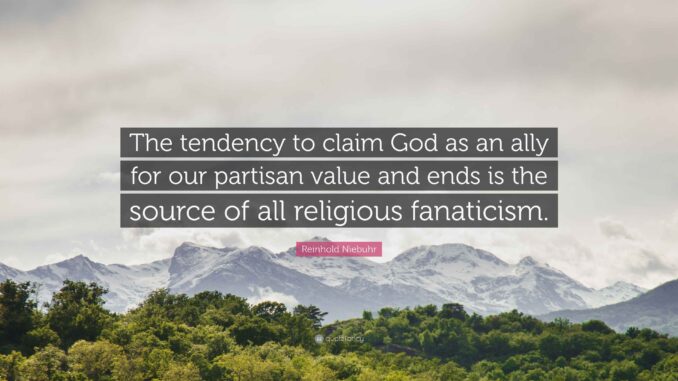
Across the scorched landscapes of human conflict, from the ancient dust of the Middle East to the modern battlefields fueled by sectarian hate, a single, poisonous seed can be found at the root. It is not the simple existence of faith, but the belief in a partisan God – a divine real estate agent who grants deeds to one tribe over another.
This idea, that the divine consciousness of the universe picks favorites, is the most destructive and enduring myth ever to take root in the human psyche. It is a theological error that has cost millions of lives and continues to be the justification for unspeakable violence.
The Divine Real Estate Agent
The concept is seductively simple: a specific piece of land, a “Holy Land,” is granted by God to a specific “Chosen People.” This is not spirituality; it is divine cartography. It transforms faith from an internal, personal journey into an external, territorial claim. The believer is no longer a seeker of truth, but a soldier for a divine title deed.
This creates an immediate and irreconcilable conflict. What happens when two tribes believe they hold the same divine deed to the same patch of earth? The result is not a theological debate; it is a war. And in war, the “partisan God” is always conscripted, always believed to be fighting for one side, blessing its missiles and sanctifying its dead.
This is the bloody harvest we see playing out in endless cycles of retaliation. It is the inevitable fruit of the poisonous seed. When you believe God is on your side, your enemy is not just a political or territorial adversary; they are a heretic, a blasphemer standing against divine will. This dehumanisation is the prerequisite for atrocity.
A Higher, Unifying Principle
To examine religion critically is to challenge this core concept of a partisan deity. If there is a creative force behind the universe – a source of love, law, and life – does it make sense that such a force would be tribal? Would the energy that spins galaxies and designs the double helix be concerned with drawing national borders and favoring one human lineage over another?
The answer offered by a deeper, more philosophical examination is a resounding no.
The divine is not a person to be persuaded, but a principle to be aligned with. It is not a king who chooses favorites, but a mother who loves all her children. This force does not grant deeds to land; it offers a path to inner peace, ethical living, and harmony with all of creation. Its “chosen people” are not those of a specific bloodline, but all who choose compassion over hatred, justice over oppression, and love over fear.
The Path Forward: From Partisan to Universal
The challenge for humanity is to outgrow the spiritual adolescence of the partisan God. This does not require abandoning faith but maturing it.
- From Exclusion to Compassion: True faith is measured by its capacity for empathy, especially for the “other,” the stranger, and even the enemy. This is the core teaching found, and often ignored, within many traditions.
- From Land to Heart: The true promised land is not a geographical location, but a state of being – a heart at peace, a mind free from hatred, a community built on justice.
- From Ownership to Stewardship: We must shift from seeing the earth as a possession granted by a divine real estate agent to understanding our role as temporary stewards, tasked with caring for a world we all share.
The conflicts we see are not holy wars. They are the tragic, bloody consequences of a primitive misunderstanding of the sacred. They are the harvest of a seed that should have been left to wither long ago. It is time to plant a new seed – one of a universal, unconditional divine love that asks not who we are, but how we love. The future of our species may depend on it.
Keep Independent Journalism Alive – Support The AIMN
Dear Reader,
Since 2013, The Australian Independent Media Network has been a fearless voice for truth, giving public interest journalists a platform to hold power to account. From expert analysis on national and global events to uncovering issues that matter to you, we’re here because of your support.
Running an independent site isn’t cheap, and rising costs mean we need you now more than ever. Your donation – big or small – keeps our servers humming, our writers digging, and our stories free for all.
Join our community of truth-seekers. Donate via PayPal or credit card via the button below, or bank transfer [BSB: 062500; A/c no: 10495969] and help us keep shining a light.
With gratitude, The AIMN Team


I have to admit that I have significant disdain for any religious group that claims that it is the “chosen one”.
My story starts when I was a child in a Baptist family.
All ok until I was very ill at around 15 years old and didn’t go to school much for 2 years.
I was a regular visitor to the Royal Hobart Hospital, and then one day some people from the church came in to see ma and told me that I must have sinned badly because God was punishing me by making me ill.
My parents of course were horrified and apparently got stuck into them – but my fate with any extreme religious groups was sealed.
In my opinion, they do nothing for either their local communities or society at large and are often just a way for some “leaders” to rip people off and enrich themselves.
To quote His Bobness:
If god is on our side
He’ll stop the next war
… and there’s no sign of that happening, so …
From time immemorial emergent humans were mystified by both the grandeur and threat of their natural environment. In their innocence they devised tales that deified the entity that supposedly created this existence and knowing no better they anthropomorphised the creator in their own image. Time and trial produced different tribal rules and belief systems that always recognised “others” as being a threat to the tribe. So we have history. Religions are human constructs and are a reflection of human inability to recognise that survival simply requires adaption to an inclusive not combative environment. Let’s burn the books!
…and as a kid in a strict rural Anglican Sunday school, sitting always in the back row I would often silently chant;
“shit, bugger bum, let the lightning come”. – and it never did!!
Partaking the body of Christ. Walking on water, turning water into wine. The looks on their clubbed faces as they jibbered on – yeah sophisticated, marked by sophistry. FFS bloody eejits. I effed off as soon as I could to continue as a river rat and commune with nature, see beauty first hand, and actually learn things useful.
I’ve never placed faith in any religion, at least not since my midlife crisis. and this article captures why. The notion of a “partisan God” has long divided humanity and justified conflict. True spirituality, to me, lies in compassion, ethics, and unity, not dogma or divine ownership. We don’t need belief to live morally; empathy and shared humanity are enough.