Letting the idealist in me loose.
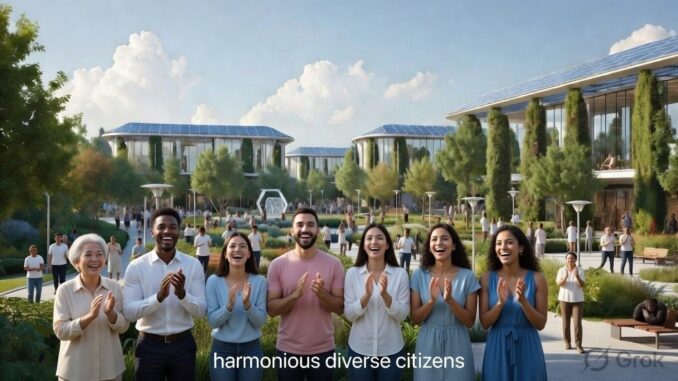
In an ideal society, people are encouraged to express their unique identities in all areas of life. This community is driven by hope for the future, living genuinely, and embracing the full journey of being human, with all its ups and downs. For example, community members regularly gather in storytelling circles, where each person shares experiences, traditions, and dreams, fostering understanding and appreciation across backgrounds. In schools, students might create “identity mosaics” by contributing pieces that reflect their personal journeys and aspirations, which are then displayed for everyone to celebrate. These daily practices turn hope into tangible action, ensuring that each person’s individuality becomes an active, visible part of community life.
Our aspirations extend to labour, where we seek meaning and fulfilment; to learning, where curiosity ignites our quest for knowledge; and to spirituality, where we seek deeper connections with ourselves and the universe. We celebrate the power of art and poetry, using these media to convey our innermost thoughts and emotions. We would also cherish the joy of play and exploration, continually pushing the boundaries of our experiences. To make these ideals real for everyone, we would introduce policies such as universal basic education, which provides access to lifelong learning, and public creative grants that support artists and innovators from every background.
For example, countries like Finland have shown that investing in universal quality education leads to higher levels of innovation and social mobility. Similarly, programs such as the National Endowment for the Arts in the United States have demonstrated how public grants can empower diverse artists and expand cultural opportunities (excluding Trump, of course).
These real-world successes show that supporting education and creativity is not just an ideal, but a proven pathway to opportunity. These steps turn inspiration into opportunity, so that everyone has the support they need to pursue meaningful work, learning, and self-expression. Together, we approach each day with unwavering zeal, ready to engage with the world around us and reflect the beauty of our diverse expressions.
Society would celebrate diversity, with empathy at the heart of education and the common good guiding politics, regardless of people’s beliefs.
Equality of opportunity for everyone would be a core part of the constitution, ensuring that all people have the same chance to pursue their dreams and contribute to society. Imagine two children growing up in the same community: one has access to excellent schools, nutritious food, and strong support at home, while the other faces crowded classrooms, uncertain meals, and little encouragement.
Without true equality of opportunity, the second child’s potential might go unrealised, not because of a lack of ability or ambition, but because of barriers beyond their control. Enshrining equality of opportunity honours every person’s dreams and talents, making fairness and justice more than just ideals, but real and reachable for everyone.
Of course, there are ongoing debates about how such policies are implemented and what forms of support best help everyone succeed. Some critics worry that enforcing strict equality of opportunity could unintentionally undermine merit and individual motivation, or that measuring opportunity is itself complex and sometimes contentious. However, by facing these critiques openly, we can strive for policies that genuinely increase fairness while also encouraging each person’s strengths. This commitment would support fairness and justice, helping to build an inclusive community where everyone can succeed.
I imagine a society where every person’s love and identity are celebrated openly. Instead of merely avoiding judgment, we come together for vibrant festivals filled with music, art, and shared stories of love in all its beautiful forms. People proudly share their journeys, and families, friends, and neighbours gather to honour the many ways people connect, support one another, and express who they are. In this world, skin colour paints the tapestry of our origins, enriching the community with a chorus of backgrounds and traditions. Here, diversity shines at the heart of our happiest moments, and everyone is valued for who they truly are.
In my ideal society, people would be encouraged to follow their dreams, including finding economic success. This freedom would be balanced by rules that prioritise the community’s well-being. Fairness would be key, making sure everyone shares in the wealth society creates. For instance, progressive taxation and support for worker-owned cooperatives would help ensure prosperity is shared, and personal ambition is aligned with the public good. However, putting these ideas into practice can present real challenges. Progressive taxation often faces political resistance, with some arguing that higher taxes could reduce incentives to work or invest, or lead to efforts to avoid taxes. In Australia, the young are currently disadvantaged,
Similarly, worker-owned cooperatives may encounter difficulties in raising capital, gaining access to mainstream markets, or navigating complex management structures. There can also be concerns that such approaches might affect overall economic competitiveness. These obstacles mean that any move toward greater fairness must be carefully planned, with open dialogue and adaptive policies to address emerging issues. This way, personal goals and the community’s prosperity would go hand in hand.
People would be guaranteed freedom of expression, including the right to disagree with others. However, true debate is not about winning, but about the art of persuasion through facts, ideas, and principles. Expressing hate toward others would be seen as lacking insight and compassion and would fall short of our common humanity.
Entry to essential health services and social welfare programs would be ensured, along with the availability of appropriate and timely treatment for all individuals in need.
Our top value should be treating others with the same kindness and respect we want for ourselves. This golden rule should guide everyone’s actions and help build a caring, understanding community.
In my ideal society, people would value science and rely on evidence and reason instead of myths. At the same time, everyone could express their spirituality, provided it did not go against the common good. This state would support free dialogue and mutual respect, allowing personal beliefs to grow while keeping the community fair and united. When conflicts arise between scientific reasoning and spiritual beliefs, these issues would be handled through respectful discussion and a process that brings together community representatives, scientific experts, and spiritual leaders. Public panels and mediation panels would encourage thoughtful conversation, seeking solutions that acknowledge both factual knowledge and deeply held beliefs, while always prioritising community health. In cases where disputes affect health, safety, or rights, objective evidence would guide decision-making, but the process would always strive for empathy, understanding, and the safeguarding of personal dignity.
My society would be judged by its hospitality and treatment of its most vulnerable citizens, including older people, people experiencing homelessness, people experiencing poverty, and people seeking asylum. To measure how welcoming we truly are, we would set clear indicators such as reducing waiting times for asylum decisions to under three months and increasing access to emergency shelter so that no one in need is turned away at night. We would also track the quality of elder care services through regular satisfaction surveys and set a goal of ensuring at least 95 per cent of our seniors have timely access to complete support. By monitoring these measures, our compassion is backed by real results, ensuring that care for the powerless is more than a mere promise.
Everyone should have the right to access the law, no matter their social or economic background. Whether someone is wealthy or struggling, they should be able to access legal help, know their rights, and manage the legal system without hindrance. Community legal clinics and technology-based platforms would serve as bridges for those who might otherwise struggle to engage with the system, providing free or low-cost legal advice and resources. By making legal support more visible and accessible, we help ensure that the right to access justice becomes a real and practical possibility for all.
Change would be a natural part of our lives, helping shape a society that welcomes progress. This community would not hold on to temporary comforts for a false sense of safety. Instead, we would see that modifying is key to becoming stronger and constructing a better future.
My ideal society would recognise that working together in a democracy moves us forward better than relying on the rule of one person.
In democracies, we naturally look for guidance and connection with others through voting. Elections let us choose leaders who represent what people want and need.
A fitness-to-serve stipulation would include a provision in our constitution ensuring that only the most qualified and knowledgeable individuals can guide Parliament. This approach means that decisions rest on expertise, making our government more effective and trustworthy.
Separately, the world of work would operate on the fundamental principle of equality among all individuals. In this vision, everyone can pursue their goals and ambitions within a caring community, with equal and just access to opportunities.
For democracy to succeed, leaders need to make well-informed decisions and set rules that advance society. They should create an environment where everyone can grow and participate in democracy.
Every member of Parliament ought to follow the core principles in a constitution created and approved by the people. This constitution, along with a bill of rights, forms the foundation of the new republic’s government.
My thought for the day
The improper use of free speech has likely played a role in the deterioration of our democratic values, yet it is precisely this same free speech that holds the potential to restore and rejuvenate our democratic system in the long run.
Keep Independent Journalism Alive – Support The AIMN
Dear Reader,
Since 2013, The Australian Independent Media Network has been a fearless voice for truth, giving public interest journalists a platform to hold power to account. From expert analysis on national and global events to uncovering issues that matter to you, we’re here because of your support.
Running an independent site isn’t cheap, and rising costs mean we need you now more than ever. Your donation – big or small – keeps our servers humming, our writers digging, and our stories free for all.
Join our community of truth-seekers. Please consider donating now via:
PayPal or credit card – just click on the Donate button below
Direct bank transfer: BSB: 062500; A/c no: 10495969

We’ve also set up a GoFundMe as a dedicated reserve fund to help secure the future of our site.
Your support will go directly toward covering essential costs like web hosting renewals and helping us bring new features to life. Every contribution, no matter the size, helps us keep improving and growing.

Thank you for standing with us – we truly couldn’t do this without you.
With gratitude, The AIMN Team

Has the ABC canned or suspended you. You were right about Albo. He is a serious disappointment.
Meanwhile back in the real world……….
A new media network – yes!
But what about freedom of speech?
I’m a dreamer for a better society Ken.
If you can keep your head whilst all those around you are losing theirs….
I agree entirely John, and now’s the time to start planning it, that’s what I’m doing, enough of this bad testosterone and bad attitudes.
Thank goodness for the clear thinking of John Lord!! For too many decades we have been coerced to believe that ”mediocrity rulz, OK!!” This applied to everything from political ethics to academic success from kindergarten through Year 12, and now unfortunately in tertiary studies including VET.
The world in all its many aspects runs on competition that identifies leaders as the best at whatever is being observed or measured. The only winners from ”no competition strategies – everybody wins a prize” thinking are established incompetent bosses or regime groups, as occurs in Australia.
If private education is so good, then why in a capitalist society is it necessary for the government to over-subsidise private schools??
Oh, so it is all about the voting trends of aspiring middle class persons to keep inept self-serving unelected political hacks making party pre-selection decisions favouring corporate ”political donors” in the manner to which they wish to remain accustomed.