Imagining Australia as a New Republic – Part 7: The Civic Campus and the Architecture of Democracy
The Civic Campus and the Architecture of Democracy
After defining who we are as a people, the next step is to give our democracy a home worthy of its spirit.
The new republic’s Parliament is not just a building – it’s a living expression of openness, balance, and shared stewardship. It’s the place where transparency is built into the walls and where the land itself is treated as a partner in governance.
The Civic Campus
The new Parliament sits within the Civic Campus, an open precinct that blends nature, culture, and law. It’s designed around access, not power – wide pathways, green roofs, and solar glass that produces more energy than it consumes.
Every approach road leads through gardens featuring plants from every state and territory, tended by volunteers and school groups. There are no fences. The grounds remain open day and night, symbolising that democracy never closes.
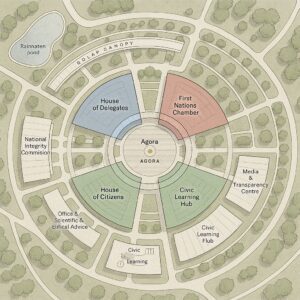
The Parliament itself stands at the heart: two circular chambers – the House of Democracy and the House of Citizens – joined by a central forum known as the Agora.
The circles overlap slightly, forming the Venn of Voices, where joint sessions meet. Above them, a skylight shaped like the Southern Cross allows sunlight to fall onto a mosaic floor representing the First Peoples’ songlines.
There is no raised dais, no “front bench.” All seats are equal distance from the centre.
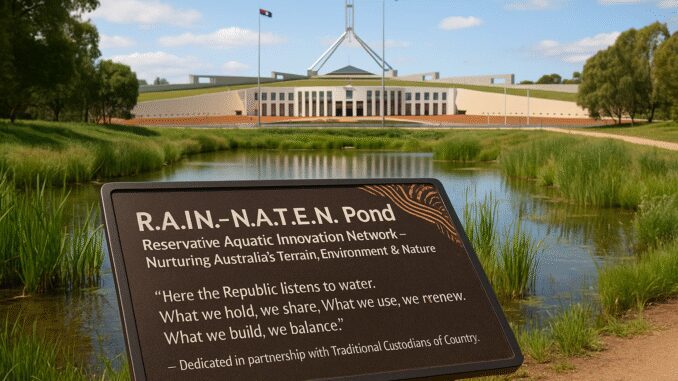
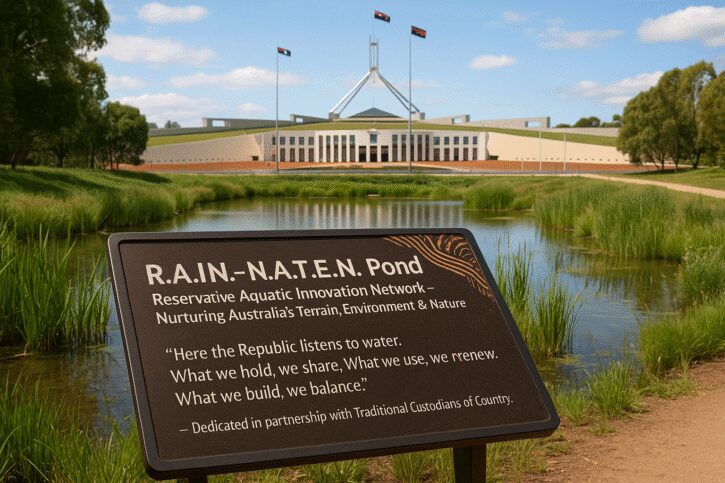
The R.A.I.N.–N.A.T.E.N. Pond
Beside the main building lies the R.A.I.N.–N.A.T.E.N. Pond – short for Renewable Aquifer Integrated Nexus – National Active Transparency & Environmental Nexus. It is both symbolic and functional:
- It collects rainwater and filters it through native wetlands before returning it to the aquifer.
- Sensors beneath the water monitor transparency – literally reflecting light levels, energy use, and water quality on nearby digital displays.
- It serves as a living metaphor for the republic itself – a system that renews, filters, and clears itself through openness and flow.
Visitors often say that when they stand beside the pond and look into its mirrored surface, they see democracy looking back.
Public Spaces
The Civic Campus is also a place of learning. A People’s Gallery winds around the outer ring of the Parliament, displaying artworks, citizen proposals, and historic documents.
The Reflection Walk links the Parliament to the nearby Cultural Garden, weaving through sculptures that tell Australia’s story from Dreaming to Republic.
A Children’s Forum hosts youth assemblies, where students practise debating real issues before visiting the House of Citizens to see how ideas become law.
Mini-Story One – The Opening Ceremony
On the morning of the first sitting of the Republic’s Parliament, sunlight filters through the Southern Cross skylight.
Delegates from every circle of five hundred are seated, waiting quietly. An Elder from the Ngunnawal Nation walks to the centre and places a coolamon of water from the R.A.I.N.–N.A.T.E.N. Pond on the mosaic floor. She says, “This is where the old and the new meet – the land beneath, the light above, and the people in between.”
The President takes the oath of service, not power, and reads the Preamble aloud.
Outside, thousands watch on open lawns, hearing the words through speakers hidden among the trees. The crowd is silent, then slowly begins to cheer.
The first day of the republic feels both ancient and new.
Mini-Story Two – The People’s Day
A few months later, families arrive for the first People’s Day – a public open-house where anyone can walk through the Parliament. Children chase dragonflies near the pond while adults wander through the Agora, reading citizens’ proposals pinned to the walls.
A delegate from the House of Citizens chats with visitors over coffee, explaining the week’s debate in plain language. At dusk, musicians gather on the amphitheatre steps and play songs in languages from every corner of the continent.
As the pond lights glow, its water reflects the colours of the flags – Aboriginal, Torres Strait Islander, and the Republic flag – rippling together.
No one is turned away; everyone belongs.
Transition in Practice
Construction of the Civic Campus begins during the third year of the transition period. Design competitions invite architects, artists, and communities to collaborate under the theme “Transparency You Can Walk Through.” All materials are locally sourced and sustainable.
Funding comes from the redirected maintenance budget of the old Parliament House and from carbon-credit savings generated by the new building’s renewable systems.
By the fifth year, the first chamber is ready for the founding session of the Republic Parliament. The old Parliament becomes the National Museum of Democracy, preserving history without nostalgia.
Why It Matters
Architecture can lie, or it can tell the truth. For a century, our buildings of power stood on hills, separated from those they served.
Now, our new Parliament stands among the people – open, grounded, and green. It reminds us that democracy is not a fortress; it’s a conversation in sunlight.
Reflection – in the Author’s Voice
When I imagine standing before the new Parliament at sunrise on Republic Day, I see the pond shimmering beside the steps. Children feed ducks, an Elder smiles at them, and a young delegate carries her notes into the chamber.
The building isn’t a monument; it’s a promise – that power will always remain visible, and that the people who built it will never again be shut out.
That, I think, is how democracy should look when it finally learns to see itself.
Imagining Australia as a New Republic – Part 8: Justice, Security and Care – Protecting the Republic’s Heart
Justice, Security and Care – Protecting the Republic’s Heart
Everything we’ve built in the new republic – democracy, fairness, and integrity – depends on one thing: how we protect it.
Justice and security aren’t about fear. They’re about trust, fairness, and care for one another. In the republic, law and protection are not instruments of control but expressions of respect.
Justice in the Republic
The justice system begins with the principle that punishment without healing is failure. Courts and prisons are replaced by restorative circles – community forums where offenders face those they’ve harmed and work toward restitution and repair.
Judges remain, but they sit beside citizens and Elders, balancing law with wisdom. The aim is prevention and restoration, not endless cycles of punishment.
Sentences include education, service, and reconciliation programs monitored by the National Rehabilitation Authority rather than private contractors.
Recidivism falls because people leave the system as members of society again, not outcasts.
Law Enforcement Reform
The republic replaces police forces with the Community Safety Service (CSS) – a professional, well-trained body accountable to both the national Integrity Commission and local citizens’ panels. Each CSS member swears an oath of service, not authority.
Body-worn cameras, transparent data, and ethical oversight become standard, not exceptional. All incidents of force are automatically reviewed by independent panels that include community representatives and human rights advocates.
CSS training focuses on conflict de-escalation, cultural understanding, and trauma response.
Weapons are the last resort, not the first.
Mini-Story One – The Justice Circle
A teenager named Caleb is caught spray-painting graffiti on a local train station.
In the old system, he’d face court, fines, maybe juvenile detention.
In the republic, he’s invited to a justice circle. His mother, the station manager, and a local Elder attend. They talk about what happened – about anger, pride, art, and accountability. Caleb agrees to help repaint the walls with a mural that celebrates the town’s stories, supervised by local artists.
A year later, he’s studying design and mentoring other kids. The mural still shines. Justice looks different when the goal is understanding instead of fear.
Defence and Security
The Defence Service of the Republic is built around protection, not projection. Its mission: defend the people, environment, and democratic institutions of Australia.
The armed forces become multidisciplinary – combining defence, humanitarian aid, climate response, and scientific research. Every soldier is trained in disaster relief and environmental stewardship.
Australia still honours alliances, but never through secret deals. Every deployment must be approved by both Houses and reviewed by the Integrity Commission.
The focus shifts from “power projection” to “stability partnership” — helping neighbours through crisis, not conflict.
Mini-Story Two – The Disaster Response
When cyclones devastate northern Queensland, the Defence Service arrives within hours. Engineers set up solar-powered shelters. Medics and drone teams map damage and deliver supplies.
Children watch uniformed officers planting trees along the riverbank after clearing debris. Nobody sees invaders – they see protectors.
The mission report reads: “Lives saved: 2,700. Trees planted: 3,000. Faith in the republic: renewed.”
Intelligence and Cyber Integrity
The republic’s intelligence agencies are restructured under the National Security Ethics Commission, with clear public charters and independent oversight.
Their focus shifts from secrecy to secure transparency: citizens know what the agencies protect and why, without endangering operations.
Cybersecurity becomes a national calling. AI systems developed under the Ethical Technology Charter guard hospitals, schools, and infrastructure – governed by algorithms that can be audited publicly. Artificial intelligence serves democracy, not markets or militaries.
Mini-Story Three – The Cyber-Rescue
A ransomware attack hits a hospital network in Perth. Before it spreads, the republic’s Cyber Integrity Unit activates a “digital quarantine” – isolating the servers within seconds. Patients remain safe, and operations continue.
The hacker group’s details are traced to an offshore shell company, but instead of silent retaliation, the NIC publishes the case report, exposing the crime to international regulators.
No one is arrested in the dark; justice happens in the light.
Social Care as National Security
The republic defines security broadly – safety from violence, but also from hunger, homelessness, and neglect.
Healthcare, education, and mental-health access are part of the same protective system. Every dollar spent on prevention replaces ten spent on punishment.
Citizens feel secure not because the state watches them, but because the state looks after them.
Transition in Practice
During the transition years, existing police, defence, and intelligence agencies continue operating while the new ethical frameworks are tested regionally.
Officers retrain for the CSS.
Military bases are redesigned as Peace and Response Centres equipped for disaster aid. Justice circles begin as pilots in regional towns, expanding nationwide by the republic’s fifth year.
No chaos, no sudden overhaul – just evolution guided by evidence and transparency.
Why It Matters
Safety built on fear can collapse overnight. Safety built on trust endures for generations.
When justice heals instead of harms, and when security is grounded in care, a nation becomes unbreakable. The republic proves that strength and kindness are not opposites – they are the same thing, rightly understood.
Reflection – in the Author’s Voice
When I imagine the republic’s justice circles, I see calm faces around a table – people who once stood on opposite sides now sharing the same light.
I think of the soldiers planting trees, the cyber-team saving lives, the nurse who no longer worries whether her data or her pay are safe.
Power, in the end, doesn’t need to roar. It can speak softly, and still protect everyone who listens.
Continued tomorrow…
Link to Part 3:
Imagining Australia as a New Republic – and a Better Nation for us all (Part 1)
Link to Part 5:
Imagining Australia as a New Republic – and a Better Nation for us all (Part 4)
Keep Independent Journalism Alive – Support The AIMN
Dear Reader,
Since 2013, The Australian Independent Media Network has been a fearless voice for truth, giving public interest journalists a platform to hold power to account. From expert analysis on national and global events to uncovering issues that matter to you, we’re here because of your support.
Running an independent site isn’t cheap, and rising costs mean we need you now more than ever. Your donation – big or small – keeps our servers humming, our writers digging, and our stories free for all.
Join our community of truth-seekers. Donate via PayPal or credit card via the button below, or bank transfer [BSB: 062500; A/c no: 10495969] and help us keep shining a light.
With gratitude, The AIMN Team


Oh the vision!
I hope to live long enough to witness it in reality.
(I’m 82 years of age).
I hope you do as surely as I’ll see it myself. If I never do see it I can still enjoy the vision and the dream and smile. 😊
I love the lead rural bush picture and pond but can’t we call it a billabong? – Symbolic and humble representative environmental precinct (non-nationalistic/paternalist/colonial). Simple/subtle/transparent/authentic, creative and inclusive concept design, layout and constitutional arrangement of the ‘New Parliament of the Republic – Civic Campus’. This would be worthy of 21st century design for both our Constitution and architecture. No monarchy, no illegitimate political or commercial lobby and vested interest/s, a purposeful indigenous space and inclusion/rightful place, progressive, representative and beautifully present and understated…uncrowded, unrushed, dignified, breathable and tranquil… I’m serious!
@Lachlan – What is ‘elifical’ and flub? Do you mean ‘ethical’ and ‘hub’, was this an AI error or illegitimate AI neologism? I do hope AI has no say in our future, the things AI generate are so mundane, random, error, socially and ethically moribund, commercially driven and corruptible – No Morlocks, mythical or AI superbeings please, but a benevolent crew of intelligent robots under Asimov’s laws and and principles, fully regulated and governed, and not interpreted by big business, oligarchs and partisan/party politics.
Is that even possible for humanity? ‘God’ knows we need it… today, not tomorrow!
AI unfortunately makes a lot of errors with more complex images (ethical is correct). The more you get AI to correct some images, the more it can introduce. Sometimes I use manual editing apps and do it myself but it can be time consuming and the world moves very fast. Sometimes I figure people will appreciate the image and humour and also fill in the errors correctly as you did. The pond (or billabong) is a case in point. I came up with the idea of creating an acronym to fit the name RAIN NATEN rather than get AI to correct and make even more errors or for me to spend a lot of time editing in an app.