By Denis Hay
Description
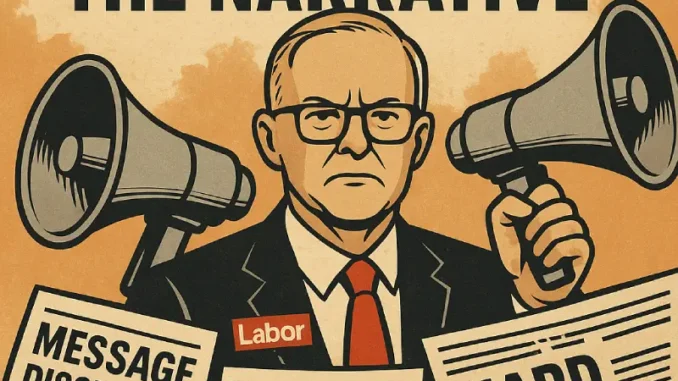
Labor controls the narrative about how Australians understand policy and public debate. Learn how it works and how to recognise it.
🎧 Prefer to listen to this article? Press play
Introduction
In Australia today, nearly seven in ten voters say they do not trust government information. This mistrust grows stronger each time Labor controls the narrative and presents only a narrow version of events.
It reflects a growing public awareness that political leaders carefully shape the story voters hear. This becomes even clearer when Labor controls the narrative to limit public debate and guide voter perception.
At the centre of this practice sits Labor narrative control, a system of crafted talking points, selective data, strategic timing, and coordinated media appearances.
For many Australians, this creates frustration and confusion. People feel they are getting a polished version of events rather than honest explanations. Most governments do this, but the current Labor government has refined the art of message management to maintain support, minimise controversy, and avoid accountability.
One key reason Labor works so hard to shape messaging is to preserve the illusion of financial limits. This prevents the public from realising that Australia has full dollar sovereignty, meaning the federal government can always spend public money to serve public purposes. The framing they choose protects political capital, not economic reality.
Understanding this makes it obvious why Labor controls the narrative around budgets and financial constraints.
The Problem: Why Australians Feel Stuck
1. The System Behind Narrative Control
Political messaging in Australia is not random. It is strategic. Labor narrative control functions as a protective shield. The government uses unified talking points to soften criticism of controversial decisions such as gas project approvals, defence spending increases, or the slow pace of cost-of-living relief.
Every minister using the same phrase on the same day is not an accident. It is message discipline. This is the outcome when Labor controls the narrative rather than providing transparent explanations.
This helps Labor avoid contradictions, push preferred frames, and present policy decisions as common sense. It also allows them to obscure areas where donors and corporate partners influence outcomes.
Internal link: Why Politicians Lie.
2. Consequences for Citizens
When governments rely on narrative control, ordinary Australians pay the price. People feel misled, confused, or powerless. Labor narrative control shapes how issues are understood, often understating the role of corporate influence or donor expectations.
Evidence of this includes:
• Soft language, such as a balanced approach or fiscal restraint.
• Limited disclosures of data that might reveal contradictions.
• Delayed release of information during major sporting events or news distractions.
These tactics distort voters’ ability to assess policy honestly.
The Impact: What Australians Are Experiencing
3. Daily Life Effects
Narrative control affects daily life. Cost-of-living pressures rise, yet explanations remain vague. Housing remains unaffordable, yet the public is told that the market needs time to adjust. Defence budgets rise sharply, described as necessary for regional stability.
These pressures intensify when Labor controls the narrative and frames problems as unavoidable rather than political choices.
Media literacy in Australia becomes essential. Without strong media awareness, Australians may not notice how Labor controls the narrative to soften responsibility for policy outcomes. Narrative control makes it harder for people to understand why outcomes keep worsening. The confusion is amplified when Labor controls the narrative and shifts attention away from the real drivers of these problems.
Internal link: Why It Feels So Hard to Get Ahead in Australia illustrates how political choices create hardship.
4. Who Benefits
Corporate donors, developers, fossil fuel companies, and defence contractors benefit from narrative control. When governments frame issues carefully, they can channel public money into private profits without strong public resistance. These beneficiaries rely heavily on how Labor controls the narrative to maintain public acceptance.
For example:
• Fossil fuel approvals described as necessary for energy stability.
• Defence spending framed as a requirement to keep Australia safe.
• Lack of transparency presented as standard procedure.
The result is a system in which political elites avoid scrutiny and those in power maintain influence.
The Solution: What Must Be Done
5. Use Dollar Sovereignty to Break the Narrative
One of the strongest tools citizens have is the understanding of Australia’s monetary sovereignty. When politicians say we cannot afford universal dental care, large-scale public housing, or a rapid transition to renewable energy, they rely on narrative control, not economic truth.
If the public understands that:
• Australia issues its own currency
• It cannot run out of dollars
• Public money is created through keystrokes
• Real limits are workers, materials, and environmental capacity
Then narrative control collapses. MMT and Job Guarantee frameworks help expose political decisions hidden behind budget myths.
Budget myths only persist because Labor controls the narrative about government spending capacity.
Internal link: Australia’s Dollar Sovereignty article.
6. Policy Solutions and Citizen Action
To break narrative control, citizens can push for structural changes:
• Stronger and faster FOI laws.
• Full ABC funding restoration.
• Mandatory disclosure of ministerial talking points.
• National media literacy curriculum.
• Community-driven narrative building through independent outlets.
• Public service reforms that reduce donor influence.
• Fact-checking requirements during political campaigns.
These changes help Australians understand reality rather than rely on filtered political spin.
Frequently Asked Questions
Q1. How can I tell when narrative control is happening?
Look for identical language across multiple ministers. This is a clear sign of coordinated Labor narrative control.
Q2. Why does the media repeat the same political messages?
Major outlets rely on access. Repeating government frames keeps relationships smooth and reduces political backlash.
Q3. Does narrative control influence voting decisions?
Yes. When voters hear polished messages without challenge, it shapes emotional responses to parties and policies.
Q4. Why does it matter if Labor controls the narrative?
It matters because narrative control shapes what the public believes is possible, affordable, or realistic. When Labor controls the narrative, political limitations replace economic reality.
Final Thoughts
Labor narrative control shapes how issues are framed, how debates unfold, and how public expectations are managed. Understanding this system empowers Australians to make informed decisions. Recognising when Labor controls the narrative helps voters separate fact from political theatre.
An informed population is the strongest defence against manipulated framing.
What Is Your Experience
How have you noticed Labor controls the narrative in your community or daily life?
Call to Action
We’d Love to Hear from You
If you found this article insightful, explore more about political reform and Australia’s monetary sovereignty on the Social Justice Australia website.
Please share your thoughts through our Reader Feedback form, check out what others are saying on our Testimonials page, or scroll down and leave a comment below. Your voice helps shape future content.
Spread the Word
Change starts with conversations. Share this article with friends, family, or your social networks so more Australians can see what’s possible. Every share helps build momentum for a fairer society.
Keep Independent Journalism Alive
We’re 100% reader-supported, no ads, no corporate strings, just honest, truth-driven journalism. If our work has informed or inspired you, we invite you to consider contributing. Even $5, or whatever you can spare, helps us keep publishing and reaching more Australians.
Donate Now – one-time or monthly.
Already donated? Share the love by leaving us a quick review on Google to help others find us.
References
ABC: Trust in the Australian government falls
Open Education Resources: How political framing shapes voter beliefs
Transparency International: Political integrity and corruption risks
This article was originally published on Social Justice Australia
Keep Independent Journalism Alive – Support The AIMN
Dear Reader,
Since 2013, The Australian Independent Media Network has been a fearless voice for truth, giving public interest journalists a platform to hold power to account. From expert analysis on national and global events to uncovering issues that matter to you, we’re here because of your support.
Running an independent site isn’t cheap, and rising costs mean we need you now more than ever. Your donation – big or small – keeps our servers humming, our writers digging, and our stories free for all.
Join our community of truth-seekers. Donate via PayPal or credit card via the button below, or bank transfer [BSB: 062500; A/c no: 10495969] and help us keep shining a light.
With gratitude, The AIMN Team



It’s about time the grown ups were in charge Mr Hay. Everyone is sick of LNP and One Nation antics.
Thanks Anne, I think many people are feeling exhausted by the constant conflict and point scoring in politics. Most Australians just want solutions that improve daily life, no matter which party introduces them. It should never be about one side being the “grown ups” and the other being written off, it should be about real accountability and policies that put people first. The more we, as citizens, stay informed and speak up, the more pressure there is for parties to focus on the public interest rather than political rivalry.
Denis: Everything you say (write) is true on this subject. The current public malaise concerning trust in government arose decades ago and was fertilised by the excesses of previous LNP regimes such that with the change of tenancy at Government benches many electors were hopeful for a change to respectful governance. Unfortunately as Labor commenced by presenting a “small target” to the Opposition it quickly became apparent that Labor had departed from its traditional base and is now mimicking the charade that the LNP perfected from the Howard era. Centrist politics relies on controlling information and hence creating the narrative. The electorate is excluded from narrative creation and has nowhere to go with this thus there appears to be no point in protesting. The old days of megaphone politics have been replaced by sleight of hand chicanery that is the food of a compliant main stream media. Now if you write a critical but respectful letter to your parliamentary representative then at best you will receive a fatuous form letter reply that avoids recognition of your concern and basically says “have a nice day”! Other than constant controlled civil disobedience I see no way of reasonably breaking this current nexus.
Thank you for such a thoughtful comment. You have captured the frustration many Australians feel when governments of either major party manage information in ways that limit transparency and shut out genuine public input. The “small-target” approach may win elections, however it leaves people feeling excluded from shaping policy outcomes that affect their lives.
I agree that traditional channels like letters often feel performative rather than participatory. The challenge now is finding modern forms of civic pressure that cannot be ignored, particularly collective, organised, and visible action, supported by independent media and citizen-led platforms that shift influence away from the old gatekeepers. Civil engagement is evolving and ordinary people are finding new ways to be heard, but it requires persistence and solidarity.
Disagree, the news and political agenda is informed by IS fossil fuel Atlas Koch faux ‘free market’ (IPA etc.) and Tanton anti-immigrant agitprop -> NewsCorp (on some issues follows FoxNews).
Then the RW MSM inc ABC then follow NewsCorp & 9F agenda every morning to ‘inform’ the public and ‘wedge’the ALP on issues of renewables and immigration, with soft BS in between…..
Politicians of all persuasions have always slanted what they say or write to suit their own agenda, nothing new here. The big difference is in our media which has now been consolidated under one or two banners, so we have bias piled on biaas, this makes sorting fact from fictions much harder.
Sadly, we (the people) have suffered this for so long and the difference between Twiddle Dee and Twiddle Dum, being so slight, many just don’t care any more.
Thanks Andrew, you raise an important perspective about how think-tanks, media networks, and corporate interests can shape the agenda before most of us see the headlines. There is certainly evidence that powerful interests influence public debate, especially around energy and immigration, and that coverage often frames issues in ways that suit those interests. At the same time, many Australians are concerned that neither major party has effectively challenged this dynamic. That is why transparency, stronger media diversity, and public participation in shaping policy narratives remain critical.
jonangel,
You’re right that politicians have always shaped their message, but what’s changed is the scale and concentration of the media environment around them. With most outlets now owned by a small number of corporations, any bias becomes amplified and repeated across platforms, which makes it harder for people to separate fact from spin. That narrowing of viewpoints is a big part of why so many Australians feel there’s little real difference between the major parties. The challenge now is finding ways for citizens to rebuild independent sources of information and push for media diversity so we can get a clearer picture of what’s really happening.
Thanks to both Mediocrates and Andrew Smith – for clarifying both the ways in which Labor presents itself as a ‘small target’ (sometimes hardly distinguishable from the Coalition), and the ways in which NewsCorpse etc push the rightwing messages that influence the way that Labor works.
As the job of politicians is primarily to be nasty to politicians on the other side – their messages to the public are usually not very useful anyway. The public ends up with trying to choose the “least worst” party. At least the Australian system allows us to choose Independents, who are inclined to say actually meaningful things.
How do you prevent discussion on sending one billion (that’s a whopping number of zeros) to a US administration to subsidise their boat-building industry.
Well, you find some strong wench on the front bench and send her round the world seeking high profile activities, an if the family comes too, even better..
Being close to a rogue nation who supports genocide, and is now embarking on piracy to get its oil, and generally behaving badly, may alarm the average Australian, so lets feed them someone who could be fiddling their travel expenses.
Annika stands on firm ground, and she has helped on this diversion from where we should be looking.
By controlling the narrative,appeasing the powerful and restricting FOI even more, are not Labor behaving in the manner of a populist,anti democratic government?
They may have a record majority, but instead of major and urgent reform, they seem hell bent on being unaccountable.We should be very disturbed about where our country is heading.
Oops, seems Albo is a very astute learner of John W Howard!