By Denis Hay
Description
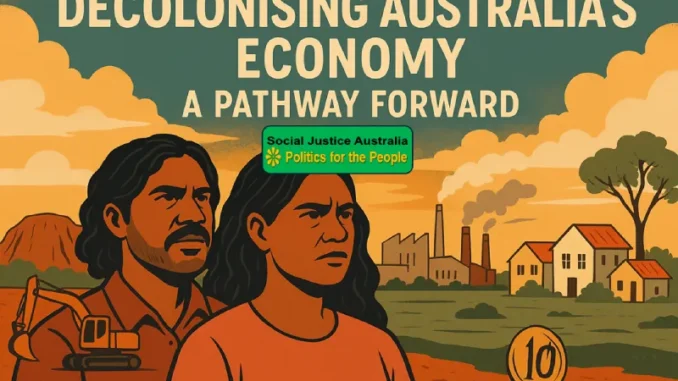
Decolonising Australia. Discover how Australia can decolonise its economy using Indigenous-led models, justice-driven policy, and monetary sovereignty.
🎧 Prefer to listen to this article? Press play
Introduction: The Invisible Chains of Colonisation
Location: Arnhem Land, Northern Territory.
Under a scorching sun, Elder Miriam Nganampa stands by a dry riverbed once full of Barramundi and water lilies. She recalls when her ancestors thrived off this land without debt, poverty, or government interference. “We had everything we needed,” she says. “Now, we ask permission to survive.”
Australia’s economy was built on the dispossession of Indigenous people. What grew from that injustice – mining, agriculture, banking – ignored the wisdom and systems of those who lived here for over 60,000 years. Today, the effects linger: inequality, marginalisation, and policy frameworks that serve corporations more than communities.
The time has come to ask: What would Australia look like if its economy served all its people? This article outlines a pathway to economic decolonisation rooted in justice, sustainability, and Australia’s dollar sovereignty.
The Problem: A Colonial Economy Built to Exclude
A Historical Lens
- Australia’s economy was established on stolen land, using forced labour and exploitative resource extraction.
- Indigenous knowledge systems – complex, sustainable, and deeply connected to land – were dismissed as primitive.
- Colonial capitalism positioned land as a commodity, not a relationship.
Contemporary Impact of Decolonising
- Aboriginal and Torres Strait Islander peoples remain among the poorest in Australia.
- Corporations continue to profit from mining and development on Indigenous land.
- Government economic priorities still reflect colonial values—surplus obsession, extractive industry dependence, and corporate welfare—highlighting the urgent need for decolonising economic policy frameworks.
Action: Multinational mining companies have reaped billions from Pilbara iron ore while nearby communities lack housing, water, and health services.
Emotion: “Our land makes them rich, but our kids go hungry,” said a Wangan and Jagalingou man outside Adani’s Carmichael mine.
The Human Cost of Economic Injustice
Personal Toll
- First Nations children are more likely to grow up impoverished, removed from family, and criminalised by the justice system.
- Intergenerational trauma is exacerbated by economic exclusion.
Thought: “I want my son to have what every Australian wants, a home, a job, dignity,” says a mother in Alice Springs. “But the system is built to keep us out.”
Policy Failures
- The Intervention and Cashless Debit Card were imposed without consent, limiting autonomy.
- Indigenous programs are often underfunded or designed without community input.
The Price of Ignoring Indigenous Wisdom
- Environmental destruction and the climate crisis result from ignoring 60,000 years of land stewardship.
Decolonising Economic Framework
Recognising Indigenous Economic Systems
- First Nations people operated successful trade, aquaculture, and agricultural systems long before 1788.
- Yolngu Matha and Martu Nation practices show how relational economies ensure sustainability and social cohesion.
Supporting Indigenous-Led Development
- Prioritise community-owned enterprises.
- Fund First Nations banks, housing co-operatives, and sovereign wealth funds.
- Adopt free, prior, and informed consent for all economic development on Indigenous land.
Dialogue: “Economic sovereignty begins when we control the outcomes,” said Barkindji leader Bruce Pascoe.
These community-led initiatives are key steps in decolonising how development happens in Australia.
Policy Pathways for Economic Decolonisation
Leverage Australia’s Dollar Sovereignty
- The Australian Government is the monopoly issuer of the Australian dollar – it can invest in Indigenous futures without needing to ‘find’ money.
- Use public money for public purposes, not budget surpluses.
Examples:
- Establish a federally funded First Nations Infrastructure Fund.
- Cancel public subsidies to extractive industries exploiting Indigenous land.
Legislative and Institutional Reform
- Embed Indigenous economic rights into legislation.
- Create constitutional recognition of Indigenous economic sovereignty.
- Mandate Indigenous-led economic councils with federal authority.
Land Back and Reparations
- Fund land repatriation and establish trusts for First Nations development.
- Recognise rent owed on Crown lands profiting from historical dispossession.
- These are foundational actions toward decolonising land ownership and wealth distribution in Australia.
Real-World Examples of Decolonised Models
Australian Success Stories
- Kowanyama Aboriginal Council runs its own supermarket, airstrip, and fisheries.
- Bawinanga Aboriginal Corporation delivers housing, art, and business support in Arnhem Land.
International Models
- Bolivia’s plurinational economy prioritises Indigenous values over GDP.
- Aotearoa (New Zealand) includes Māori representation in economic policy.
Emotion: These examples inspire a vision of an Australia where Indigenous prosperity is national prosperity.
Summary: A Just Economy for All
Decolonising Australia’s economy is not about guilt – it’s about justice. It means acknowledging stolen land, valuing Indigenous systems, and using public money for the public good.
We have the tools, knowledge, and, thanks to Australia’s monetary sovereignty, we have the money.
Now, the focus must be on decolonising our systems so they serve all Australians, not just the privileged few.
Q & A Section
What does it mean to decolonise Australia’s economy?
A: It means dismantling the structures that benefit from colonisation – land theft, resource extraction, and exclusion – and replacing them with Indigenous-led, justice-oriented systems.
How can Australia’s monetary sovereignty help?
A: As the issuer of its own currency, Australia can fund transformative investments without relying on taxes or debt. This includes Indigenous infrastructure, health, housing, and education.
What are examples of decolonised economic practices?
A: Community-controlled businesses, sovereign wealth funds, and localised economies prioritising sustainability, consent, and cultural continuity.
Question for Readers
What steps do you think Australia should take first to decolonise its economy?
Call to Action
If you found this article insightful, explore more about political reform and Australia’s monetary sovereignty at Social Justice Australia:
👉 https://socialjusticeaustralia.com.au
Share this article with your community to help drive the conversation toward a more just and equal society.
Click on our “Reader Feedback” menu: Please let us know how our content has inspired you. Submit your testimonial and help shape the conversation today.
Support Social Justice Australia – Help Keep This Platform Running
Unlike corporate media, we rely on readers to remain independent and ad-free.
💡 Your support helps:
- ✅ Keep this website running without corporate influence
- ✅ Fund in-depth analysis on critical social issues
- ✅ Advocate for policies that put people and justice first
Even a small monthly contribution can make a big impact. Thank you for supporting the movement for truth and justice.
If you value our work, please leave a quick Google Review here and help others discover us.
This article was originally published on Social Justice Australia
Keep Independent Journalism Alive – Support The AIMN
Dear Reader,
Since 2013, The Australian Independent Media Network has been a fearless voice for truth, giving public interest journalists a platform to hold power to account. From expert analysis on national and global events to uncovering issues that matter to you, we’re here because of your support.
Running an independent site isn’t cheap, and rising costs mean we need you now more than ever. Your donation – big or small – keeps our servers humming, our writers digging, and our stories free for all.
Join our community of truth-seekers. Donate via PayPal or credit card via the button below, or bank transfer [BSB: 062500; A/c no: 10495969] and help us keep shining a light.
With gratitude, The AIMN Team


Every former colonial possession of the British Empire has experienced political intrigue by the departing British officials, communal disharmony, administrative corruption, military coups, revolution and even civil war following “liberation and independence”. The after effects of British colonialisation persist to this day.