
By Denis Hay
Description
A public-purpose economy puts people before profit. Here’s how it works and how we can make it happen in Australia.
🎧 Prefer to listen to this article? Press play
Introduction: The System is Broken: But it Doesn’t Have to be
Australia’s economy is rigged to serve corporations, not communities. After decades of neoliberalism, public services are eroded, inequality is entrenched, and the common good is sidelined.
Who suffers? Ordinary Australians – those locked out of housing, stuck in underfunded hospitals, or crushed by debt. These are not market failures; they are policy choices that prioritise profit over people.
A public-purpose economy changes the equation. By using Australia’s monetary sovereignty to invest in universal services, job guarantees, and public infrastructure, we can realign the economy to serve people and the planet. This isn’t just possible – it’s essential.
What is a Public-Purpose Economy?
A public-purpose economy is designed to serve people, communities, and the environment – not private profit.
It’s built on public ownership, democratic control, and the idea that everyone deserves access to the essentials of life: housing, education, healthcare, transport, energy, and decent work.
Key Features of a Public-Purpose Economy
- Publicly owned and operated essential services
- Free universal healthcare and education
- A federally funded Job Guarantee
- Climate-focused infrastructure
- Government use of public money to fund a public-purpose economy
What it Could Look Like in Australia
If Australia adopted a public-purpose economy, our daily lives would transform.
Essential services would be restored, not sold off. Communities would thrive, not just survive.
Housing as a Right, Not an Investment
- A large-scale return to publicly built and owned housing
- Rent caps and strong tenant protections
- End homelessness and stop property speculation
Free, Fully Funded Public Health and Education
- No out-of-pocket costs for healthcare, dental, or mental health
- Rebuild public TAFE and universities
- Ban outsourcing and private creep into public hospitals and schools
Jobs for All Through a National Job Guarantee
- Government provides meaningful, socially beneficial jobs
- Living wages, strong protections, and community-based placements
- End to forced unemployment and insecure gig work
Public-Led Climate Action and Infrastructure
- National renewable energy grid and electrified transport
- Climate restoration jobs for reforestation and regenerative farming
- Phase out fossil fuel subsidies and invest in future-proof systems
How Australia’s Monetary Sovereignty Makes it Possible
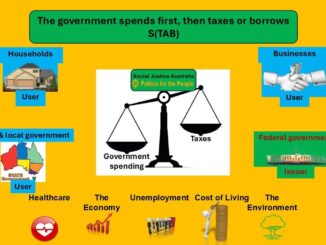
Australia is a sovereign currency issuer – it creates the Australian dollar. That means the federal government cannot “run out of money” the way a household, business, or even state government can.
Public-purpose spending is not constrained by revenue but by real resources and inflation. The myth of government needing to “find the money” through tax or borrowing is outdated and harmful.
Why We Can Afford It
- The true limit is inflation, not insolvency
- As long as there are idle people and unmet needs, public spending is appropriate
- Public investment creates value: healthy communities, educated citizens, and climate resilience
Stop Saying ‘Taxpayer Money’
- Federal spending is not funded by taxes
- Taxes create demand for the currency and help control inflation
- Essential services should be funded as public purpose investments – not financial burdens
Why the Neoliberal Model Has Failed
Neoliberalism turned essential services into commodities and citizens into customers.
Its impacts are everywhere:
- Housing costs are obscene, while public stock decays
- Public hospitals are stretched to crisis levels
- Education is a debt trap, not a right
- Fossil fuel companies thrive while climate targets are missed
The system is working – as designed. But it’s not working for us.
How to Make a Public-Purpose Economy a Reality
Change won’t come from those in power without pressure from below.
Educate and Share the Truth
- Spread the message of Australia’s monetary sovereignty
- Push back on “we can’t afford it” narratives
- Use platforms, forums, and conversations to shift public understanding
Elect People, Not Parties
- Support independents and minor parties that reject corporate money
- Demand policy over personality
- Make every electorate unsafe for vested interests
Challenge Corporate Control
- Divest from big banks and move to community-owned alternatives
- Fight for deprivatisation of energy, transport, and housing
- Boycott exploitative companies and support public-interest media
Conclusion: A Future Built on Purpose, Not Profit
Neoliberalism commodifies everything – including life itself.
A public-purpose economy values people, planet, and dignity. It restores the idea that government exists to serve – not to sell.
With our monetary sovereignty, Australia has every tool it needs to fund a just and resilient society.
All that’s missing is the will. Let’s build it – together.
❓ What public service would you most like to see reclaimed under a public-purpose economy – and why?
🔍 Q&A: People Also Ask
Q1: What is a public-purpose economy?
It’s an economic model where governments use their fiscal power to provide universal access to essential services like housing, healthcare, education, and employment.
Q2: How would Australia fund it?
Using its monetary sovereignty, Australia can create public money to fund what is socially and economically needed. Taxes and borrowing are not prerequisites.
Q3: Is a job guarantee viable in Australia?
Yes. The government can create jobs that serve community needs and environmental goals—ending unemployment and insecurity.
Q4: Isn’t this just socialism?
No. A public-purpose economy can coexist with private enterprise but ensures that the foundations of a decent life are universally guaranteed.
Q5: Why hasn’t this been implemented?
Decades of misinformation, lobbying, and corporate-aligned media have stifled public understanding of what’s economically possible.
Call to Action
We’d Love to Hear from You!
Inspired by this article?
See what others are saying on our Reader Testimonials page.
Share your thoughts via our Reader Feedback form – your voice helps shape future content.
Scroll down and leave a comment below to join the discussion.
If this article resonated with you, explore more on political reform and Australia’s monetary sovereignty at Social Justice Australia.
Spread the word:
Share this article with friends, family, or your social networks to keep the conversation going and help build a fairer, more just Australia.
Support Independent Voices That Challenge the Status Quo
Social Justice Australia doesn’t rely on corporate advertisers or donors. We exist because of passionate readers like you.
If you believe in independent media that:
• Educates and informs through truth-based analysis
• Exposes injustice and failed policies
• Advocates for real, people-first reform
… then please consider supporting our work.
Click here to donate – one-time or monthly, your contribution keeps our platform alive, ad-free, and uncompromising.
Thank you for being part of this movement.
Together, we are changing the conversation – and the future.
Help others discover our work – leave us a quick Google review. It only takes a moment and means the world.
References
Centre for Future Work – The Australia Institute
Modern Money Lab – University of Adelaide
This article was originally published on Social Justice Australia
Dear reader, we need your support
Independent sites such as The AIMN provide a platform for public interest journalists. From its humble beginning in January 2013, The AIMN has grown into one of the most trusted and popular independent media organisations.
One of the reasons we have succeeded has been due to the support we receive from our readers through their financial contributions.
With increasing costs to maintain The AIMN, we need this continued support.
Your donation – large or small – to help with the running costs of this site will be greatly appreciated.
You can donate through PayPal or credit card via the button below, or donate via bank transfer: BSB: 062500; A/c no: 10495969


Oh the feasible economic dream ….. where Australian voters get first use of their economy rather than foreign owned multinational corporations parasitising our wealth like heartworms in a dog.
The MSM talk about ”increasing taxation” but the real need is to evaluate and remove subsidies to corporations and special interest groups like the long distance road freight corporations who receive considerable financial benefit in the form of rebates, fuel subsidies and other cost offsets while funding political parties to keep railways closed, hence eliminating competition while increasing aerial pollution, fossil fuel consumption and personal health problems from diesel particulates & gaseous exhausts.
Late last century politicians took the American Kool-aid model into Australian government to achieve short term financial goals while ignoring long term deleterious consequences. It is now time to rectify this situation by reversing privatisation of government services, especially electrical energy and gas supply, to encourage industrial & manufacturing businesses here for Australian workers, rather than watch as foreign corporate executives laugh at the stupidity of Australian gas policy while making MILLIONS dealing in OUR GAS!!
Hi New England Cocky,
You’ve hit the nail on the head. Australia’s wealth is being siphoned off by foreign-owned corporations while public needs go unmet.
You’re absolutely right to point out the hypocrisy of “tax hikes” talk while billions in public money quietly subsidise corporations, especially those that pollute, underpay, or undermine our domestic industries. The long-distance road freight example is a perfect case: it’s a textbook case of corporate welfare, not public investment.
The shift to a public-purpose economy starts with reclaiming our ability to decide how national resources are used, and who they benefit. With Australia’s monetary sovereignty, there’s no excuse not to fund the things that matter: jobs, clean energy, local manufacturing, and essential services.
Privatisation hasn’t just failed, it’s weakened us. The time to reverse it is now. Thank you for raising these critical points.