By Denis Hay
Description
Government bailouts in Australia often protects private firms. Should the public receive ownership and future profits in return?
Government Bailouts in Australia: Should the Public Own What It Saves?
Imagine waking up tomorrow to discover that a major Australian airline has collapsed. Thousands of workers face unemployment. Regional communities lose essential services. Businesses dependent on transport face disruption. Financial markets become nervous.
Within days, politicians appear on television announcing billions of dollars in emergency assistance.
Suddenly, money that seemed unavailable for housing, healthcare, aged care, education, or environmental protection becomes available.
Most Australians would support action to protect jobs and maintain essential services. The real question is not whether governments should intervene. Governments already intervene whenever major industries face collapse.
The more important question is this: if the public saves a company, why does the public rarely receive ownership in return?
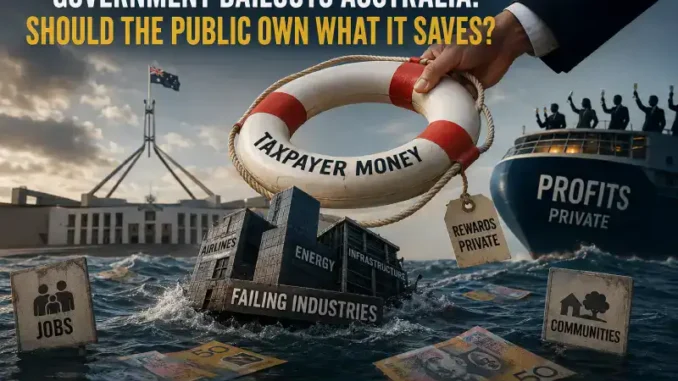
For decades, governments around the world have followed a model that socialises losses while privatising profits. Shareholders enjoy the rewards when times are good. When disaster strikes, the public often bears the risk.
This raises fundamental questions about fairness, economic efficiency, and the role of government in a modern economy.
Support Independent Analysis
If you value independent, fact-based analysis that challenges conventional narratives, please consider supporting Social Justice Australia.
👉 https://socialjusticeaustralia.com.au/support-social-justice-australia/
Every contribution helps keep independent Australian political and economic analysis available to everyone.
The Strange Logic of Modern Bailouts
Profits Are Private, Losses Become Public
One of the most remarkable features of modern capitalism is the willingness of governments to rescue large corporations when they get into trouble.
During prosperous years, profits flow to:
- Shareholders.
- Executives.
- Investors.
When losses occur, governments often step in to prevent collapse.
The public effectively becomes the insurer of last resort.
This creates an obvious imbalance. Citizens bear risk without receiving equivalent rewards.
Critics often describe this system as:
Privatising profits and socialising losses.
Whether discussing banks, airlines, toll roads, energy companies, or infrastructure projects, the pattern appears repeatedly.
Why Governments Rescue Companies
To be fair, governments usually have legitimate reasons for intervention.
A major corporate collapse can:
- Destroy thousands of in.
- Disrupt supply chains.
- Harm regional economies.
- Threaten essential services.
- Damage national security.
Allowing a strategically important company to fail may produce consequences far beyond the company itself.
Governments therefore face a difficult choice.
Do they allow collapse and accept widespread damage?
Or do they intervene using public money?
Most choose intervention.
The problem lies not in the rescue itself, but in the conditions attached to it.
What is a Government Bailout?
Government bailouts come in many forms.
Many people imagine governments simply writing cheques to struggling corporations. Reality is often more complicated.
Direct Bailouts
Direct assistance may include:
- Grants,
- Emergency loans.
- Debt guarantees.
- Equity injections.
- Asset purchases.
These measures provide immediate financial support.
Indirect Bailouts
Governments also assist industries through:
- Tax concessions.
- Subsidies.
- Special regulatory arrangements.
- Government-backed borrowing.
These forms of support may be less visible but can involve enormous sums over time.
Australian Examples
Australia has experienced numerous forms of industry support.
Examples include:
- Banking guarantees during the Global Financial Crisis.
- COVID-era support for airlines and tourism.
- Ongoing fossil fuel subsidies.
- Assistance for agricultural industries during droughts.
- Manufacturing assistance packages.
Each case is different.
However, a common pattern emerges.
Public money reduces private risk.
Yet ownership remains overwhelmingly private.
The Public Pays but Receives Little in Return
Consider what happens when a struggling company receives government support.
The company survives.
Operations continue.
Jobs may be protected.
Markets stabilise.
These outcomes can be positive.
But who benefits when recovery occurs?
Typically:
- Existing shareholders retain ownership.
- Executives retain control.
- Future profits remain private.
Meanwhile, the public receives little beyond the avoidance of disaster.
That is an extremely low return on a potentially massive investment.
Imagine helping a neighbour save their house from foreclosure by contributing half the purchase price.
Most people would expect some ownership stake.
Yet governments frequently rescue corporations without obtaining similar rights on behalf of citizens.
Reality Check
Government Bailout Models Compared
| Model | Public Risk | Public Reward |
| Traditional Bailout | High | Low |
| Bailout With Equity Stake | High | Moderate to High |
| Temporary Nationalisation | High | High |
| Public Ownership from Start | Shared | Shared |
The table highlights the central issue.
The public often assumes substantial risk while receiving minimal financial benefit.
The Hidden Cost of Corporate Welfare
Many bailout discussions focus only on immediate costs.
Less attention is given to long-term consequences.
Distorting Competition
When governments repeatedly rescue large corporations, smaller competitors may be disadvantaged.
Businesses that operate responsibly can find themselves competing against firms that expect public rescue if things go wrong.
Rewarding Poor Management
Repeated bailouts can encourage reckless behaviour.
Economists refer to this as “moral hazard.”
If executives believe government assistance will always be available, incentives for prudent management weaken.
Increasing Public Cynicism
Many citizens question why governments claim limited resources for social programs while rapidly mobilising support for large corporations.
This perception can undermine trust in public institutions.
People begin to wonder whether governments serve citizens or powerful economic interests.
What Other Countries Have Done Differently
Some nations have adopted alternative approaches.
Instead of helping without conditions, they have secured ownership stakes for the public.
Sweden’s Banking Rescue
During Sweden’s banking crisis in the early 1990s, the government intervened aggressively.
Rather than simply helping, the government obtained ownership interests in rescued institutions.
As the banking sector recovered, taxpayers benefited from the recovery.
This approach is often cited as one of the most successful banking rescue programs in modern history.
The United States Auto Industry Rescue
Following the Global Financial Crisis, the United States government acquired ownership stakes in major automotive manufacturers.
The goal was not permanent ownership.
Instead, the government stabilised the industry and later reduced its holdings as conditions improved.
The key principle was simple:
If the public assumes risk, the public should share in recovery.
Norway’s Public Ownership Model
Norway provides another example.
The country maintains significant public ownership in strategic industries and uses resource wealth to build long-term national prosperity.
Its sovereign wealth fund has become one of the largest investment funds in the world.
The lesson is not that every industry should be nationalised.
The lesson is that public ownership can sometimes generate enormous public benefits when managed effectively.
Why Governments Rarely Demand Ownership
If obtaining an ownership stake appears logical, why do governments so often avoid it?
The answer is not primarily economic. It is political and ideological.
For more than four decades, many Western governments have embraced the idea that private ownership is inherently superior to public ownership.
This belief became especially influential during the privatisation wave of the 1980s and 1990s.
Under this philosophy:
- Markets are assumed to allocate resources more efficiently.
- Governments are viewed as poor business managers.
- Public ownership is portrayed as outdated.
These assumptions often persist even when evidence suggests the reality is more complex.
The Influence of Neoliberal Thinking
Neoliberal economic policies have shaped government responses across much of the developed world.
Under this framework:
- Privatisation is encouraged.
- Deregulation is promoted.
- Public enterprises are viewed with suspicion.
- Government intervention is often justified only during emergencies.
Ironically, many governments that publicly champion free markets are quick to intervene when large corporations face collapse.
This creates a contradiction.
Markets are praised when profits are being made but government support is welcomed when losses occur.
Lobbying and Political Influence
Large corporations possess considerable political influence.
Through lobbying, industry groups, and media relationships, major businesses often have significant access to decision-makers.
When governments design rescue packages, corporate interests frequently push for assistance without ownership conditions.
The result is that bailouts may protect shareholders while leaving citizens with little long-term benefit.
Fear Campaigns About Nationalisation
The word “nationalisation” often generates strong reactions.
Critics may portray any public ownership proposal as:
- Anti-business.
- Inefficient.
- Bureaucratic.
- Extreme.
Yet public ownership exists across the world, including in countries widely regarded as successful market economies.
The debate should not focus on ideology.
It should focus on evidence.
The relevant question is:
What ownership structure best serves the public interest in a particular situation?
The Case for Public Ownership
Public ownership is not appropriate in every circumstance.
However, there are compelling arguments for governments obtaining ownership stakes when public money is used to save private enterprises. Similar principles can be seen in community-owned financial institutions, discussed in Building Financial Power Locally: Community Banks After the Election
Risk and Reward Should Be Shared
When taxpayers fund a rescue, citizens are assuming financial risk.
Basic fairness suggests they should also participate in future rewards.
If a rescued company returns to profitability, the public should benefit alongside private investors.
Creating Long-Term Public Revenue
Ownership can provide ongoing income through:
- Dividends.
- Capital gains.
- Asset appreciation.
This revenue can help fund:
- Healthcare.
- Education.
- Public housing.
- Infrastructure.
Instead of public money disappearing into a one-off rescue package, it can become an investment that generates future returns.
Improving Accountability
Ownership provides governments with influence over decision-making.
This can help ensure that rescued companies:
- Maintain employment.
- Invest responsibly.
- Serve national interests.
- Avoid excessive executive remuneration.
Without ownership, governments often have limited leverage once the immediate crisis passes.
When Nationalisation Makes Economic Sense
The question is not whether every business should be publicly owned.
The more useful question is whether certain industries are so important that public ownership may be justified.
Natural Monopolies
Some industries naturally favour a single provider.
Examples include:
- Water networks.
- Electricity transmission.
- Rail infrastructure.
- Major ports.
Duplicating these systems can be inefficient and costly.
Public ownership can sometimes deliver better outcomes than private monopolies whose primary objective is profit maximisation.
Strategic Industries
Certain sectors are essential to national resilience.
These may include:
- Telecommunications.
- Defence manufacturing.
- Critical minerals.
- Energy infrastructure.
Governments already recognise the importance of these industries.
The debate is whether strategic importance should sometimes be matched by public ownership.
Industries Too Important to Fail
If governments repeatedly rescue an industry because failure is unacceptable, it raises an obvious question.
Why remain committed to full private ownership if public support is continually required?
Repeated bailouts may indicate that the risks and rewards are not being shared appropriately.
Australia’s History of Public Ownership
Many Australians are surprised to learn how much of the nation’s economic infrastructure was once publicly owned.
For much of the twentieth century, public ownership was normal rather than exceptional.
The Commonwealth Bank
The original Commonwealth Bank was far more than a commercial bank.
It played a leading role in financing national development and supporting economic stability.
For decades it was one of Australia’s most trusted institutions.
The bank consistently generated profits while remaining publicly owned.
Eventually it was fully privatised during the 1990s.
Today those profits flow to private shareholders rather than the Australian public.
Readers interested in how Australia could bring strategic assets back under public control may also find our article on Reclaiming Public Assets: A Post Election Mandate for Change useful.
The Commonwealth Bank demonstrates that public enterprises can operate successfully over extended periods.
Telecom Australia
Before privatisation, Australians relied on Telecom Australia.
The organisation built much of the nation’s communications infrastructure.
Its successor, Telstra, was progressively privatised.
Supporters argued that privatisation would increase efficiency.
Critics argue that the public lost control of a strategic national asset.
The debate continues today.
Public Utilities
Electricity, water, ports, and transport systems were once more commonly owned by governments.
Many have since been sold, leased, or corporatised.
The results have been mixed.
Some privatisations improved efficiency.
Others generated ongoing concerns about:
- Rising prices.
- Reduced accountability.
- Service quality.
- Foreign ownership.
This mixed record suggests that ownership models should be judged on outcomes rather than ideology.
Reality Check
Public Versus Private Is Not the Real Question
The real question is not whether an organisation is publicly or privately owned.
The real questions are:
- Is it efficient?
- Is it accountable?
- Does it serve the public interest?
- Are risks and rewards distributed?
Both public and private enterprises can succeed.
Both can fail.
Good governance matters more than ownership labels alone.
Australia’s Dollar Sovereignty and Bailouts
Australia issues its own currency through the Commonwealth Government and the Reserve Bank of Australia.
This means the federal government is not financially constrained in the same way as households, businesses, or state governments.
The true limits on federal spending are:
- Available labour.
- Skills.
- Technology.
- Raw materials.
- Productive capacity.
This distinction matters when discussing bailouts.
The question is often presented as:
“Can Australia afford to rescue an industry?” This issue is explored further in Where Does the Money Go? Understanding Australias Billions, which examines how federal spending actually works.
A more useful question may be:
“Does rescuing this industry serve a public purpose?”
If the answer is yes, a second question follows:
“How can citizens receive a fair return on that investment?”
Public Purpose Versus Private Profit
Governments frequently justify bailouts by citing public benefits.
These may include:
- Employment.
- Economic stability.
- National security.
- Essential services.
If public purpose justifies intervention, it is reasonable to ask whether public ownership should sometimes accompany that intervention.
Otherwise, citizens may assume the risks while private investors retain most of the rewards.
A Better Bailout Model for Australia
The debate about government bailouts Australia is often framed as a choice between doing nothing and handing over billions of dollars with few conditions attached.
There are several alternatives that could better protect the public interest.
Bailouts With Equity Stakes
One option is for governments to acquire shares in companies they rescue.
Under this model:
- Jobs can be protected. Another approach to protecting employment is a federal Job Guarantee. Readers can learn more in The Case for a Job Guarantee.
- Essential services can continue.
- The company remains operational.
- Citizens receive a share of future profits.
If the business recovers, taxpayers benefit alongside existing shareholders.
This approach treats public assistance as an investment rather than a gift.
Comparison of Bailout Models
| Model | Protects Jobs | Public Ownership | Future Public Return |
| Traditional Bailout | Yes | No | Limited |
| Bailout with Equity Stake | Yes | Partial | Moderate |
| Temporary Nationalisation | Yes | Full | High |
| Permanent Public Ownership | Yes | Full | Ongoing |
Temporary Public Ownership
In some situations, temporary nationalisation may be appropriate.
Under this approach:
- Government takes ownership during the crisis.
- The organisation is stabilised.
- Operations continue.
- Employment is protected.
- Ownership is later returned to the private sector if appropriate.
This model has been used successfully in several countries during financial crises.
The goal is not permanent government control.
The goal is to protect the public investment while restoring stability.
Job Guarantees and Community Protection
Public assistance should come with clear obligations.
Examples could include:
- Maintaining Australian jobs.
- Protecting regional communities.
- Limiting executive bonuses.
- Preventing asset stripping.
- Ensuring local investment.
If public money is being used, the public should receive measurable benefits.
Building an Australian National Wealth Fund
The most transformative approach would be the creation of a national wealth fund.
Whenever governments rescue strategically important industries, ownership stakes could be transferred into a publicly owned investment fund.
Over time, the fund would accumulate assets that generate income for future generations.
Norway has demonstrated how public ownership of strategic resources can build enormous national wealth.
Australia possesses significant natural resources and strategic industries that could potentially support a similar long-term approach.
Common Arguments Against Nationalisation
A balanced discussion requires examining the main objections.
Governments Cannot Run Businesses
This is the most common criticism.
Certainly, some public enterprises have been poorly managed.
However, private companies also fail regularly.
The collapse of private corporations is often the very reason bailouts become necessary.
Ownership alone does not determine success.
Leadership, governance, accountability, and competence matter far more.
Public Ownership Is Inefficient
There are examples supporting this claim.
There are also examples contradicting it.
The original Commonwealth Bank was highly successful.
Numerous publicly owned utilities around the world continue to perform effectively.
Likewise, many private monopolies have delivered poor outcomes for consumers.
The evidence suggests that efficiency depends more on management quality than ownership structure.
Nationalisation Is Too Expensive
Critics often argue that governments cannot afford large-scale public ownership.
Yet governments frequently find billions of dollars when crises emerge.
The question is not always the initial cost.
The question is whether ownership generates future returns that outweigh the investment.
A profitable publicly owned enterprise may cost far less than repeated bailouts.
Public Ownership Could Discourage Investment
Some investors worry that government ownership creates uncertainty.
This concern deserves consideration.
However, clear rules can minimise uncertainty.
Governments can specify that ownership stakes are only triggered when public money is required to rescue a failing enterprise.
This creates transparency while protecting the public interest.
What Could Australia Look Like in Twenty Years?
Imagine an Australia where public investments generate ongoing returns for citizens.
Instead of repeated bailouts producing little long-term benefit, public ownership stakes create national assets.
Revenue generated from these investments could help support:
- Affordable housing.
- Public healthcare.
- World-class education.
- Infrastructure upgrades.
- Climate resilience projects.
These are some of the same challenges discussed in Why It Feels So Hard to Get Ahead in Australia Today, which examines the pressures facing ordinary Australians.
Strategic industries could remain focused on long-term national interests rather than short-term profit maximisation.
Communities facing economic disruption could receive stronger protection.
Governments could approach industry assistance as investment rather than emergency spending.
Most importantly, citizens would see a clearer connection between public risk and public reward.
Conclusion
Government bailouts in Australia are not unusual.
In fact, governments around the world routinely intervene when major industries face collapse.
The real debate is not whether governments should act.
The real debate is what citizens should receive in return.
For decades, many bailout arrangements have protected shareholders while leaving the public with limited long-term benefits.
This has created a system where profits remain private while losses are often socialised.
A more balanced approach would recognise a simple principle:
If a company is important enough for the public to save, the public deserves a fair share of the future rewards.
That does not mean every industry should be nationalised.
It does mean Australians should seriously consider whether ownership stakes, temporary public ownership, or national wealth funds could provide better outcomes than unconditional corporate rescue packages.
The next time politicians announce a multi-billion-dollar industry rescue, the most important question will not be how much is being spent.
It will be:
Who will benefit when the crisis is over?
Frequently Asked Questions
What is a government bailout?
A government bailout occurs when public funds or guarantees are provided to support a struggling company or industry to prevent failure and broader economic damage.
What is nationalisation?
Nationalisation occurs when government takes ownership of a private company or industry, either temporarily or permanently.
Has Australia nationalised industries before?
Yes. Australia has historically owned major enterprises including the Commonwealth Bank, Telecom Australia, public utilities, and transport infrastructure.
Are government bailouts always bad?
No. Bailouts can protect jobs, maintain essential services, and prevent economic crises. The debate concerns the conditions attached to those bailouts.
What is the difference between a bailout and an ownership stake?
A bailout provides support without necessarily obtaining ownership. An ownership stake gives the public a share of future profits and influence over company decisions.
Social Media Preview
When governments bail out failing industries, taxpayers absorb the risk. But should citizens receive ownership and future profits in return? This article explores public ownership, nationalisation, and whether Australia should rethink corporate rescue packages.
Call to Action
If you found this article insightful, explore more about political reform and Australia’s monetary sovereignty on Social Justice Australia: https://socialjusticeaustralia.com.au/
Share this article with your community to help drive the conversation toward a more just and equal society.
Click on our “Reader Feedback” menu. Let us know how our content has inspired you. Submit your testimonial and help shape the conversation today!
Additionally, leave a comment about this article below.
If you value independent, fact-based analysis that challenges conventional narratives, please consider supporting Social Justice Australia: https://socialjusticeaustralia.com.au/support-social-justice-australia/
Every contribution helps keep independent Australian political and economic analysis available to everyone.
Remember: as a nation with dollar sovereignty, Australia can invest public money to serve public purpose. Tell your MP you support that.
References
- Productivity Commission
- Reserve Bank of Australia
- Australian Parliamentary Library
- Australian Bureau of Statistics
This article was originally published on Social Justice Australia
Also by Denis Hay:
What Happened to a Fair Go? Life in Australia 1955 vs 2025
What Happened to the Australian Dream?
Keep Independent Journalism Alive – Support The AIMN
Dear Reader,
Since 2013, The Australian Independent Media Network has been a fearless voice for truth, giving public interest journalists a platform to hold power to account. From expert analysis on national and global events to uncovering issues that matter to you, we’re here because of your support.
Running an independent site isn’t cheap, and rising costs mean we need you now more than ever. Your donation – big or small – keeps our servers humming, our writers digging, and our stories free for all.
Join our community of truth-seekers. Please consider donating now via:
PayPal or credit card – just click on the Donate button below
Direct bank transfer: BSB: 062500; A/c no: 10495969

We’ve also set up a GoFundMe as a dedicated reserve fund to help secure the future of our site.
Your support will go directly toward covering essential costs like web hosting renewals and helping us bring new features to life. Every contribution, no matter the size, helps us keep improving and growing.

Thank you for standing with us – we truly couldn’t do this without you.
With gratitude, The AIMN Team
“For decades, governments around the world have followed a model that socialises losses while privatising profits.” What we presently have is a society supporting an economy, instead of the other way around!!!!!
“…Imagine waking up tomorrow to discover that a major Australian airline has collapsed…..”
I dare say the thought of such an event kept Alan Joyce from enjoying his morning sleep-ins. However his “golden hand-shake” of A$14–15 million on top of A$125 in income after 22 years with Qantas would have helped him to plan for a modest retirement.
And that is the point: whilst QANTAS received Government bail-outs to stay afloat, excessive executive salaries must have contributed to unbalanced spread sheets. So the Government effectively allowed Joyce to waltz into the sunset with a bag full of taxpayers dollars! Ridiculous!
“Government bailouts in Australia often protects private firms. Should the public receive ownership and future profits in return?”
Absolutely! It’s our money.