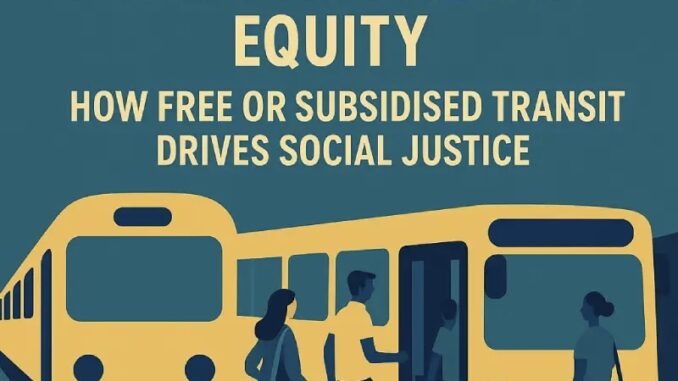
By Denis Hay
Description
Free public transport in Australia supports social justice, equality, and climate goals while improving access to jobs and housing.
🎧 Prefer to listen to this article? Press play
Introduction: The Overlooked Pillar of Equality
Free public transport is more than convenience; it is a foundation of opportunity. Across Australia, millions depend on buses, trains, and trams to reach work, healthcare, and education.
Around the world, free public transport is recognised as a cornerstone of fair and sustainable societies. Yet rising costs and poor coverage have turned mobility into a privilege rather than a right.
Recognising how free public transport in Australia supports social justice is vital to reducing inequality, tackling climate change, and restoring fair access to essential services.
The Problem: Unequal Access, Unequal Lives
1. The Cost Barrier of Commuting
Public transport fares eat into low incomes. Free public transport could ease the burden that rising fares place on low incomes. A Brisbane commuter can spend over $50 weekly just travelling to work. Rising fuel costs and limited services isolate families and job seekers.
At the heart of transport equity in Australia lies one question: should mobility depend on your postcode or pay packet?
Internal link: The Cost of Living in Australia
2. When Public Transport Fails the Public
Regional and outer-suburban areas are underserved, leaving residents disconnected from employment and education. These accessibility gaps show why free public transport is essential for connecting regional and outer-suburban communities.
Infrastructure Australia reports that over 30% of Australians in outer suburbs lack reliable public transport, an alarming indicator of inequality and policy neglect.
The Impact: How Inequitable Transit Shapes Society
3. Social Justice on the Move
Free or subsidised public transport transforms lives. Students can reach TAFE, carers can attend appointments, and older citizens can stay active and connected. When access is equal, opportunity follows, and fairness becomes tangible.
Internal link: A New Social Contract
4. Environmental and Economic Dividends
Reducing car dependence cuts pollution, congestion, and stress. Affordable transport stimulates local economies and supports community growth.
China shows this perfectly. Its world-class, affordable public transport network, high-speed trains and electric city buses show how public investment can prioritise people and planet over profit. According to china.org.cn, over 30 billion passengers used Chinese urban rail systems in 2023, with fares kept low to ensure access for all.
By investing in free public transport, Australia could cut emissions and congestion while improving the quality of life.
Luxembourg and Tallinn, Estonia, offer successful free-transit models that reduce emissions and improve equality, lessons Australia can adopt.
📊 Quick Fact:
Australian households spend an average of 15 % of their income on transport (ABS 2024).
Cutting or eliminating fares could save families up to $4,000 per year and reduce emissions by 10–15%.
The Solution: Investing in People and Planet
5. Australia’s Dollar Sovereignty and Public Transit Reform
Because Australia issues its own currency, funding free transit is a choice, not a financial impossibility. Through dollar sovereignty, the federal government can invest public money to serve public purpose rather than private profit.
Modern Monetary Theory (MMT) reminds us that affordability is never the obstacle; real resources are. Trains, drivers, and technology exist; what’s lacking is political courage.
Internal link: Australia’s Dollar Sovereignty.
6. Policy Options and Pathways
Implementing free public transport policies requires national coordination, vision, and commitment to fairness. To make fair transport a reality, policymakers can:
- Fund state trials of free or capped fares.
- Electrify fleets with Australian-made EV buses.
- Expand regional networks connecting homes and jobs.
- Integrate ticketing nationwide for seamless travel.
- Guarantee public ownership to prevent fare exploitation.
With these steps, free public transport can become a permanent part of Australia’s social justice framework, strengthens the economy, and helps reach net-zero goals.
Frequently Asked Questions
Q1: Is free public transport realistic in Australia?
Yes. Canberra and Melbourne’s free and discounted models show increased ridership and social participation.
Q2: How would it be funded under a sovereign-currency system?
Through direct federal spending, the same mechanism is used for defence, infrastructure, and education.
Q3: What international models prove it works?
Luxembourg offers entirely free national transport, Tallinn grants residents unlimited access, and China provides low-cost nationwide mobility through state investment.
Final Thoughts: Mobility as a Human Right
Mobility defines participation in society. When movement is unaffordable, equality disappears. Expanding free public transport nationwide will ensure no one is left behind, while strengthening the nation’s climate response and economy.
Public money must serve public purpose, and transport equity is the road forward.
What’s Your Experience?
Would free public transport improve your access to work, study, or healthcare? Share your thoughts in the comments below.
Call to Action
We’d Love to Hear from You
If you found this article insightful, explore more about political reform and Australia’s monetary sovereignty on the Social Justice Australia website.
Please share your thoughts through our Reader Feedback form, check out what others are saying on our Testimonials page, or scroll down and leave a comment below. Your voice helps shape future content.
Spread the Word
Change starts with conversations. Share this article with friends, family, or your social networks so more Australians can see what’s possible. Every share helps build momentum for a fairer society.
Keep Independent Journalism Alive
We’re 100% reader-supported, no ads, no corporate strings, just honest, truth-driven journalism. If our work has informed or inspired you, we invite you to consider contributing. Even $5, or whatever you can spare, helps us keep publishing and reaching more Australians.
Donate Now – one-time or monthly.
Already donated? Share the love by leaving us a quick review on Google to help others find us.
Engaging Question
Do you think free public transport could help close Australia’s growing inequality gap?
Resources
ABS: Australian Bureau of Statistics: Household Expenditure Data 2025
The State Council: The People’s Republic of China: China’s Public Transit: Building an Inclusive Network.
Infrastructure Australia: Infrastructure Audit Report 2024
This article was originally published on Social Justice Australia
Keep Independent Journalism Alive – Support The AIMN
Dear Reader,
Since 2013, The Australian Independent Media Network has been a fearless voice for truth, giving public interest journalists a platform to hold power to account. From expert analysis on national and global events to uncovering issues that matter to you, we’re here because of your support.
Running an independent site isn’t cheap, and rising costs mean we need you now more than ever. Your donation – big or small – keeps our servers humming, our writers digging, and our stories free for all.
Join our community of truth-seekers. Donate via PayPal or credit card via the button below, or bank transfer [BSB: 062500; A/c no: 10495969] and help us keep shining a light.
With gratitude, The AIMN Team


The thing about charging for a service is the cost of the actual process. 10s to 100s of millions of $dollars$ for software and hardware to take a payment plus banking fees to process the payments and/or the expenses of accepting cash. Plus the costs of making it mobile as well as the costs of hosting the data in a useable form for research and marketing.
The costs become a sizeable chunk of the fare.
Then there is the enforcement costs. PSOs who act more like SS Troops than customer service officers. Kids dragged through the mill because they either tried to dodge a small fare or could not afford it, or the system was too slow and they wanted to travel together with their friends.
How about that young woman trying to get home from an outing at night, worrying about her transport card or whether she has the money to pay for that fare. Trying to decide whether to walk, use public transport or if she can afford an Uber. Risking her safety due to finances or a lost card or possibly be being too intoxicated to drive.
Meanwhile there are so many areas with poor or no public transport.
Where I live one of the bus services is hourly in peak and 2-hourly off peak. It then has to link with another service in town that is every 20 minutes in peak and hourly off peak. Then that service takes you to the train station. If a connection is missed you can be delayed for hours.
Nowhere in the world does public transport make a profit. It is always subsidised by councils, governments and, ultimately, taxpayers. Some models provide different levels of service and accountability, some charge more or less or nothing for fares, some are cleaner and more reliable than others, but none make money.
Let us reassign the PSOs to customer service, assisting passengers in general and tourists or the disabled or those unfamiliar with the system in particular. They can police behaviour, ensuring that people are safe on the the train, tram or bus. Making sure they know which service to use and which stop to get off. With no money to worry about things will be better.
Oops! I think I just described a tram conductor or station attendant!
[Disclaimer: In the interests of full disclosure my first job was in public transport for 15 years (1974 to 1989) and I was a tram conductor and driver and a bus driver before moving into the revenue side of the transport system and studying transport management.]
By making transport free the actual cost of running the transport is reduced and we can concentrate on better service instead.
So true Denis, however, there are a few obstacles, not all transport is “Public” so some coverage for private owned transport would be required.
But yes, such a scheme would be beneficial to society, it would reduce air pollution and congestion in towns and cities. It would reduce our dependence on off shore oil refineries, while keeping the Australian dollar in Australia.
By taking many vehicles off the road it would reduce accidents and improve the flow of goods and materials.
Outer rural areas would be a problem, but increased rail and bus services and vouchers for taxi use could be introduced.
Nothing is for “free”, but a jump on, jump off transport system, would have an ongoing beneficial impact on society.
You’ve made some excellent points, Lee, particularly about the waste and harm caused by fare collection systems and enforcement. The billions spent on ticketing, compliance, and banking fees could indeed be redirected to service improvements and safety.
The only thing I’d clarify is the idea that taxpayers would subsidise a free service. In reality, Australia issues its own sovereign currency, meaning the federal government isn’t limited by tax revenue when funding essential public goods. Taxes don’t “pay for” services like transport; they help manage inflation and resource use.
Free public transport would be publicly funded, not taxpayer-funded, just as we fund roads, schools, and hospitals, investments made for the public good. With dollar sovereignty, Australia can afford to prioritise mobility, equality, and climate-friendly infrastructure without burdening citizens.
You make some thoughtful points, Jonangel, especially about reducing congestion, accidents, and our dependence on imported fuel.
You’re right that not all transport is currently public, but I’d argue it should be. Essential mobility, like healthcare or education, works best when it’s universally available, reliable, and not driven by profit. Public ownership ensures the focus stays on community benefit rather than corporate return.
Private operators could still have a role, but under public coordination where routes, fares, and standards are guided by social purpose, not shareholder demands. Australia’s dollar sovereignty gives us the freedom to invest in a fully public, free transport system, one designed around access, sustainability, and fairness rather than profit margins.
Great article Denis. Yes, yes, yes.
Lee, my dad worked for the railways, somewhere between 45 and 50 years ago he told me train travel (it may even have been public transport entirely) should be made free and ticketing staff could be reassigned. I’ve always argued in favour, but felt my argument was weak on the financial side, thanks ever so much for the insights.
Thanks, Gonggongche. Your dad was well ahead of his time, he understood what many still overlook today: the cost of ticketing and enforcement outweighs the benefits. With Australia’s dollar sovereignty, we can fund free public transport just like roads or hospitals, as a public good that serves everyone.
Denis
I’ve been on The Guardian of late. I’ve wanted to raise dollar sovereignty but lack confidence in my ability to counter an argument that spending on hospitals would raise inflation.
I have instead argued that there is plenty of room to spend on hospitals if the government spent wisely and raised taxes on assets where the revenue mostly goes overseas, that is stop fossil fuel subsidies and tax gas companies. That suffices for the argument, but I would like to raise dollar sovereignty.
I can see the argument that the government spends when it prioritizes something, so things the government spends unwisely on where the money stays in Australia could be replaced by spending on hospitals or free public transport.
Am I limiting myself too much?
You’re not limiting yourself at all, Gonggongche. You’re already making strong points, and adding dollar sovereignty simply strengthens them.
Government spending on hospitals does not cause inflation unless it pushes the economy beyond its actual capacity, such as not having enough nurses, beds, or equipment. Inflation comes from real shortages, not from the dollars themselves.
Dollar sovereignty simply clarifies the mechanism: Australia issues its own currency, allowing it to always fund hospitals, free public transport, or any other service that utilises Australian resources. The real limit is staff, materials, and planning, not money.
You’re on the right track already. Dollar sovereignty simply gives you the confidence to say, “We can fund what we need, as long as we have the real resources to do it.”
Once again, we have the suggestion that MMT is some form of panacea.
Once again, I won’t extensively repeat positions I have already expressed, but an often ignored (but vital) component of MMT is that governments cut spending during times of inflationary pressure.
Does the free public transport stop when the government faces inflation?
What evidence is there that a government in the past 30 years has done anything beyond relying on inequitable and punishing interest rates to control inflation?
AC
Thanks for raising this, and you’re right that MMT isn’t a panacea. It simply explains how a currency-issuing government works and what the real limits to spending are.
A key point often missed is this: free public transport would not stop during inflation, because inflation isn’t caused by essential public services being free. Cutting services doesn’t reduce inflation, it just makes life harder.
When inflation happens, a government should deal with the real cause of the price rises, not the public good.
For example:
• If inflation is driven by energy prices, fix the energy supply.
• If inflation is driven by housing shortages, build housing.
• If inflation is driven by corporate price-setting, regulate pricing power.
• If inflation is driven by supply bottlenecks, invest in capacity.
You fix the source of the inflation, not the services that make society fairer.
Public transport, hospitals, education, and other essential services are not what drives inflation, and cutting them does nothing to solve it. In fact, free public transport lowers household costs, reduces fuel demand, and improves productivity, which helps stabilise the economy rather than overheat it.
So, the question isn’t whether free transport would stop during inflation, it’s whether the government is willing to address the actual drivers of inflation instead of relying on blunt tools like interest rates.
Wollongong runs a substantial free bus system. The existence of the University and large TAFE at North Wollongong was, I believe partly responsible for the decision to be made to relieve major traffic and parking problems that would arise with hundreds of students coming and going each day. When I studied at UOW, I used to take the train from Albion Park Rail to the North Wollongong station, where full sized buses run on an untime-tabled shuttle from the station, stopping at TAFE and then cruising around the university campus. This is always well patronised during the school terms. A second free bus which serves the general population, runs from North Wollongong, into the CBD, stopping at the Wollongong Hospital and Wollongong Station and on demand.
Thanks Denis, sorry I hadn’t noticed your reply until I just now.