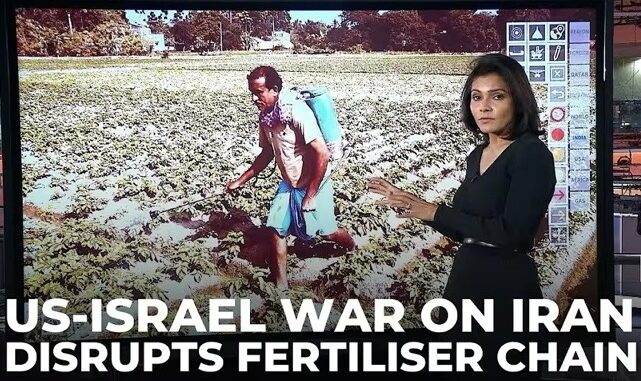
The closure of virtually all commercial traffic through the Strait of Hormuz occasioned by the Iran War is not merely a matter of oil and gas, the usual prized duo that feature in the nervous chatter of global markets. There are other less conspicuous products that have also been snared in the process. Consider fertilisers, with a supply shock that may well push prices beyond the 2022 peak following the Russian invasion of Ukraine. Given their role in agriculture, another, less publicised shock arising from this prolonged war is in the offing. Prices, at this writing, are already biting. Egyptian urea prices have risen by 25%, reaching $625 per metric tonne, up from $484 to $490 between February 17 and February 23.
The North Dakota State University’s Agricultural Trade Monitor may not make scintillating reading, but it is of sufficient interest to note that the Gulf accounts for some 43% of seaborne urea exports, approximately 44% of seaborne sulphur, over a quarter of traded ammonia and far from negligible quantities of phosphates. The effect of the illegal war commenced by the US and Israel on February 28 had immediate effects. “Within the first week of the crisis, major Gulf producers began declaring force majeure and reducing operations across urea, ammonia, and sulfur.”
In their March report, the authors note that, unlike 2022, when Russian fertilizers were rerouted, “limited alternative routes” present themselves with a closed Strait. Risks for the US could be identified in urea, MAP (Mono-Ammonium Phosphate), and DAP (Di-Ammonium Phosphate) fertilizers.
Serious risks present themselves to such heavily reliant fertilizer importers as Brazil, given its reliance on nitrogen and phosphate. The country imports over 80% of its fertilisers. “The Hormuz closure simultaneously removes direct Gulf supply to Brazil and constrains Morocco’s ability to substitute for it.” This also involves the Chinese market, which, while self-sufficient in many respects, still relies on Brazil, which in turn is highly dependent on urea from the Middle East. Both need the fertilisers to grow soybeans which are consumed by livestock such as pigs and cows.
India is also a country most conspicuously vulnerable. It is the largest importer of DAP imports, accounting for 28.7% of the international market. Much to its misfortune, its major suppliers – consider Saudi Arabia (24%) and Morocco (22%) – face the problem of maritime access via Hormuz and the Red Sea. Similarly with urea, India imports about $2.2 billion worth, accounting for 7.2% of global imports and 20-25% of domestic needs. Again, major suppliers such as Oman (15%) and Saudi Arabia (9.5%) find themselves in the zone of conflict and supply. Given that the country has 30 urea manufacturing plants that require natural gas or naphtha feedstock, disruptions in LNG supply will drive up production costs and is already reducing capacity.
The continued closure of the Strait would also restrict the supply of global sulphur “raising costs for phosphate producers in China, Morocco, and Indonesia, countries that depend on Gulf sulfur such as feedstock, and constraining global phosphate supply at a time when alternative sources are already limited.”
The cascading effects of this fertiliser choke in Hormuz lies, not only in the closure that restricts Gulf product from making it to markets. It means that fertiliser producers are unable to exploit vital ingredients. Take, for instance, the case of Egypt’s urea plants: the natural gas supply upon which the country’s fertiliser production requires was cut off with Israel shutting down offshore gas fields. (This will necessitate diving into the ever-dearer LNG market.) With natural gas supplies from Qatar severed, fertilizer firms in India, Bangladesh and Pakistan have begun to cease production.
If the Trump administration thought it could be spared domestic grievances on the agricultural front, the president of the American Farm Bureau Federation sought to disabuse him. In a March 9 letter of praise and sorrow to President Donald Trump, Zippy Duvall reminded him that global fertiliser markets, like oil, were “highly vulnerable to disruptions in maritime transit routes, especially through the Strait of Hormuz, a critical shipping corridor for key fertilizer materials and finished fertilizer.” The halt of energy production in the Middle East would also “affect the price and availability of many downstream products farmers depend upon.” Such shocks in the supply chain would push “already record-high input prices even higher at a time when farm margins are already extremely tight and many farmers are under water.”
Duvall, filled with vim, went on to urge the President to “use your authority to take proactive steps to safeguard fertilizer supply chains and reduce the risk of market disruptions that could threaten American agriculture.” These included, among several recommendations, deploying the US Navy to shield maritime suppliers of fertilizer shipments through the Strait of Hormuz (the improbability and feasibility of this does not seem to have dawned on Duvall), providing insurance coverage, ensuring appropriate domestic port, rail and barge capacity “to expeditiously deliver fertilizer inputs to rural America” in timely fashion and using Presidential power “suspend countervailing duties on imported fertilizer products to moderate price increases” on a temporary basis.
The historian Adam Tooze makes the essential point that, if you want to schedule conflict, do it so as to avoid clashes with the agricultural cycle. By disrupting the cycle and causing a rise in staples, food security is imperilled and social unrest is sown. It is abundantly clear that the planners behind the war on Iran have shown themselves both contemptible and inept in appreciating that fact. The consequences will be borne globally, and international disorder in agriculture and food is in the making. Truly, a crime against peace.
Keep Independent Journalism Alive – Support The AIMN
Dear Reader,
Since 2013, The Australian Independent Media Network has been a fearless voice for truth, giving public interest journalists a platform to hold power to account. From expert analysis on national and global events to uncovering issues that matter to you, we’re here because of your support.
Running an independent site isn’t cheap, and rising costs mean we need you now more than ever. Your donation – big or small – keeps our servers humming, our writers digging, and our stories free for all.
Join our community of truth-seekers. Please consider donating now via:
PayPal or credit card – just click on the Donate button below
Direct bank transfer: BSB: 062500; A/c no: 10495969

We’ve also set up a GoFundMe as a dedicated reserve fund to help secure the future of our site.
Your support will go directly toward covering essential costs like web hosting renewals and helping us bring new features to life. Every contribution, no matter the size, helps us keep improving and growing.

Thank you for standing with us – we truly couldn’t do this without you.
With gratitude, The AIMN Team

WOW!I wonder if Netanyahu realised the whole impact of what he was conning the Tangerine Tyrant into.
Food riots may well be in the offing. No (sensible) leader wants that. But we’re dealing with the Orange Shitgibbon and his thugs.
As Jon Stewart has pointed out, Trump’s wars are God’s way of teaching Americans Geography.
Whoever heard of the Strait of Hormuz before Trump started his bombing?
Sigh, if only we had machines that could convert pollie speak into fertiliser we’d never have to ship it in from foreign shores ever again. In fact we’d have so much we could sell it on the world open market and make pile of cash.
The biggest exporters of fertiliser (& inputs) are Russia, China, Morocco, Canada, and the United States, along with some Gulf States; surely Trump and Netanyahu’s chum Putin will not benefit?
TACO Trumpery’s bull manure & bluster is no substitute for manufactured phosphate, nitrogen & potassium fertilisers.
However, the real question is, “”Why is Australia dependent upon IMPORTED FERTILISERS?? Are our agricultural industries too small to provide an adequate market for an on-shore fertiliser manufacturer??”
The only “fertiliser” in good supply is of the Taurean type emanating from Canberra.
Trump and Netanyahu. Never mind the damage that may be starting to arc up in Europe, let alone the barbarism directed at mid east countries?
The politicians call these people “friends”, but with “friends” like these, who needs enemies?
Many of us lived through the consequencs of the ’74 “oil shock”.
Our “friends” have gifted us the possible recession that follows the selfish stunts. Thanks, cnuts!
Oz used to manufacture & distribute most of our agricultural fertilizers via Incitec and Pivot.
Now, since they amalgamated and became an Oz & US based multinational behemoth, the vast majority of Oz agricultural fertilizers/components are imported, exposing us to supply chain problems, (as some say, we don’t make anything in Oz any more). Thank goodness we’re not at war with China or Canada, upon whom we would now have to largely rely.