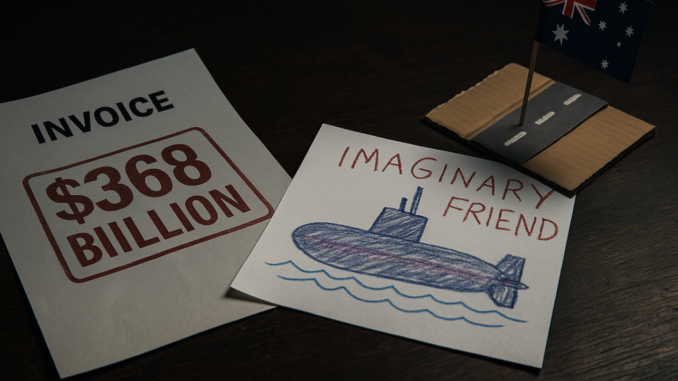
How the AUKUS Caucus built a cargo cult and called it strategy.
There’s a certain kind of Australian politician who never quite grew out of childhood. You know the type: Richard Marles, Tony Abbott, Christopher Pyne. Peter Pan to a man. Their eyes light up whenever a Pentagon staffer remembers their name. They sit bolt upright like kelpie pups on the back of the ute, ears pricked for master’s return. They mistake condescension for intimacy, patronage for partnership, obedience for relevance.
Marles, Pat Conroy (Defence Industry), and Brendan O’Connor (Veterans’ Affairs) along with “Rear Admiral-Albo” and Wayfinder Penny Wong make up the AUKUS Caucus: a dream team. Not bound by evidence, timelines, or arithmetic; only by faith. Faith that if Australia sends enough money, bases and deference across the Pacific, the Great Mate in the Sky will someday descend bearing nuclear submarines and strategic salvation.
Australia’s $368 billion imaginary friend.
The Cargo Cult Playbook
Cargo cults arise when isolated societies witness advanced powers arrive with miraculous technology. Locals build imitation runways; light signal fires hoping the planes will return. The AUKUS Caucus has updated the ritual for the modern age. Our runways are ports. The offerings are our sovereignty. The signal fires are AUSMIN pressers. And the planes, as ever, do not land.
Richard Marles, Labor’s embattled Defence Minister, is the cult’s high priest. Asked about implementation delays, he smiles wanly and intones the sacred words: “Full steam ahead.” Full steam ahead to where is never explained.
AUKUS is sold as strategic realism. In practice, it operates as faith: belief substituted for capacity, ritual for delivery, loyalty for leverage.
The Hegseth Problem
This week Marles and Wong flew to Washington for the annual, ceremonial abasement known as AUSMIN. Their opposite number is Pete Hegseth. Former Fox News shouter, veterans’ charity mismanager, and a chap once carried from a strip club by mates after trying to storm the stage. Now improbably directing US defence as Secretary of War.
Hegseth’s character matters because AUKUS asks us to entrust our strategic future to decision-makers whose judgment, attention span and institutional grip are already demonstrably strained. His own mother calls him as an “abuser of women” who “belittles, lies and cheats,” urging him to “get some help and take an honest look at yourself.”
When a nation stakes $368 billion on the judgment of a man disqualified by his own mother from trust, it has crossed from strategy into pathology.
8 December, Marles and Wong are pictured nodding earnestly as Hegseth endorses a $368 billion submarine fantasy he cannot possibly deliver. He barks approval of AUKUS as “pragmatic hard power.” Wong, cryptic as ever, merely echoes Trump’s mantra: “full steam ahead.” The boats are not coming, so who cares what fuels the boiler?
The Pragmatic Hard Power Con
Pragmatic hard power? It could be a new brand of laundry detergent. The absurdity runs deeper than performance.
Australia is trading real sovereignty for imaginary submarines.
AUKUS legislation effectively transfers operational priority and access over key Australian military bases to the US. The terminology is pure institutional dissemblance: “expanded US rotational presence” and “integrated command arrangements.” In plain English: we concede control over our own strategic assets. We slip a few lazy billion to US and British shipyards to “expedite” production; meaning we subsidise their accumulated backlogs. We bind our “defence posture” so thoroughly into US command that when Washington sneezes, Canberra catches cold.
But we do get to wave flags. Hum anthems. Pay invoices.
Each concession merits national debate. Yet, the AUKUS Caucus has sealed the deal without meaningful parliamentary inquiry, without detailed public costings, only an “oversight” committee denied subpoena power, denied independent costing, and so carefully neutered it might as well be chaired by a shredder.
The Legal Trap
And yes, the legal architecture is exactly what critics feared. Under the agreement, Australia provides $4.7 billion (with more coming) to US and UK submarine builders, and according to questioning in Senate Estimates, there is no clawback provision; Australia does not get its money back if the US fails to transfer nuclear submarines.
The AUKUS agreement allows any party to withdraw with one year’s notice. But here’s the lethal asymmetry: Australia’s payments are subsidies, not deposits; they are not refundable, and there is no guarantee that the submarines will ever be delivered.
The US and UK can walk away at any time. They keep the cash, the upgrades, the expanded industrial bases and the sovereign right to prioritise their own needs. Which, as serious countries, they will do.
Australia, meanwhile, is padlocked like a rental fridge in a share-house. Jiggle the handle all you like, but the thing won’t open unless the bloke with the key decides you’ve paid up.
A Big Perhaps
At some point, the more unsettling explanation has to be entertained. Perhaps the submarines are not delayed. Perhaps they are not even expected. Perhaps AUKUS is not failing at all, but performing exactly as intended. The money flows early and without clawback. The bases open. Command structures integrate. Strategic dependency is formalised. The submarines remain permanently over the horizon, always promised, never required. If this were a ruse designed to secure American basing access and regional posture while outsourcing the political pain to future governments, it would be hard to design it differently. Whether Australia’s political class believes its own story, or merely finds it convenient, becomes almost beside the point. The outcome is the same.
And whatever the truth of the submarines, Defence needs a bit of a rescue.
Defence’s House of Horrors
Marles’ predicament worsens when you look at Defence itself: a moral, administrative and institutional nightmare he inherited and, like his predecessors, Linda Reynolds and Peter Dutton, has failed to master. Could anyone? Australia’s predicament worsens also.
The Brereton inquiry exposed 39 unlawful killings in Afghanistan. The stain remains. Atop this moral wreckage sits administrative farce: a Defence official leaked confidential information before walking straight into a job with a private weapons contractor.
The Hunter class frigates tell the broader story. What began life as a $45 million per ship concept has metastasised into $2.6 billion per ship, with hundreds of millions in variations already locked in, and the program at least 18 months late due to design immaturity.
When Labor took office, 28 major Defence projects were running a combined 97 years behind schedule, with roughly a quarter of procurement unfunded. Over it all looms $368 billion we’ve agreed to throw at AUKUS, as a $60 billion annual defence budget swells toward $100 billion by 2034, absorbing failure without correcting it. (AUKUS costs are a guess, announced without consulting Treasury, Parliament or any other authority.)
What Do We Actually Get?
And what does Australia receive for this tithe?
- Not submarines.
- Not even capability.
- A promise.
Five SSN AUKUS boats to be built in Adelaide at some conveniently indeterminate date. Early 2040s if all goes well. If Britain remembers how to build submarines at scale. If the US has spare industrial capacity. If history pauses politely to accommodate our fantasy.
The BAE Systems Track Record
BAE Systems, cast as AUKUS’s industrial saviour, spent two decades struggling to deliver the UK’s Astute class submarines. Early boats ran five years late. Costs ballooned by roughly 50 percent. By 2009 an extra £1.35 billion had already been added. Later boats pushed delays to six years, with total overruns well past £1.3 billion.
This is the outfit now promising that, once a few more billion pounds are poured into Barrow shipyard, it will produce a brand new nuclear submarine every 18 months. A tempo unseen since the Cold War. The same system that took two decades to crawl through one troubled program now offers to sprint through a more complex shared design.
Policy? No. It’s magical thinking with a Gantt chart.
The Pillar Two Mirage
When reality intrudes, the faithful point to Pillar Two, the sideshow of defence tech collaboration; AI, cyber and hypersonics; meant to suggest strategic depth where there is only debt. Scott Morrison dubbed it “AUKUS in Space,” as if adding a preposition and some stars transformed a lopsided submarine purchase into visionary strategy.
But the real achievement is rhetorical: substituting buzz-words for credible policy. In this sense, AUKUS is Scott Morrison’s most enduring legacy.
The Question Marles Won’t Answer
No-one likes a smart-arse but the pitiful Richard Marles still cannot explain why nuclear submarines are worth this ruinous spend when modern diesel-electric boats exist.
Modern diesel-electric submarines provide maximum range, endurance and stealth, operating underwater before having to resurface to snorkel and recharge batteries. Australia’s own Collins-class diesel submarines demonstrated during 2003 multinational exercises that they were comparable in underwater warfare to US Los Angeles-class nuclear-powered attack submarines, trading roles and achieving , successful attacks despite being smaller and less powerful.
Cheaper, crewable, already in production from many European and Asian shipyards; they could patrol our seas this decade, not as a thought experiment for the 2040s. Proven alternatives include the Naval Group Scorpene class, in service with Malaysia, India and Brazil, or the Type 212/214 and Type 218SG submarines designed by ThyssenKrupp Marine Systems, each optimised for shallow water operations, sea control and maritime interdiction.
Marles’ silence on these alternatives is not diplomacy. It is concealment. And on the Pentagon review? He defers to the gods. Never mind that US shipyards face challenges in producing Virginia-class submarines at the rate needed to sustain domestic needs. Never mind that the “strategic environment” supposedly demanding these submarines will have mutated several times before a single SSN AUKUS is afloat.
The Keating Indictment
Let us be clear. This is not alliance. It is abdication with a flag on it. It is not strategy. It is superstition dressed up as seriousness and invoiced to the taxpayer.
Australia has not been made safer by this arrangement. It has been made smaller. Smaller in judgment. Smaller in autonomy. Smaller in its willingness to say no when no is the only adult answer available.
We are told this is the price of maturity. In truth, it is the price of political adolescence: the desperate need to be liked by bigger boys, the fear of standing alone, the refusal to do the hard work of thinking for ourselves.
A nation that spends $368 billion on a promise, while surrendering control over real assets in the present, is not hedging risk. It is institutionalising delusion. Serious countries build capabilities. They do not build faith-based procurement programs and call them deterrence.
The Runway at Dusk
For $368 billion, AUKUS is not a procurement program. It is a wager on dependency.
Australia is paying staggering sums for submarines that do not yet exist, to be built by industries in chronic difficulty, on timelines that belong to fantasy, while ceding real autonomy over real assets in the present. In return, we receive reassurance. Access. Attention. The comforting sense that someone larger, louder and more heavily armed is standing somewhere behind us.
This is not how confident countries behave. Confident countries invest in capabilities they can crew, afford and deploy. They debate trade-offs openly. They do not confuse faith with strategy or obedience with influence.
AUKUS has shrunk Australia’s strategic imagination at precisely the moment it should have been expanding it. We have narrowed our options, mortgaged our future, and told ourselves it is maturity. In truth, it is fear wearing the language of realism.
History will not ask whether the submarines eventually arrived. It will ask why a nation willingly surrendered so much, so early, for so little certainty in return. And it will judge us not by the promises we believed, but by the choices we made when the risks were already plain.
This article was originally published on URBAN WRONSKI WRITES
Keep Independent Journalism Alive – Support The AIMN
Dear Reader,
Since 2013, The Australian Independent Media Network has been a fearless voice for truth, giving public interest journalists a platform to hold power to account. From expert analysis on national and global events to uncovering issues that matter to you, we’re here because of your support.
Running an independent site isn’t cheap, and rising costs mean we need you now more than ever. Your donation – big or small – keeps our servers humming, our writers digging, and our stories free for all.
Join our community of truth-seekers. Donate via PayPal or credit card via the button below, or bank transfer [BSB: 062500; A/c no: 10495969] and help us keep shining a light.
With gratitude, The AIMN Team


Spot on. If you can see this, if I can see this, if a large proportion of Australians can see this how long can our leadership be allowed to try to blow smoke in our eyes?
A pile of rubbish, is a pile of rubbish.
Thanks for a Sunday morning read that I didn’t need David.What I will never understand is why Albanese didn’t put the kybosh on this when they first assumed government.Could it be because there’s actually no real difference between our political duopoly,and/or they are both pathetically weak?
Given the latest Aged care fracas,it appears that this government is a serial shirker of responsibility.The signs are not good.
The US will keep dangling the mythical subs in front of the gumbmint of the day as bait as long as they keep paying the billion plus dollars bribes flowing their way every year (fully knowing that they will never honour the contract).
Australian politicians want to spend $368 Billion for a couple of so called Aukus U-boats that we will never get then in the same breath say we can’t afford the expense of the NDIS.
Is it just me or does anybody else think if half a brain cell ever made it through security into parliament house it would be on its Pat Malone.
It seems to me these same politicians are so far up the Americans arse you couldn’t get them out with two sticks of Gelignite and a heavy haul tow truck.
Its always a possibility that a nation famed for its criminal history (Al Capone) has made a suggestion that can
t be ignored, like "Wouldnt it be a shame to see Australia bombed to be so much ruble, and agent orange seals its future?”.To which Albo may ask how much money does the crim want, and how is this going to pass the pub test.
Satan then sets up a bank a/c called AUKUS, and requires payments to made into this a/c, as and when we call for it.
National security guarantees money will flow with very little comment from the victim nation, and why would a friend with bases here want to bleed us dry?