By Denis Hay
Description
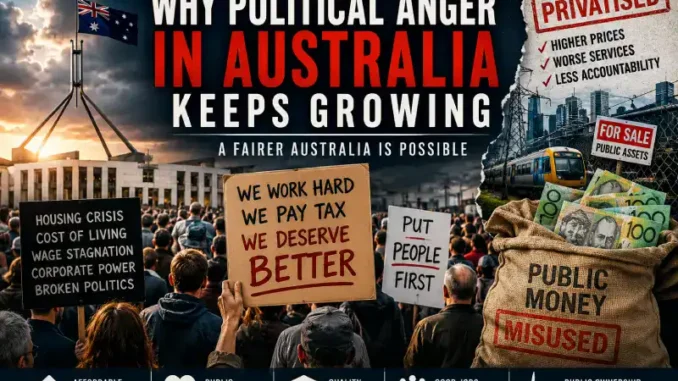
Political anger in Australia is rising as inequality, privatisation, and misuse of public money leave citizens feeling ignored.
Introduction – Australians Are Losing Faith in Politics
Political anger in Australia is growing because many citizens feel the country no longer works for ordinary people. Australians are working harder, paying more for housing, food, electricity, insurance, and healthcare, yet many feel less secure than earlier generations.
Australia is one of the wealthiest nations on Earth. Yet increasing numbers of citizens are struggling to afford necessities. Young Australians are losing hope of owning a home. Older Australians worry about rising living costs and overstretched healthcare systems. At the same time, corporate profits continue to rise while governments repeatedly claim there is “not enough money” for stronger public services.
Many Australians increasingly believe that politics now serves powerful corporations, lobbyists, and wealthy interests more than it serves citizens. The privatisation of essential services, the misuse of public money, and decades of neoliberal economic policies have contributed to growing distrust and frustration across society.
The danger is that anger without solutions can become division and hopelessness. But Australia does not have to continue down this path. There are practical reforms that could restore fairness, strengthen democracy, and ensure that the nation’s wealth benefits all citizens rather than a privileged few.
The Problem – Why Australians Feel Ignored
1. Rising Costs and Declining Security
For many Australians, everyday life has become financially exhausting.
Housing affordability has become one of the biggest drivers of frustration. According to Australian Bureau of Statistics data, housing costs continue to consume a growing share of household income. Rents have surged in many cities while property prices stay out of reach for younger generations.
At the supermarket, families face rising grocery prices. Electricity bills continue climbing despite decades of promises that privatisation would create competition and lower costs. Insurance premiums have also increased sharply.
Meanwhile, wage growth has often failed to keep pace with inflation. Many workers are trapped in insecure casual or gig economy jobs without the stability that earlier generations enjoyed.
Australians are increasingly asking a simple question: if the nation is wealthy, why are so many people struggling?
2. Many Australians Feel Politics No Longer Represents Them
Another major source of political anger in Australia is the growing belief that governments no longer genuinely represent citizens.
Large corporations and lobby groups have enormous influence over public policy. Political donations, lobbying access, and the revolving door between politics and corporate consulting firms have damaged public trust.
Many Australians also feel trapped by a two-party political system that appears resistant to meaningful reform. Safe seats reduce accountability because politicians in many electorates face little real electoral competition.
At the same time, concentrated media ownership shapes political narratives and often limits serious discussion about structural reform. Citizens increasingly feel they are given carefully managed political messaging rather than honest conversations about the nation’s problems.
According to Transparency International Australia, public trust in institutions has declined significantly in recent years, reflecting widespread concerns about integrity and accountability.
The Impact – How Privatisation Changed Australia
3. Privatisation in Australia and the Loss of Public Control
One of the clearest drivers of public frustration has been the privatisation of essential public services.
In recent decades, governments have sold or outsourced many public assets and services, often claiming that the private sector would deliver greater efficiency. Instead, many Australians believe the result has been higher costs and reduced accountability.
Electricity networks in states such as Victoria and New South Wales were privatised. Toll roads became highly profitable private monopolies. Public transport systems increasingly relied on outsourcing and private contracts.
Aged care gives another example. Numerous inquiries exposed severe failures in privately operated aged care facilities, where profit extraction often took priority over quality care.
Even employment services and vocational education were heavily outsourced, sometimes with disastrous outcomes.
Australians increasingly question why essential services that citizens depend on daily should run primarily to maximise shareholder profits.
4. Australians Often Pay More for Worse Services
Many privatised systems now appear to deliver exactly what critics warned about.
Electricity prices rose sharply after privatisation in several states. Toll road costs continue climbing. Regional communities often experience reduced services because private operators prioritise profitability over public need.
Public-private partnerships often socialise risks while privatising profits. When projects fail, governments often absorb the losses while corporations keep long-term revenue streams.
The National Broadband Network also became a source of frustration for many Australians. Instead of being treated purely as essential public infrastructure, the rollout was shaped by commercial pressures and political compromises, resulting in a more expensive and less efficient outcome than originally envisioned.
This growing sense that public wealth has been transferred into private hands has become a major source of anger toward politics itself.
How Right-Wing Economic Policies Fuelled Political Anger
5. The Rise of Neoliberalism
Since the 1980s, Australia has increasingly embraced neoliberal economic policies.
These policies promoted deregulation, privatisation, reduced public ownership, outsourcing, and the idea that markets should dominate economic decision-making.
Supporters argued this would increase efficiency and economic growth. While parts of the economy expanded, many citizens increasingly experienced insecurity, inequality, and declining public services.
Secure employment became less common. Union power weakened. Public sector investment often declined. Governments increasingly adopted business-style approaches to essential public services.
The result has been a society in which wealth concentration has accelerated, while many ordinary Australians feel left behind.
6. Public Money Increasingly Flows to Corporate Interests
Another major contributor to political anger in Australia is the belief that public money is often directed toward powerful private interests rather than public needs.
Governments continue providing billions in fossil fuel subsidies while many households struggle with energy bills. Large consultancy firms receive enormous public contracts. Defence spending projects often run over budget.
According to the Australian National Audit Office, multiple major government contracting failures have raised concerns about accountability and value for money.
At the same time, Australians are repeatedly told there is insufficient funding for affordable housing, stronger public healthcare, or expanded social services.
This contradiction fuels growing resentment and distrust.
The Human Cost of Political Failure
7. Anxiety, Stress, and Growing Social Division
Economic insecurity and political frustration are taking a psychological toll.
Many Australians feel anxious about the future. Financial stress affects mental health, relationships, and community stability. Citizens increasingly feel disconnected from institutions that once provided security and social cohesion.
Social media and highly concentrated media systems can also amplify anger and division. Outrage-driven political coverage often encourages conflict rather than constructive problem-solving.
Without meaningful reform, frustration can easily become cynicism and disengagement from democracy itself.
8. Young and Older Australians Both Feel Left Behind
Younger Australians face enormous challenges.
Home ownership feels increasingly unattainable. Student debt burdens continue growing. Secure employment pathways are weaker than in earlier decades.
At the same time, many older Australians worry about access to healthcare, the quality of aged care, and rising living costs in retirement.
Different generations may experience these pressures differently, but the underlying frustration is often similar: many people no longer believe the economic system fairly rewards ordinary citizens.
The Solution – What Must Change
9. Progressive Policies Australia Could Implement
Australia has the resources and capacity to create a far fairer society.
Progressive policies Australia could implement include:
- Large-scale affordable public housing construction.
- Expanded Medicare and public healthcare.
- Fully funded high-quality public education.
- Stronger worker protections and secure employment pathways.
- Public ownership of essential infrastructure.
- Greater investment in regional communities.
- Stronger anti-corruption measures.
- Fairer taxation systems.
These policies are not radical in historical terms. Many reflect systems Australia once had more strongly in place during earlier decades, when economic security and public investment were more widespread.
10. Australia’s Dollar Sovereignty and Public Investment
One of the most misunderstood issues in Australian politics is federal government spending.
As a nation with monetary sovereignty, the Australian federal government is not financially constrained in the same way households are. Public money can be created and directed toward productive public investment when real resources are available.
This does not mean unlimited spending without consequences. Inflation and resource constraints still matter. However, it does mean that governments have a far greater capacity to invest in the public good than many citizens are led to believe.
Australia can afford quality healthcare, education, housing, and infrastructure if political priorities shift toward serving citizens rather than narrow corporate interests.
Public investment in citizens strengthens the nation economically, socially, and democratically.
11. Restoring Democratic Accountability
Rebuilding trust also requires democratic reform.
Reforms include:
- Stronger political donation laws
- Greater transparency around lobbying
- Breaking up concentrated media power
- Supporting independent journalism
- Expanding anti-corruption oversight
- Encouraging greater citizen participation in policymaking
Australians must feel governments are accountable to the public rather than corporate donors or powerful lobby groups.
Democracy becomes fragile when citizens believe their voices no longer matter.
Frequently Asked Questions
Why is political anger in Australia increasing?
Many Australians are frustrated by rising living costs, housing insecurity, inequality, privatisation, and the belief that governments increasingly serve corporate interests over citizens.
How has the privatisation of Australia affected citizens?
Privatisation often led to higher prices, reduced accountability, worsening service quality, and greater corporate control over essential public infrastructure.
What progressive policies does Australia need most?
Affordable public housing, stronger healthcare and education systems, secure employment policies, and public investment in infrastructure are among the most discussed reforms.
Can Australia afford stronger public services?
Yes. As a monetarily sovereign nation, Australia has substantial capacity to invest in public services when real economic resources are available.
Why do many Australians distrust politics?
Corporate influence, political donations, media concentration, and repeated policy failures have weakened trust in major political institutions.
Final Thoughts – Australia Does Not Have to Continue Down This Path
Political anger in Australia is not appearing out of nowhere. It reflects deep frustration with rising inequality, declining public services, insecure work, and the growing belief that governments increasingly prioritise corporate interests over public wellbeing.
But anger alone will not solve these problems.
Australia remains an extraordinarily wealthy nation with enormous productive capacity, skilled citizens, and strong democratic traditions. The challenge is not a lack of national wealth. The challenge is political priorities.
Public money should primarily serve public purpose. Essential services should work for citizens, not simply for private profit. Democracy should ensure ordinary Australians have genuine influence over the direction of the country.
A fairer Australia is still possible if citizens demand stronger accountability, better public investment, and policies that ensure the nation’s wealth is shared more equitably across society.
What Is Your Experience?
Do you believe politics in Australia still serves ordinary citizens, or has it become too heavily influenced by corporate interests and privatisation?
Have you personally experienced rising frustration with the cost of living, declining services, or a lack of political accountability?
Call to Action
If you found this article insightful, explore more about political reform and Australia’s monetary sovereignty on Social Justice Australia.
Share this article with your community to help drive the conversation toward a more just and equal society.
Click on our “Reader Feedback” menu. Let us know how our content has inspired you. Submit your testimonial and help shape the conversation today!
Additionally, leave a comment about this article below.
Remember: as a nation with dollar sovereignty, Australia can invest public money to serve public purpose. Tell your MP you support that.
Engaging Question:
What public service do you believe should be returned to public ownership first?
References
- Australian Bureau of Statistics
- Reserve Bank of Australia
- The Australia Institute
- Australian National Audit Office
- Transparency International Australia
This article was originally published on Social Justice Australia
Keep Independent Journalism Alive – Support The AIMN
Dear Reader,
Since 2013, The Australian Independent Media Network has been a fearless voice for truth, giving public interest journalists a platform to hold power to account. From expert analysis on national and global events to uncovering issues that matter to you, we’re here because of your support.
Running an independent site isn’t cheap, and rising costs mean we need you now more than ever. Your donation – big or small – keeps our servers humming, our writers digging, and our stories free for all.
Join our community of truth-seekers. Please consider donating now via:
PayPal or credit card – just click on the Donate button below
Direct bank transfer: BSB: 062500; A/c no: 10495969

We’ve also set up a GoFundMe as a dedicated reserve fund to help secure the future of our site.
Your support will go directly toward covering essential costs like web hosting renewals and helping us bring new features to life. Every contribution, no matter the size, helps us keep improving and growing.

Thank you for standing with us – we truly couldn’t do this without you.
With gratitude, The AIMN Team
Couldn’t agree more. Putting it simply, we’re sick of being sidelined, in favour of corporations and billionaires. Many of us also are angry about the major parties’ support of genocide. It’s got me beat how any of them thought we could swallow that.
This is what people forget, yes, when Telecom had a monopoly, you could wait six days to get your phone put on, but people in rural areas had a reliable telecommunications network. Now, they don’t.
Hanson does NOT have the answers to this country’s problems, especially as she now has Rinehart’s hand up her clacker acting as ventriloquist!
Just like to thank the other commenters.
Thank god I flicked this on after watching some of the stuff from tv stations on the budget.
Just like to thank the other commenters.
Thank god I flicked this on after watching some of the stuff from tv stations on the budget.
whoops!
academic, Dennis.
Our personal airspace is so cluttered, we are free to be dehumanised by friends, trolls and/or ‘sponsored’.
Equally we are free to develop our opinions, from the opinions of others.
Neither opinions need a basis from, or reference to, facts.
Jan,
A lot of Australians seem to feel that governments are becoming increasingly disconnected from ordinary citizens and far more responsive to corporate interests and powerful lobby groups. That frustration is clearly growing across many issues, including cost-of-living pressures, housing, public services, and foreign policy.
In international conflicts, many people are deeply distressed by the human suffering they witness and feel that governments are not reflecting the concerns of ordinary citizens strongly enough. Regardless of political position, I think most Australians want consistency in human rights, international law, and the protection of civilian lives.
The growing anger we are seeing is not just about one issue. It reflects a broader feeling that ordinary people are struggling to have their voices heard in political decision-making.
Cool Pete,
That is one of the strongest criticisms many Australians make about privatisation. Public services like Telecom were originally designed around universal service and long-term national benefit, not simply profitability.
The argument many people make today is that once essential infrastructure becomes heavily profit-driven, regional and rural communities often receive worse services because they are less commercially attractive.
I also think many Australians are becoming increasingly concerned about the level of influence wealthy individuals and corporations can have over politics and public debate. Regardless of political party, citizens want politicians making decisions in the national interest rather than appearing too closely aligned with powerful financial interests.
Paul Walter,
I think a lot of Australians are looking for discussion that goes beyond the usual political talking points and media spin. One of the strengths of independent platforms is that people can share perspectives and experiences that are often missing from mainstream coverage.
The comments section has added some valuable insights because many people are clearly feeling similar frustrations about cost-of-living pressures, privatisation, political accountability, and the direction the country is heading.
Australia was once called the ‘Lucky Coutry’ and indeed it was until we gave away our natural resources, land, water, farms, industries, manufacturing, etc. to the highest overseas bidder, all in te name of greed and profit the bottom line. Japan makes more money from the sale of our LNG than we do. We now have to buy back inferior quality materials/goods at higher prices based on global market prices. The gap between the have’s and have nots has become a gulf, not a gap. We are flooding the country with people who have large families but no expertise, not working or paying income tax, for which we have to find housing, social and health benefits etc.
The powerful have always controlled, ordered, oppressed, managed, profiteered, invested “safely”, cornered and hoarded, the few over many. That class or clique or fellowship has interests to be farmed. A Hanson type is a cheap easy tool, copping gifts and repaying from the highups and serving interests by distorting and pretences. Media maggots are rented. Real information remains scarce, mishmashed. Blame someone? Who? And, Mr. S Mathers is quite wrong here. I taught migrant english classes for over eight years, people who worked, earned, survived, were fine candidates. We who might blame are often to blame.
Mr Shevill Mathers,
I think many Australians share concerns about the sell-off of national assets, rising inequality, the decline of manufacturing, and governments placing too much faith in privatisation and global markets.
Where I would differ slightly is on migration. I think the real issue is less about blaming migrants themselves and more about governments failing to properly plan infrastructure, housing, healthcare, education, and secure employment alongside population growth.
Many migrants work hard, pay taxes, and contribute significantly to Australian society and the economy. The frustration many citizens feel is often directed at governments that allowed housing shortages, wage pressures, privatisation, and declining public investment to develop over decades.
In my view, ordinary Australians and migrants are not natural enemies. The deeper issue is whether governments are using public policy and public money to genuinely serve the long-term interests of all citizens rather than prioritising corporate profits and endless economic growth above everything else.
Mr Shevill Mathers has obviously been anywhere except in my life experience, which is, that immigrants to Australia (except the 25% of 10 pound Poms who went back to ”sunnier” England, some without leaving the wharf) are here to work for a better life for their families and themselves. There has always been work for good tradies, and too many slackers masquerading as tradies. Indeed, there has always been opportunity for any person prepared to put in the required effort to be successful.
Mr Mathers is prepared to blame the voters for the senseless decisions made by self-serving politicians w.r.t the unfortunate under-development of processing industries for Australian raw materials, especially minerals. Many thanks to successive COALition misgovernments for giving away Australian natural resources for others to refine overseas and manufacture into products that Australians have to bay back at enormous profit ….. to the foreign miners, processors and manufacturers.
Australia has become a third world export economy, a quarry for European and American multinational corporations, because our conservative politicians lack imagination, drive and willingness to accept a challenge.