By Dr Dan Steinbock
What began as Israel’s obliteration in Gaza now extends to Lebanon, Iran and the Gulf, thanks to US arms and finance. If diplomacy fails to interrupt this trajectory, the expansive arc of war will transform a regional conflict into a prolonged international disorder.
On May 31, Lebanese Prime Minister Nawaf Salam gave a televised address in which he condemned Israel’s invasion and intensified attacks on southern Lebanon as a dangerous escalation, warning that a “scorched-earth policy” will never bring security to Tel Aviv:
“Israel must understand that with its scorched-earth policy, collective punishment, and the bulldozing of villages and towns, it will gain neither security nor stability.”
As Salam said, this process is now advancing. “Israel is practicing mass displacement that amounts to collective punishment. It no longer targets only specific locations or areas, but has adopted a policy of comprehensive destruction of cities, towns, and all aspects of life within them.”
Tactical wins, strategic devastation
Israel’s Obliteration Doctrine is a lethal mix of scorched earth policy, collective punishment and civilian victimization, coupled with massive indiscriminate bombardment and systematic use of artificial intelligence (AI), as I have demonstrated in The Obliteration Doctrine (2025) and The Fall of Israel (2024).
This doctrine often goes hand in hand with ecocide, which Israel has committed in Gaza and is committing in Lebanon. The net effect is ethnic cleansing and, given continued and unhindered escalation, genocidal atrocities.
Whether Prime Minister Netanyahu, former PM Naftali Bennett or former head of the Israeli defense forces Gadi Eisenkot will win the 2026 Israeli legislative election is effectively immaterial. With or without Netanyahu, the Obliteration Doctrine will prevail.
Netanyahu brought to power the most far-right Messianic government in Israeli history. Naftali Bennett is a millionaire politician and the ex-leader of a religious Zionist far-right party. Ironically, the more “moderate” of the three is the ex-military chief Gadi Eisenkot who first tested the Obliteration Doctrine in Dahiya, a Shia enclave in Beirut in 2006.
The greatest threat to Israel’s long-term future is not external enemies alone, but the transformation of military escalation into a permanent governing principle. Once security policy becomes inseparable from territorial expansion, ethnic cleansing and perpetual warfare, the consequences extend far beyond the battlefield.
From Gaza to Lebanon and Iran – and back
The Gaza war has already produced one of the gravest humanitarian crises of the 21st century. Across much of the Global South, public opinion increasingly interprets the destruction of Gaza through the lens of displacement, collective punishment and ethnic cleansing. Understandably, the expansion of military operations into Lebanon has reinforced those perceptions.
This divergence in perception is becoming one of the defining geopolitical fault lines of our era. In the view of the Global South, military realities on the ground continue to outpace diplomacy. The question is no longer whether the conflict will reshape the region, but how extensive that transformation will become.
In The Obliteration Doctrine, my greatest concern was that “what happens in Gaza won’t stay in Gaza.” It is now a lethal blueprint and a broader regional template. Hence, the large-scale destruction of towns, repeated displacement of civilians, and continuing cross-border operations in Lebanon.
The broader U.S.-Israel-Iran confrontation has become increasingly intertwined with the Lebanon-Gaza conflict, with attacks, counter-attacks and continuing tensions around the Strait of Hormuz generating major energy-market disruptions.
The energy crisis connection
The strategic significance of the conflict has increased dramatically because it now intersects directly with the U.S.-Israel-Iran confrontation. Even partial disruptions have triggered sharp increases in oil and gas prices and heightened concerns regarding inflation, growth and supply security.
Since the escalation of regional conflicts stretching from Gaza and Lebanon to the Red Sea and the Persian Gulf, energy markets have become increasingly vulnerable to disruption. Shipping routes, insurance costs, strategic chokepoints and investment decisions have all been affected by growing instability. What began as the devastation of Gaza has evolved into a crisis with potentially global economic consequences.
The Middle East remains the world’s most important energy-producing region. Even when actual supply disruptions remain limited, the risk premium generated by military escalation can significantly increase energy prices. Such increases function as a global tax on growth – as the epicenter of the crisis, Asia is a prime example.
For advanced economies already burdened by high debt levels and slow productivity growth, persistent energy inflation undermines economic recovery. For developing countries dependent on imported energy, the consequences are even more severe. Rising fuel costs translate into higher food prices, greater fiscal deficits and heightened social instability.
The Gaza-Lebanon crisis is therefore not merely a regional conflict. It is part of a wider process linking geopolitical fragmentation, energy insecurity and economic deceleration.
US-Israel connection
Washington remains Israel’s indispensable strategic partner. Military cooperation, intelligence sharing and diplomatic support continue to provide the foundation of Israel’s security architecture. Yet the relationship faces growing contradictions.
American policymakers increasingly confront a centrifugal dilemma. On one hand, they seek to preserve Israel’s military superiority and deterrence capabilities. On the other, they must manage the economic and geopolitical consequences of prolonged regional conflict.
At the same time, these policymakers are challenged by the increasingly vocal Israel lobby, the export exigencies of the US military contractors and the rising opposition of the American electorate, particularly the younger voter cohorts.
Every expansion of the war imposes costs on broader American interests. Energy volatility threatens global growth. Escalation risks confrontation with regional powers. Humanitarian devastation fuels anti-American sentiment across much of the Global South.
So, Washington’s objectives are becoming increasingly complex and self-defeating. It seeks Israeli security without regional war, deterrence without escalation, and strategic dominance without bearing the full economic and political costs of prolonged conflict.
As those goals are proving increasingly difficult to reconcile, Washington is burdened by both Israeli insecurity and a regional war, escalation without deterrence, the full spectrum of costs of the prolonged conflict – and increasing concerns about crumbling strategic dominance in the region.
Expanding arc of war – and risks of miscalculation
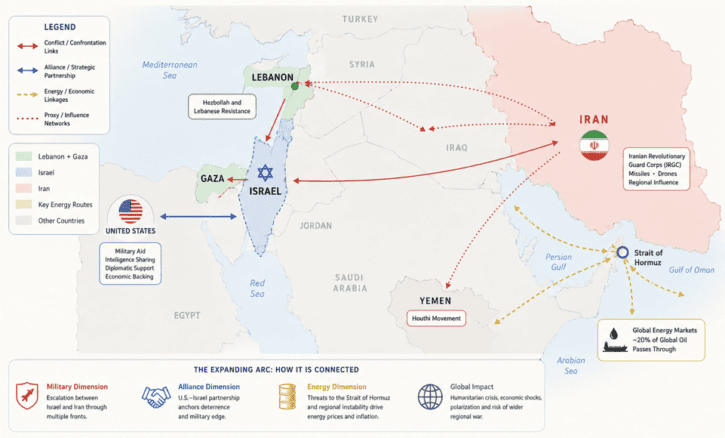
The most significant recent development is the gradual fusion of multiple conflicts into a single strategic theater. Gaza, Lebanon, the Red Sea, Syria, Iraq and the Persian Gulf increasingly form interconnected fronts within a broader contest between the U.S.-Israel partnership and Iran’s regional network.
Military actions in one arena now generate repercussions across the others.
This expanding arc of war magnifies the risks of miscalculation. A localized confrontation that might once have remained contained now possesses the potential to trigger regional escalation, energy shocks and wider geopolitical fragmentation.
This is precisely how localized wars become systemic crises.
The Expansive Arc of War
Israel risks validating the warning implicit in both The Fall of Israel and The Obliteration Doctrine: that a state can achieve tactical successes while simultaneously undermining the foundations of its own long-term security and legitimacy.
Every tactical win is setting the stage for further strategic failure, deeper divides internally, and greater international estrangement.
International crisis of credibility
The international response has exposed a growing crisis in global governance. Until the devastation of Gaza, many Western governments emphasized Israel’s security concerns while expressing futile concern about civilian casualties in the Middle East.
Many countries in Asia, Africa and Latin America have a markedly different perspective, focusing on humanitarian suffering, displacement and alleged violations of international law. As these narratives diverge, confidence in international institutions continues to erode.
For much of the Global South, the perception of selective enforcement of international norms has become increasingly difficult to ignore. If international law appears applicable to some states but not others, its legitimacy inevitably suffers. This credibility gap may prove one of the most enduring consequences of the conflict.
The central question is no longer whether the Gaza war has transformed the Middle East. It has. The question is whether the region is moving toward stabilization or toward a broader doctrine of permanent conflict.
If military escalation continues, the consequences will extend far beyond Israel, Lebanon and Gaza. Energy insecurity, economic fragmentation, humanitarian crises and geopolitical polarization will increasingly shape the international system.
The tragedy is that all parties face mounting risks. Lebanon risks further devastation. Gaza faces a reconstruction challenge of historic proportions. The United States risks strategic overstretch. The international community risks institutional irrelevance.
The road ahead
Modern conflicts are no longer judged solely by military outcomes. They are judged by their developmental consequences. A military victory that produces permanent economic devastation can become a strategic defeat.
The tragedy of the current moment is that every actor increasingly perceives escalation as necessary while simultaneously fearing its consequences.
Lebanon risks deeper devastation. Gaza faces prolonged humanitarian catastrophe and uncertain political futures. Iran confronts mounting economic and military pressures. The United States faces growing strategic commitments. Israel confronts rising diplomatic isolation even as it seeks greater security.
In the resulting obliteration dynamic, military escalation progressively destroys the political and economic foundations needed for lasting peace.
In this view, the debate over ethnic cleansing, genocide and obliteration is not merely a legal or moral argument. It is a debate about whether the region can escape a cycle in which every military victory plants the seeds of the next catastrophe – and possibly of an overwhelming global downturn.
This article was originally published on Informed Consent (US) on June 4, 2026
 Dr. Dan Steinbock is an internationally recognized strategist of the multipolar world and the founder of Difference Group. He has served at the India, China and America Institute (USA), Shanghai Institutes for International Studies (China) and the EU Center (Singapore). He is also the author of The Obliteration Doctrine (2025) and The Fall of Israel (2024). For more, see https://www.differencegroup.net
Also by Dr Steinbock:
Iran: US adopts Israel’s Gaza/Beirut Obliteration Doctrine
The Ebola Crisis: The Inconvenient Truths
Keep Independent Journalism Alive – Support The AIMN
Dear Reader,
Since 2013, The Australian Independent Media Network has been a fearless voice for truth, giving public interest journalists a platform to hold power to account. From expert analysis on national and global events to uncovering issues that matter to you, we’re here because of your support.
Running an independent site isn’t cheap, and rising costs mean we need you now more than ever. Your donation – big or small – keeps our servers humming, our writers digging, and our stories free for all.
Join our community of truth-seekers. Please consider donating now via:
PayPal or credit card – just click on the Donate button below
Direct bank transfer: BSB: 062500; A/c no: 10495969

We’ve also set up a GoFundMe as a dedicated reserve fund to help secure the future of our site.
Your support will go directly toward covering essential costs like web hosting renewals and helping us bring new features to life. Every contribution, no matter the size, helps us keep improving and growing.

Thank you for standing with us – we truly couldn’t do this without you.
With gratitude, The AIMN Team
On the one hand we have a criminally insane ,malignant narcissist, surrounded by selected yes men courtiers, and on the other, a beast who has gathered the worst possible zionist extremists, to keep his sad, deplorable ,arse out of jail.No amount of innocent deaths is too many.
In the stands of the world, we have the leaders of the neoliberal systems that hold profit above any human need, wringing their manicured hands at the devastation their ideology has wrought, but lacking the fortitude to change it.
Meanwhile, the obscenely rich build their fortresses.
Elsewhere, in the third world, people scrabbling to survive another day, wonder when their agony will be noticed.Oh well,the footy continues, and celebrities continue to have their dirty laundry aired.
@ Harry,
thanks mate I couldn’t have put it better myself.
During the genocides in Rwanda and Myanmar many news outlets had no qualms about using the word ‘genocide’ even before the ICJ had ruled it to be a genocide (which takes years.)
Despite a UN commission, every reputable human rights organization in the region, and reputable genocide scholars declaring the displacement, destruction of the means of living and slaughter of Gazans by Israel a genocide these same news outlets won’t use the word ‘genocide’.
It’s interesting that despite acknowledging the ethnic cleansing Dan didn’t use the word ‘genocide’ but rather Israel’s Obliteration Doctrine and ecocide.
The dispossession Palestinians and demolition of their homes is not just happening in Gaza and Lebanon, Israel is using supposed archeology to destroy Palestinian home in East Jerusalem.
It has a program, with some name to do with King David, that destroys the homes so that there can be an ‘archeology dig’. The USA is helping to fund this through an old act designed to protect USA heritage overseas. The dig is outside the remit of the act but that hasn’t stopped those in control of the program set up by the act from sending money to Israel on the sly.
Many Western governments, the USA, UK, France, Germany and Australia in particular, have been complicit in Israel’s genocide of the Palestinians. It should come as no surprise that they sided with Israel and the USA in their illegal war on Iran and Lebanon.
Australia has recognized Palestine but refuses to accept the presence of the Palestinian embassy and the credentials of the Palestinian ambassador to Australia.
France and the UK have accepted the presence of Palestinian embassies and the credentials of ambassadors from Palestine. The Albanese regime is tying such things as the disarmament of Hamas to this before it will acknowledge a Palestinian embassy and ambassador.
https://www.youtube.com/watch?v=u6cuSE3wgb8
Sen. David Shoebridge attempted to ask why it was that ‘like-minded countries’, a term Penny Wong was repeatedly using to justify not recognizing the embassy, in France and the UK had accepted the embassy and ambassador but the Albanese regime wouldn’t. Wong continually talked over, interrupted, gaslit and made personal attacks on Shoebridge in an arrogant and utterly disingenuous performance of evasion, bluster and cheap political point scoring.
It was preceded by an argument about Australia sending weapons parts to Israel, where Wong was incredibly dishonest in her gaslighting and faux concern for those suffering in Gaza.
As @eoghancavanagh3519 said in the comment section:
“Penny Wong’s line that “Australia has not supplied weapons to Israel for the past five years” is not a fact — it is an accounting trick. It rests on a UN register that counts only finished weapons systems and quietly omits the components Australian firms pump into the F-35 supply chain: over 70 companies, billions in contracts, feeding jets that Israel flies over Gaza, with fresh deliveries in January 2026. Cornered, Wong didn’t admit the denial was false; she rebranded it, recasting the exports as “non-lethal parts” and palming responsibility onto Lockheed Martin. But under the Arms Trade Treaty Australia signed, parts of weapons are weapons, and laundering them through Washington extinguishes nothing. Her own department has conceded dozens of active “military use” permits to Israel while refusing to say what they cover. When the wording has to work this hard, it is because the truth won’t.”
She was successful in talking over Shoebridge and getting under his skin. If a smartarse gaslighter who has no conscience when it comes to the genocide in Gaza is what you consider as a good minister than she is your women. But when even Marjorie Taylor-Green makes you look bad on calling out a genocide she aint my idea of a decent minister.
We got rid of Morrison, Wong should go too.
Israel sows the seeds of its own destruction. ‘Twas ever thus.
Not so sure ‘thanks to US arms and finance’ when much history and geopolitics is in the background.
Outside of the Anglosphere (leaning on US media & ‘analysis’) analysts in Europe inc Russian have a far more holistic outlook and understand the relationship eg ‘frenemies’ Netanyahu, Trump and Putin (in background Kushner, Koch, Murdoch et al).
Putin invades Ukraine for a special op, gets into trouble, Hamas kicks off Oct 7 allegedly presumed support from Russia &/or China), Netanyahu and Kahanist allies bomb the sh*t out of Gaza, whose Hamas leadership was funded by Qatar via Israel (see Qatargate), then US RW MSM and Trump blame Harris, Biden and Dems to suppress their vote.
Outcome was manna from heaven for Putin to have a breather on Ukraine, Netanyahu to avoid corruption charges and Trump to win ’24 Presidential election; but used to wedge, blame and pummel pro-Palestine* supporters, centre, students and universities.
(*US writer of the left & knowledgeable on Europe, Sandra Kendzior author of ‘In Plain Sight’, hung with pro-Palestine campus protesters, but was concerned when hearing ‘Kremlin talking points’, fed directly back to Koch Heritage and Evangelicals’ ‘Project Esther’ to pummel the centre, Harris and the Dems).
Meanwhile US or Anglo faux anti-imperialist tankie of the left (or right?) around October 7 stopped dog whistling Ukraine, NATO and ultimate target, the EU, after Trump’s election they didn’t blame the US for Ukraine/NATO, anymore?
One local tankie who turns up with RWNJs offshore does the rounds of indie media as an ‘expert’, but deleted most of his anti-Ukraine, anti-NATO and anti-US Tweets once Trump was elected, but they are still indexed on Google 🙂
Not unrelated to this unholy alliance between US MAGA white Christian nationalists and the Kremlin, is how some European analysts have revisited those mostly Syrian migrant/asylum seeker caravans resulting from Russian bombing campaigns and civil war. At the time viewed as organic, now infer that ‘caravans’ were used as PR to became integrated with Brexit, borders and anti-immigrant policies in Europe.