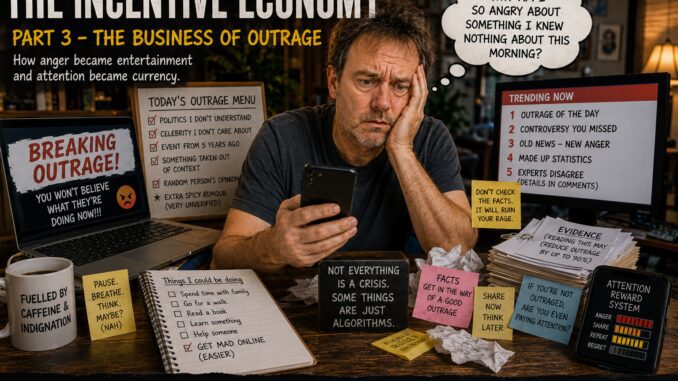
The Incentive Economy
Part 3 – The Business of Outrage
Now With 43% More Panic!
Dad’s Test
Did I have this problem five minutes ago?
Who benefits if I believe I do?
What happens if I simply say… “No thanks.”
Congratulations.
You’ve successfully survived Part 2.
Reward yourself.
Not by buying anything.
Apparently that’s how they get you.
Instead, let’s talk about outrage.
Because outrage might just be the most renewable resource on Earth.
Unlike fossil fuels, it never seems to run out.
Once upon a time newspapers competed to break stories.
Now they often compete to break blood pressure records.
Every headline is:
SHOCK!
DISASTER!
CRISIS!
YOU WON’T BELIEVE…
Actually…
… I probably will.
Somewhere along the line we stopped asking,
“Is this important?”
and started asking,
“Will this keep people scrolling?”
They’re not the same question.
Not even close.
Imagine opening a restaurant.
Every customer leaves happy.
Satisfied.
Content.
They go home.
Business is… steady.
Now imagine opening an outrage factory.
Every customer leaves furious.
Determined to tell twenty friends.
Returns tomorrow.
Shares your content.
Comments.
Argues.
Clicks.
Congratulations.
You’ve just discovered a far more scalable business model.
The internet didn’t invent outrage.
It simply industrialised it.
Social media platforms don’t wake up each morning asking,
“How can we make society slightly calmer today?”
They ask,
“How do we maximise engagement?”
Those sound similar.
They’re not.
Research consistently shows that emotionally charged content spreads further than calm, nuanced discussion.
Anger.
Fear.
Disgust.
Moral outrage.
These emotions travel.
Nuance usually catches the next bus.
The algorithm isn’t evil.
It’s obedient.
It simply does exactly what we’ve asked it to do.
Maximise engagement.
Unfortunately humans engage spectacularly well with things that make them angry.
The algorithm doesn’t care whether you’re outraged about politics…
…or pineapple on pizza.
A click is a click.
This isn’t just about social media.
Television discovered it.
Talkback radio mastered it.
Twenty-four-hour news channels industrialised it.
Politics enthusiastically adopted it.
The internet merely gave everyone their own broadcasting studio.
Outrage has another remarkable quality.
It doesn’t need solving.
In fact…
solving it can be commercially inconvenient.
Imagine if every political disagreement were calmly resolved.
Think of the poor pundits.
What would they yell about between elections?
Imagine an executive meeting.
“Good news everyone.
The housing crisis has been solved.
Healthcare is functioning brilliantly.
The economy is stable.
Nobody is frightened.
Nobody is furious.
Social cohesion is improving.”
Silence.
Someone eventually asks,
“So… what exactly are we going to put on the front page tomorrow?”
This isn’t to suggest journalists, politicians or commentators secretly gather beneath Parliament House stroking white cats.
Again…
the incentives do the coordinating.
If outrage attracts attention…
attention attracts advertising…
advertising attracts revenue…
then outrage quietly becomes a business model.
Not because people are necessarily malicious.
Because they’re responding to incentives.
Politicians eventually noticed.
Some discovered something fascinating.
Problems are useful.
Unresolved problems can be even more useful.
Especially if someone else can be blamed.
Migrants.
The previous government.
The current government.
Young people.
Old people.
Public servants.
The media.
The media about the media.
The experts.
The anti-experts.
Experts who are now suddenly experts again because they agree with me.
It’s amazing how flexible expertise can become.
Then there are the professional outrage merchants.
Every morning they wake up with one simple question.
“What should everyone be furious about today?”
By lunch they’ve found three things.
By dinner they’re furious that people aren’t sufficiently furious.
Of course…
there are genuine scandals.
Real corruption.
Real injustice.
Real abuse of power.
Real suffering.
Those deserve outrage.
Democracy depends upon it.
The difficulty arises when everything is presented as civilisation ending before Thursday.
Eventually audiences become exhausted.
Or worse.
Unable to distinguish genuine emergencies from manufactured ones.
Jacques Peretti’s documentaries taught me something important.
He rarely shouts.
He rarely tells you what to think.
He asks questions.
Good questions.
The sort of questions that quietly annoy you because you can’t stop thinking about them afterwards.
Perhaps journalism should spend less time manufacturing outrage…
…and more time manufacturing curiosity.
Douglas Adams would probably have loved social media.
For about six minutes.
Then he’d have written a chapter describing an algorithm that became sentient, looked at humanity’s browsing history and quietly resigned.
Here’s a thought experiment.
Imagine social media rewarded:
Curiosity.
Kindness.
Nuance.
Changing your mind when new evidence appeared.
Saying,
“I don’t know.”
Admitting,
“I was wrong.”
Can you imagine the engagement statistics?
Neither can the shareholders.
I’ve started trying something different.
When I see a headline carefully engineered to make me furious…
I pause.
I ask Dad’s Test.
Did I have this problem five minutes ago?
Sometimes the answer is yes.
Some stories genuinely matter.
Other times…
I’ve simply had my emotional thermostat adjusted by someone whose income depends upon me remaining emotionally overheated.
That’s worth noticing.
This series keeps arriving at the same destination.
The question isn’t whether capitalism is good.
Or socialism.
Or conservatism.
Or progressivism.
The question is much simpler.
What behaviour are we rewarding?
Reward outrage.
You’ll get outrage.
Reward attention.
You’ll get attention-seeking.
Reward division.
You’ll get division.
Reward curiosity…
Now there’s an interesting experiment.
Perhaps that’s the challenge for all of us.
Not to stop caring.
Not to become cynical.
But to become just a little harder to manipulate.
To become people who ask one extra question before sharing the next outrage.
Who benefits?
Because if nobody asks…
someone else will continue answering it with our attention.
And attention, it turns out, is remarkably profitable.
Homework (Entirely Optional… But Highly Recommended)
The Century of the Self – Adam Curtis
The Men Who Made Us Spend – Jacques Peretti
The Social Dilemma (Netflix)
Spend an evening watching those three.
Then try opening social media.
You’ll quickly discover something rather unsettling.
The algorithm knows far more about your emotional buttons than you do.
Fortunately…
Dad’s Test still works.
Most of the time.
Continued tomorrow… The Incentive Economy: Part 4 – The Business of Productivity
Keep Independent Journalism Alive – Support The AIMN
Dear Reader,
Since 2013, The Australian Independent Media Network has been a fearless voice for truth, giving public interest journalists a platform to hold power to account. From expert analysis on national and global events to uncovering issues that matter to you, we’re here because of your support.
Running an independent site isn’t cheap, and rising costs mean we need you now more than ever. Your donation – big or small – keeps our servers humming, our writers digging, and our stories free for all.
Join our community of truth-seekers. Please consider donating now via:
PayPal or credit card – just click on the Donate button below
Direct bank transfer: BSB: 062500; A/c no: 10495969

We’ve also set up a GoFundMe as a dedicated reserve fund to help secure the future of our site.
Your support will go directly toward covering essential costs like web hosting renewals and helping us bring new features to life. Every contribution, no matter the size, helps us keep improving and growing.

Thank you for standing with us – we truly couldn’t do this without you.
With gratitude, The AIMN Team

Be the first to comment