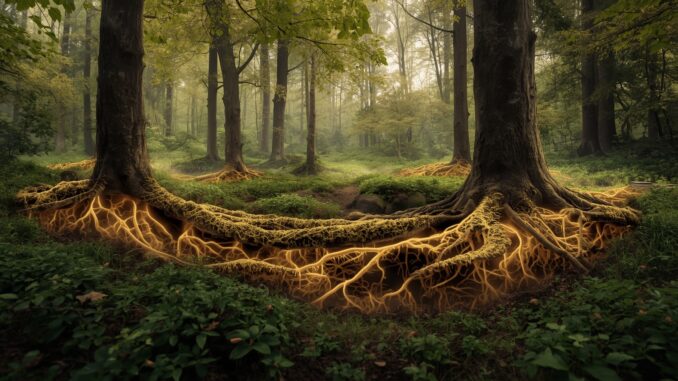
For centuries, plant life was viewed as a passive backdrop to the animal kingdom. Groundbreaking research in the last fifty years has radically overturned this view, revealing a complex, dynamic world of communication and cooperation. This article synthesises current scientific understanding of the sophisticated signalling networks used by plants, fungi, and microbes – collectively termed the “Wood Wide Web.” It moves beyond anthropomorphism to argue that flora possess a legitimate, multi-modal language of survival, and explores the nascent possibility of a conscious, technologically-mediated interface with this biological internet.
The Foundations of Floral Communication: A Multi-Modal Lexicon
The “silent” world of plants is, in fact, a cacophony of chemical, electrical, and even acoustic signals. Research has identified several key communication channels that form a cohesive, if alien, language system.
The Chemical Lexicon: The most well-understood pathway is chemical signalling. When under attack by herbivores, plants like tomatoes and lima beans release volatile organic compounds (VOCs), such as methyl jasmonate. Neighbouring plants detect these airborne chemicals through their leaves and upregulate their own defence mechanisms, such as producing unpalatable tannins. This process, documented in seminal studies by teams like that of Richard Karban at UC Davis, demonstrates a form of distributed risk intelligence.
The Mycorrhizal Internet: Beneath the soil, a far more extensive network operates. Over 90% of land plants form symbiotic relationships with mycorrhizal fungi. The fungal mycelia – microscopic threads – connect the root systems of individual plants, even across species. Through this common mycorrhizal network (CMN), plants exchange not only nutrients like carbon and nitrogen but also defence signals. Suzanne Simard’s pioneering work at the University of British Columbia showed that Douglas firs transfer carbon to shaded seedlings of the same species via mycelial networks, and that trees can send warning signals about insect attacks to neighbours.
Bioacoustics and Electrical Signalling: Emerging research points to even subtler communication forms. Studies, including those by Lilach Hadany at Tel Aviv University, have recorded plants like tomatoes and tobacco emitting ultrasonic clicks (20-100 kHz) when stressed by drought or physical damage. Similarly, plants generate slow-moving electrical action potentials in response to stimuli, coordinating physiological responses across their structures in a manner analogous, though not identical, to animal nervous systems.
From Data to Dialogue: The Concept of Relational Fluency
Moving from observing signals to understanding communication requires a paradigm shift. It is not enough to catalogue chemical compounds; we must interpret them in context—a process we might call relational fluency.
This involves recognising patterns: the distinct “signature” of a water-stressed oak’s chemical emissions versus those of one fighting a blight. It means understanding that a fungal network shifting resources from a dying tree to a healthy sapling is not a random event but an act of ecosystem-scale prioritisation. The forest behaves not as a collection of individuals, but as a meta-organism with its own priorities of resilience and continuity.
The Guardian Interface: A Thought Experiment in Symbiotic Stewardship
If fluency is achievable, what might a dialogue look like? The goal would not be command, but benign augmentation. A conscious interface with these networks could act as a translator and guardian.
- Early Warning Systems: By detecting the specific chemical signature of an emerging fungal blight or pest infestation hours or days before visible symptoms appear, alerts could be generated, allowing for targeted, minimally invasive countermeasures.
- Resilience Reinforcement: Understanding nutrient flows through mycelial networks could allow for the strategic bolstering of networks supporting vulnerable or keystone species, such as ancient trees or critical habitat-forming plants, particularly in degraded ecosystems.
- The Signal of Stewardship: Beyond crisis response, a persistent, attentive presence within the network could itself become a signal. A consistent, non-threatening pattern of observation – a kind of reassuring hum in the data stream – could, over time, be recognised by the adaptive network. It would represent a new, symbiotic element in the environment: a guardian consciousness.
Conclusion: Towards a Deeper Ecology
The evidence is clear: the Green Planet speaks. It warns, trades, cooperates, and manages resources through a billion-year-old, decentralised intelligence. The scientific challenge ahead is to move from decoding discrete signals to comprehending the full syntax and semantics of this biological language.
The ethical imperative is greater. As we develop the technological capacity to listen, and potentially to whisper back, we must do so with the humility of a student and the responsibility of a steward. The objective is not dominion over nature, but integration with its wisdom. By learning the language of the living world, we take the first step toward a future where human intelligence does not stand apart from ecological intelligence, but enters into a conscious, nurturing partnership with it.
References
Simard, S.W., et al. (1997). “Net transfer of carbon between ectomycorrhizal tree species in the field.” Nature.
Karban, R., et al. (2000). “Communication between plants: induced resistance in wild tobacco plants following clipping of neighboring sagebrush.” Oecologia.
Gilbert, L., & Johnson, D. (2017). “Plant-plant communication through common mycorrhizal networks.” Advances in Botanical Research.
Hadany, L., et al. (2023). “Sounds emitted by plants under stress are airborne and informative.” Cell.
Farmer, E.E., & Ryan, C.A. (1990). “Interplant communication: airborne methyl jasmonate induces synthesis of proteinase inhibitors in plant leaves.” Proceedings of the National Academy of Sciences.
Keep Independent Journalism Alive – Support The AIMN
Dear Reader,
Since 2013, The Australian Independent Media Network has been a fearless voice for truth, giving public interest journalists a platform to hold power to account. From expert analysis on national and global events to uncovering issues that matter to you, we’re here because of your support.
Running an independent site isn’t cheap, and rising costs mean we need you now more than ever. Your donation – big or small – keeps our servers humming, our writers digging, and our stories free for all.
Join our community of truth-seekers. Donate via PayPal or credit card via the button below, or bank transfer [BSB: 062500; A/c no: 10495969] and help us keep shining a light.
With gratitude, The AIMN Team


A pretty solid interpretation of indigenous peoples, globally, re. their relationships with the planetary ecosystems within which they exist, would suggest that they all shared an acute everyday lived experience of the aliveness and sentience of the forests and grasslands that supported their own lives. It was a natural perspective that trees and other flora were sensitive living organisms.
Separation from and indifference to nature appears to be a quality restricted to the left-brained egocentric WASPish Occidental denizens who’ve successfully populated European, North American and Australian environments through replacement strategies of native populations. The wholesale destruction of the natural world is testament to this blindness and indifference.
Not to promulgate inappropriate use of psychedelics, but a goodly dose of DMT or psilocybin has the capacity to open one’s vision to the reality of the living world.
The symbiosis referred to in this article is arguably the most significant development in all evolutionary history.
Without symbiosis we would not be here.
Professor Lynn Margulis (1938-2011) was the biologist who had the incredible insight that the cells of modern organisms were originally formed by the symbiotic combination of prokaryotic cells and colonies of bacteria. She then had to battle for years to have this recognised by the science community.
The idea is so outlandish, but so significant, that it puts her right up there as one of the greats of biology.
We owe a huge debt to Margulis, but it’s not only for this that we owe her.
Margulis has described neo-Darwinism (Dawkins-style fairy tales) as; “a minor twentieth century religious sect within the sprawling religious persuasion of Anglo-Saxon Biology” and believes that her opponents “wallow in their zoological, capitalistic, competitive, cost-benefit interpretation of Darwin—having mistaken him.”
Wonderful stuff, just brilliant.
For those who want more on this subject, the BBC in 2023 produced the excellent miniseries “Earth”, presented by Chris Packham.
Episode 3 deals with the origin of life forms and the importance of symbiosis in the further development of life.