How to Lobby for Change: Engaging Parliamentary Committees to Reform Our Democracy
By Sue Barrett
When a seasoned politician like Mark Dreyfus, Australia’s former Attorney-General and a parliamentarian with over two decades of service, takes to the floor of the House to condemn the election tactics of a fellow MP, it signals that those tactics represent a profound breach of democratic norms. In his address this week, Dreyfus detailed a pattern of “shameful and abhorrent” misconduct during the recent federal election in Goldstein, where Liberal MP Tim Wilson narrowly reclaimed the seat.
In a bizarre twist, we must thank Wilson for inadvertently exposing these systemic flaws through his campaign’s actions, providing a real and stark opportunity to call out such conduct and demand urgent reform.
This article applies the Democracy Watch AU Framework to assess Wilson’s campaign, offering citizens a tool to evaluate political conduct and advocate for stronger electoral integrity.
We owe gratitude to Dreyfus for highlighting these divisive strategies employed by Wilson and his team, including proxy groups. By placing this on the parliamentary record, he not only defends democratic principles but also empowers citizens to scrutinise the intentions behind such conduct and push for change.
As Dreyfus noted, this goes beyond mere courtesy; it erodes the integrity of our system, undermining public confidence and deterring participation.
To prevent such conduct from recurring in Goldstein or elsewhere, citizens can take action by making submissions to parliamentary committees like the Joint Standing Committee on Electoral Matters (JSCEM) to advocate for stronger electoral safeguards. Details on how to prepare and submit are provided at the end of this article. They can also contribute to citizens doing their bit to hold politicians to account like Eye on Goldstein’s Linktree.
We are not without agency and power. Democracy is a ‘participation sport’. You want better reforms and better representation – get active.
Understanding the Framework: Peering Behind the Curtain of Political Conduct
This article employs the Democracy Watch AU Framework, combining a Performance Scorecard to evaluate observable behaviours and Albert Bandura’s Moral Disengagement mechanisms to identify patterns of justification that allow unethical actions to persist.
Applied to publicly available evidence from the Goldstein campaign, including Dreyfus’ speech, media reports, and Wilson’s responses, it offers a fair and balanced assessment. The focus is on facts and patterns, avoiding unsubstantiated claims to help readers assess politicians’ motivations while steering clear of defamation risks.
The Performance Scorecard rates five dimensions of democratic leadership on a 1-10 scale, grounded in measurable evidence. Bandura’s eight mechanisms reveal how individuals rationalise harmful behaviour, such as minimising consequences or blaming victims, to maintain a positive self-image. High disengagement scores suggest intentions prioritising personal or political gain over public service, often cloaked in defensible language.
Dreyfus’ speech, highlighting the erosion of norms, underscores the value of this framework in discerning whether such conduct reflects isolated lapses or deeper patterns.
The Speech That Shook Parliament: Dreyfus’ Damning Account
In his address, Dreyfus contrasted his own respectful campaign in Isaacs with the “deeply troubling conduct” in neighbouring Goldstein.
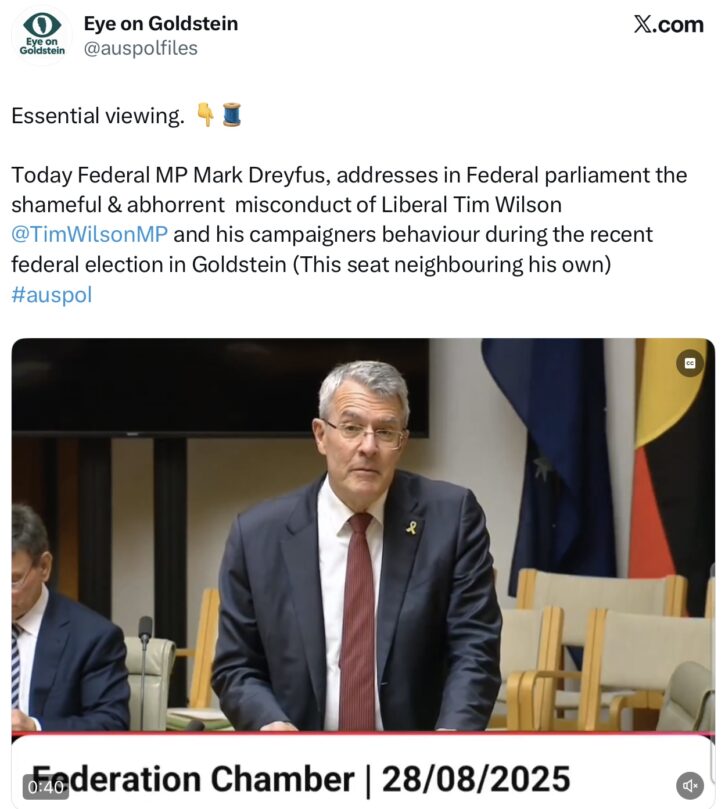
He recounted repeated incidents: verbal abuse of young volunteers (including calling them “little scum”), threats of extreme violence, and death threats against figures like Victorian Premier Jacinta Allan and former MP Zoe Daniel. Dreyfus criticised Wilson for not condemning these but making excuses, such as attributing one volunteer’s aggression to “low blood sugar.”
He noted the need for private security to protect Daniel and her team from vandalism and intimidation, and extended his critique to post-election scrutineering, where Wilson’s team allegedly used “standover tactics.”
Praising Daniel’s integrity, she ran on “ideas and values” despite facing misogynistic slurs, stalking, and being in need of AFP protection. Dreyfus highlighted the personal toll: harassment that made her fear being followed home. He tied this to broader democratic threats, warning that such hostility deters participation and undermines institutions.
Notably, Dreyfus referenced Wilson’s past as Human Rights Commissioner (2014-2016), lamenting his failure to uphold dignity and accountability when it mattered. He also condemned a vexatious NACC referral against Daniel by a former Liberal MP, calling it a “reckless attempt to misuse the commission for political advantage”, a claim the NACC dismissed as groundless.
This speech, protected by parliamentary privilege, places these allegations firmly in the public domain. It speaks volumes about Wilson’s campaign: for Dreyfus, a veteran known for restraint, to speak so forcefully suggests a threshold of unacceptable behaviour was crossed, revealing intentions more focused on victory than values.
Applying the Democracy Watch AU Framework to Tim Wilson: Evidence from Goldstein
Wilson won by 175 votes amid controversy. Public evidence, including Dreyfus’ account and citizen commentary, informs this assessment. For balance, it includes Wilson’s claims of facing personal attacks, which he says the community “saw through.”
Part 1: Performance Assessment
- Representation and Inclusivity (2/10)
Dreyfus described tactics that divided Goldstein’s diverse community, with proxies like Repeal the Teal exploiting Jewish sensitivities through baseless antisemitism claims. Volunteers felt “cornered” by aggression, as one voter reported. Citizens echoed this: “Tim Wilson told many lies to our Goldstein Jewish community about Zoe Daniel.” While Wilson points to his own attacks, evidence shows exclusionary rhetoric over unity. - Policy Effectiveness (3/10)
The campaign emphasised attacks over outcomes, with proxies spreading falsehoods on climate issues. Postal strategies succeeded tactically, but measurable community benefits are absent, as critiques note self-serving gaps in delivery. - Transparency and Accountability (1/10)
Wilson distanced himself from misconduct, offering excuses rather than condemnation. On X, he dismissed allegations as “evidence-free,” reframing them as victimhood. Dreyfus highlighted opacity in proxy funding ($5-10 million estimated), and citizens called Wilson “mendacious.” - Community Engagement (2/10)
Engagement turned toxic, with heckling and disruptions. Dreyfus noted “waves of intimidation,” including death threats. Some volunteer were reduced to tears; citizens labelled Wilson a “nasty egotist.” His town halls were selective, overshadowed by hostility. - Ethical Conduct (1/10)
Dreyfus called it a “blight,” citing threats and disrespect for processes. Proxy ties and NACC misuse suggest conflicts. Public views: “Wilson weaponised fear.” Wilson says he upholds integrity, but evidence points to lapses.
Total Performance Score: 9/50
Summary: Low scores indicate behaviours misaligned with public service, as Dreyfus’ speech underscores.
Part 2: Moral Disengagement Assessment
Dreyfus’ address reveals patterns where Wilson justified or minimised harms, suggesting intentions disingenuous at best, where aggressive tactics were rationalised to secure a win without regard for ethical fallout.
Rated: 1 is highly morally engaged through to 7 being highly morally disengaged:
- Moral Justification (5/7): Wilson portrayed his campaign’s divisive actions as necessary to defend “community values” against opponents’ perceived flaws, as seen in proxy smears that Dreyfus criticised as exploiting vulnerabilities for electoral gain, framing them as protective rather than harmful.
- Euphemistic Labelling (4/7): Intimidation and disruptions were softened through language like calling them “free speech” or attributing aggression to minor issues such as low blood sugar, obscuring the real fear and abuse reported by volunteers in Dreyfus’ account.
- Advantageous Comparison (6/7): By deflecting to opponents’ alleged “whispering campaigns,” Wilson made his team’s misconduct appear less severe, a tactic evident in his X responses and parliamentary replies that downplayed documented threats relative to other claims.
- Displacement of Responsibility (6/7): Wilson shifted blame to external factors, such as teals’ supposed misinformation, while denying direct involvement in proxy actions despite clear links, allowing him to avoid accountability for the intimidation Dreyfus detailed.
- Diffusion of Responsibility (5/7): Accountability was diluted by implying broader group or party involvement in decisions, as in his failure to personally address specific incidents of abuse, spreading the onus across the campaign team rather than taking leadership.
- Distortion of Consequences (7/7): Harmful effects, like volunteer harassment and death threats, were minimised or disputed as exaggerated media narratives, with Wilson focusing on his narrative while ignoring the tangible impacts Dreyfus described, such as the need for AFP security.
- Dehumanisation (5/7): Opponents were reduced to labels like “elitist” or worse through proxy rhetoric, stripping them of humanity and justifying hostility, as highlighted in Dreyfus’ examples of misogynistic slurs and targeted abuse.
- Attribution of Blame (7/7): Wilson implied victims, including Daniel’s supporters, brought problems on themselves by spreading “lies,” suggesting they provoked the backlash, a victim-blaming approach that Dreyfus countered by praising Daniel’s principled campaign.
Average Moral Disengagement Score: 5.625/7
Summary: High moral disengagement points to rationalisations enabling mendacious conduct, where unethical tactics were justified or downplayed to preserve a moral self-image. As Dreyfus implies in noting Wilson’s failure to act despite his human rights background as Commissioner, this reveals a disconnect between professed values and actions, suggesting intentions driven by ambition over accountability, allowing harmful behaviours to persist unchecked.
Broader Implications: Safeguarding Democracy
Dreyfus’ speech exposes how such patterns erode trust. Reforms like truth-in-political-advertising and proxy caps would help.
A Call for Integrity and Reform
Dreyfus’ intervention reveals much about Wilson’s intentions: a campaign where ethics yielded to ambition, as evidenced by the moral disengagement that rationalised division and deceit. This not only diminishes public trust but highlights systemic vulnerabilities that demand action to prevent future occurrences. Australia deserves better; democracy thrives on vigilance and reform.
To stop this kind of conduct, we must reform campaigns by curbing misinformation, postals, and proxies. Third-party proxies, unchecked misinformation, and postal vote loopholes cannot dodge accountability.
Wilson’s campaign exposes electoral gaps needing robust reform, building on recent legislative changes like the Electoral Legislation Amendment (Electoral Reform) Act 2025, which introduced donation caps and lower disclosure thresholds.
- Truth in Political Advertising Laws: South Australia’s fact-checking model, with fines up to $25,000 for repeat offenders, could penalise misinformation like PBCC’s claims. A federal body, independent of the AEC, would restore trust, as proposed in bills like the Electoral Legislation Amendment (Fair and Transparent Elections) Bill 2024.Third-Party Spending Caps: Limiting proxy budgets to $500,000 per electorate and requiring real-time donor disclosure would expose groups like Australians for Prosperity. Criminal penalties for non-compliance could deter dark money, aligning with recommendations from the Joint Standing Committee on Electoral Matters. Personally, I would like to see them banned altogether.
- Privacy Act Amendments: Closing loopholes allowing political data sharing, as seen with PBCC’s access, would protect voters. Encryption mandates for voter data could address 59% voter concern, following the Privacy and Other Legislation Amendment Bill 2024.
- Postal Vote Safeguards: Requiring AEC-only handling of postal votes would end diversions to party offices. Audits of postal vote chains could ensure integrity, addressing issues raised in the 2022 federal election inquiries. This is a biggie.
- AEC Enforcement Powers: On-the-spot fines for booth disruptions, as with Better Australia, and rapid-response teams at polling stations would deter intimidation, enhancing powers under recent amendments to the Commonwealth Electoral Act.
- Proxy Registration System: Mandating AEC registration for third-party groups, disclosing leadership and funding, would unmask fronts like Repeal the Teal. Bans on unregistered campaigning could enforce compliance, as advocated in government responses to disinformation.
What citizens can do to bring about reform
We, as ordinary citizens, can drive change through petitions, town halls, and social media campaigns with verified sources.
We can also make effective use of parliamentary committees.
Parliamentary committees offer a powerful avenue for action: all of us can and should submit to groups like the Joint Standing Committee on Electoral Matters (JSCEM).
Get working groups together to assess and work on what submissions you want to make is key. This is democracy in action. Here is the process.
Visit aph.gov.au/Parliamentary_Business/Committees, select “Inquiries Accepting Submissions,” and choose relevant inquiries (e.g. electoral reform).
- Submit online via the e-submission form, email the committee secretariat, or post.
- Keep submissions concise, relevant to the inquiry’s terms, and include facts or recommendations.
- Submissions are typically published (with personal details redacted) and protected by parliamentary privilege, shaping legislation through official reports.
- Check deadlines and consider state parliaments for local issues via their websites.
You can use the Democracy Watch AU Framework to assess public figures, business and political leaders too.
Goldstein deserves, and Australia needs, better representation rooted in integrity, not division.
You know what to do.
Onward we press
Resources
- Eye on Goldstein
- Australian politics with a focused eye on Goldstein:
- We are “Eye on Goldstein”: Goldstein political news & investigative content – Especially holding to account Liberal Tim Wilsons’ record & actions in office.
- Community can email leads/tips to: eyeongoldstein@gmail.com
- Secure email to: goldsteinvoices@proton.me
- X: @auspolfiles
- https://linktr.ee/eyeongoldstein
- Link to Mark Dreyfus’ Speech 28 August 2025
- AEC Transparency Website
- Joint Standing Committee on Electoral Matters (JSCEM).
- Democracy Watch AU
- A selection of my Substack Articles
This article was originally published on Sue Barrett
Dear reader, we need your support
Independent sites such as The AIMN provide a platform for public interest journalists. From its humble beginning in January 2013, The AIMN has grown into one of the most trusted and popular independent media organisations.
One of the reasons we have succeeded has been due to the support we receive from our readers through their financial contributions.
With increasing costs to maintain The AIMN, we need this continued support.
Your donation – large or small – to help with the running costs of this site will be greatly appreciated.
You can donate through PayPal or credit card via the button below, or donate via bank transfer: BSB: 062500; A/c no: 10495969

Tim Wilson is just acting out the Liberal Party’s vain and arrogant “born to rule” philosophy. Mark Dreyfus could do no less than call out Wilson’s electoral activities as reprehensible. Wilson’s campaign strategies come straight from Nicolo Macchievelli’s book “The Prince” which produced the mantra – “the end justifies the means” – an attitude that disregards common decency and ethics.
Tim Pod-Polisher is a sub grub, lower than a maggot’s mort’s dock, a liberal typical modern rash or pox, Mariana’s trench denizen, a ringworm.
I spent many hours door-knocking in Goldstein and 12 hours on one booth, and walked 10,000 steps on the day . I have had 7 decades in politics, and I have never seen such a gutter campaign as was run by the opposition to the sitting member in my many years of involvement at three levels of government. On the day, voters were harassed and screamed at, and one easily identifiable supporter of the liberals called me a Hamas supporter, and simulated or actually spat at me . With our use of information identifying the entitled voters at an address, it was clear that a significant number of homes and units were not occupied by the person listed on the electoral roll. Many homeowners showed an elevated aggression towards me and fellow doorknockers personally. This was a very gutter-level campaign run by the liberals, and the AEC should have been more proactive.The people of Goldstein lost this election it was not won by the liberal party
But, was this “a very gutter-level campaign run by the liberals” or was it run by the Zionist Lobby with which Tim Wilson closely identifies?
Both Wilson and Dreyfus are Jewish and this may indicate where the real problem lies, certainly not something we want to see in Australian politics.
What a charming little rotter.Karma will be stalking him for the rest of his miserable life,even when he inevitably ends up in the gutter…or is he already there?
Seemed to be a low life campaign pushing the boat out on what is morally, ethically and legally acceptable, but lack of scrutiny by the RW MSM too busy cheer leading.
When you see Wilson’s ecosystem including the Libs, NewsCorp and the Atlas Koch IPA……no surprise?